India Resists US Protectionist Tariffs Under Modi Administration
Source:Indian Express ↗
Why It Matters
Understanding the nuances of India-US trade relations is crucial for UPSC aspirants, as it illustrates the frequent dichotomy between growing strategic/defense alignment and persistent economic friction. It also touches upon the broader global trend of rising protectionism and how India asserts its economic sovereignty on the global stage.
Summary
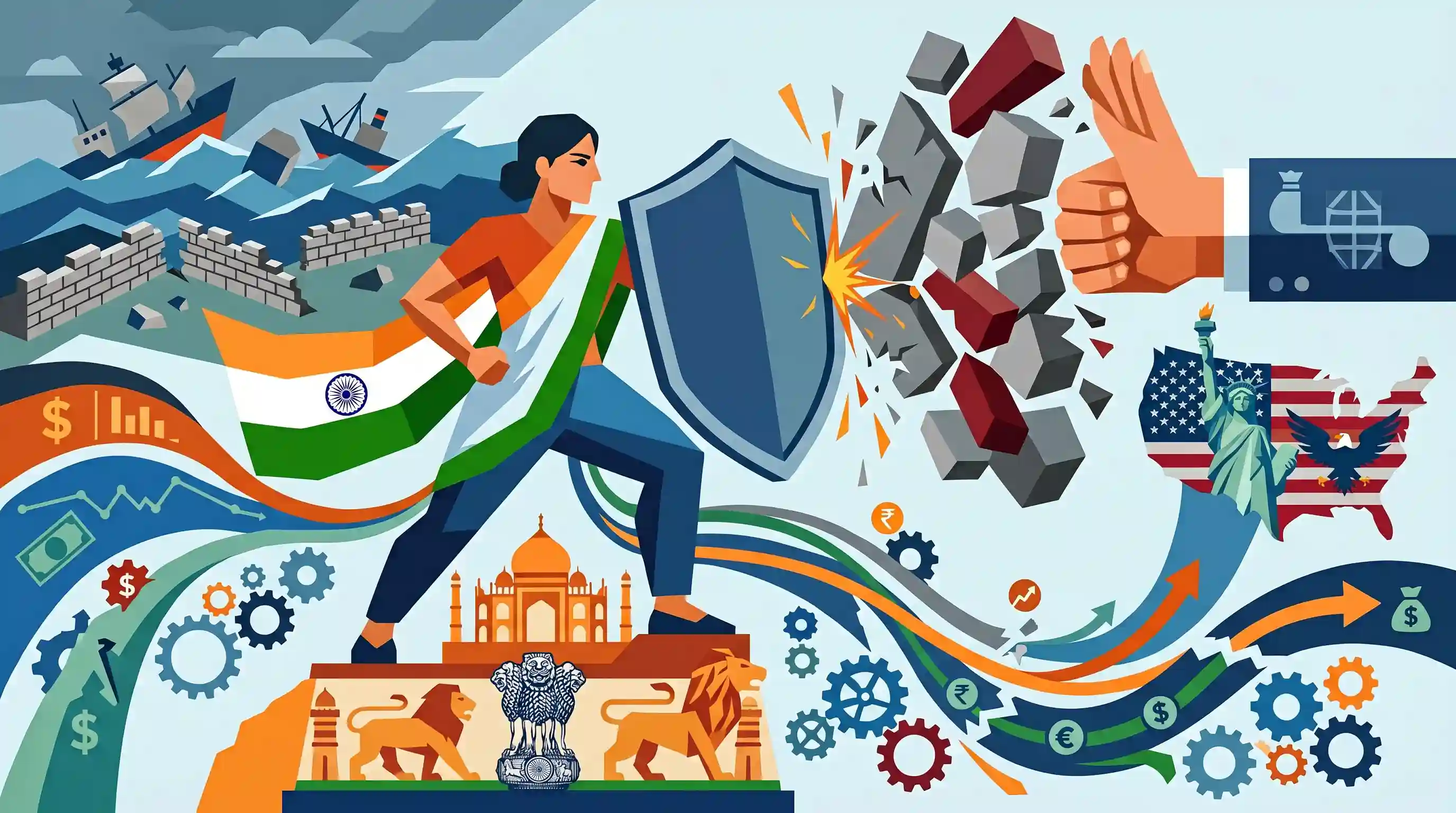
The article discusses the trade conflicts between India and the United States, particularly focusing on the use of tariffs and protectionist measures by the US to pressure New Delhi. Associated closely with Donald Trump's policies, these tactics have been met with a firm and resolute stance from India under Prime Minister Narendra Modi. The piece emphasizes that India has successfully demonstrated it will not give in to bullying, prioritizing its domestic economic interests and strategic autonomy even as it navigates complex bilateral relations and a global shift toward protectionism.
Key Points
- The article highlights the ongoing trade frictions between India and the United States, exacerbated by tariff threats and protectionist policies.
- Under Prime Minister Narendra Modi, India has adopted a resolute stance, proving it will not succumb to bullying tactics from Washington regarding trade concessions.
- The US approach, particularly associated with Donald Trump's America First policy, heavily leverages tariffs to pressure trading partners.
- India's firm response demonstrates its commitment to strategic autonomy and protecting domestic economic interests amidst a global shift away from free trade towards protectionism and bilateralism.
Important Terms
Strategic Autonomy

The ability of a nation to pursue independent foreign policy and national interests without being constrained by external pressures or permanent military alliances.
UPSC context
GS Paper II (International Relations). Tests understanding of India's multi-alignment strategy and sovereign decision-making in a multipolar world.
Protectionism
Government policies that restrict international trade to help domestic industries, often through tariffs, quotas, or subsidies.
UPSC context
GS Paper III (Economy). Relevant for topics on globalization, trade wars, and the shift away from free trade.
Generalized System of Preferences (GSP)
A U.S. trade program providing non-reciprocal, duty-free tariff treatment to certain products from developing countries to support their economic growth.
UPSC context
GS Paper II/III. Tests knowledge of trade-based developmental aid and historical friction in India-US economic relations.
Retaliatory Tariffs
Additional import duties imposed by a nation on another country's goods in direct response to that country's own restrictive trade measures.
UPSC context
GS Paper III (Economy). Pertains to trade disputes, 'tit-for-tat' diplomacy, and the impact on bilateral trade volumes.
Section 232 (Trade Expansion Act)
A U.S. legal provision allowing the President to restrict imports if they are deemed a threat to national security.
UPSC context
GS Paper II. Relevant for analyzing how domestic U.S. laws impact global trade norms and Indian exports like steel.
Reciprocal Tariffs
A 'tit-for-tat' trade policy where a country matches the tariff levels imposed by a trading partner on its own exports.
UPSC context
GS Paper III (Economy). Critical for understanding the shift toward transactional diplomacy and its effect on WTO-led multilateralism.
Prelims Trap
"The US Generalized System of Preferences (GSP) requires reciprocal tariff concessions from developing nations like India."
GSP is a non-reciprocal preferential tariff system extended unilaterally by developed countries. Developing nations do not have to offer matching tariff cuts in return.
Static Concepts Connected
What are the standard WTO-sanctioned trade remedy measures?
- Anti-dumping Duty (ADD): Applied when an exporting country sells goods below their normal domestic market value.
- Countervailing Duty (CVD): Imposed to neutralize the negative economic effects of specific export subsidies provided by foreign governments.
- Safeguard Measures: Temporary restrictions applied when a sudden, unforeseen surge in imports threatens to injure domestic industries.
What is the Generalized System of Preferences (GSP)?
- Non-reciprocal nature: It is a unilateral tariff exemption granted by developed countries to developing nations without expecting equivalent market access in return.
- UNCTAD Origins: The system was instituted under the aegis of the UN Conference on Trade and Development (UNCTAD) in 1971 to promote export-led growth.
Cross-Topic Patterns
Trade friction vs Energy realism
India's trade friction with the US runs parallel to its strategic defiance of Western pressure, sustaining vast oil imports from Russia to prioritize domestic inflation control and energy security.
PLI schemes under Section 301 radar
US probes targeting India's PLI schemes link domestic industrial policy directly to international trade disputes and the WTO's Agreement on Subsidies and Countervailing Measures (SCM).

Expect a multi-statement 2026 Prelims question distinguishing US unilateral trade laws (Sec 301/232) from WTO remedies (ADD/CVD) and GSP.
Linked PYQs · 3
Linked PYQs · 3
- 2019MainsGS2
‘What introduces friction into the ties between India and the United States is that Washington is still unable to find for India a position in its global strategy, which would satisfy India's national self-esteem and ambitions.’ Explain with suitable examples.
- 2012MainsGS2
Discuss the likely negative impact of the protectionist measures proposed by the US on India's software industry.
- 2025MainsGS3
What are the challenges before the Indian economy when the world is moving away from free trade and multilateralism to protectionism and bilateralism? How can these challenges be met?
