US and Iran hold secret talks in Doha to secure Strait of Hormuz
Source:Indian Express ↗
Why It Matters
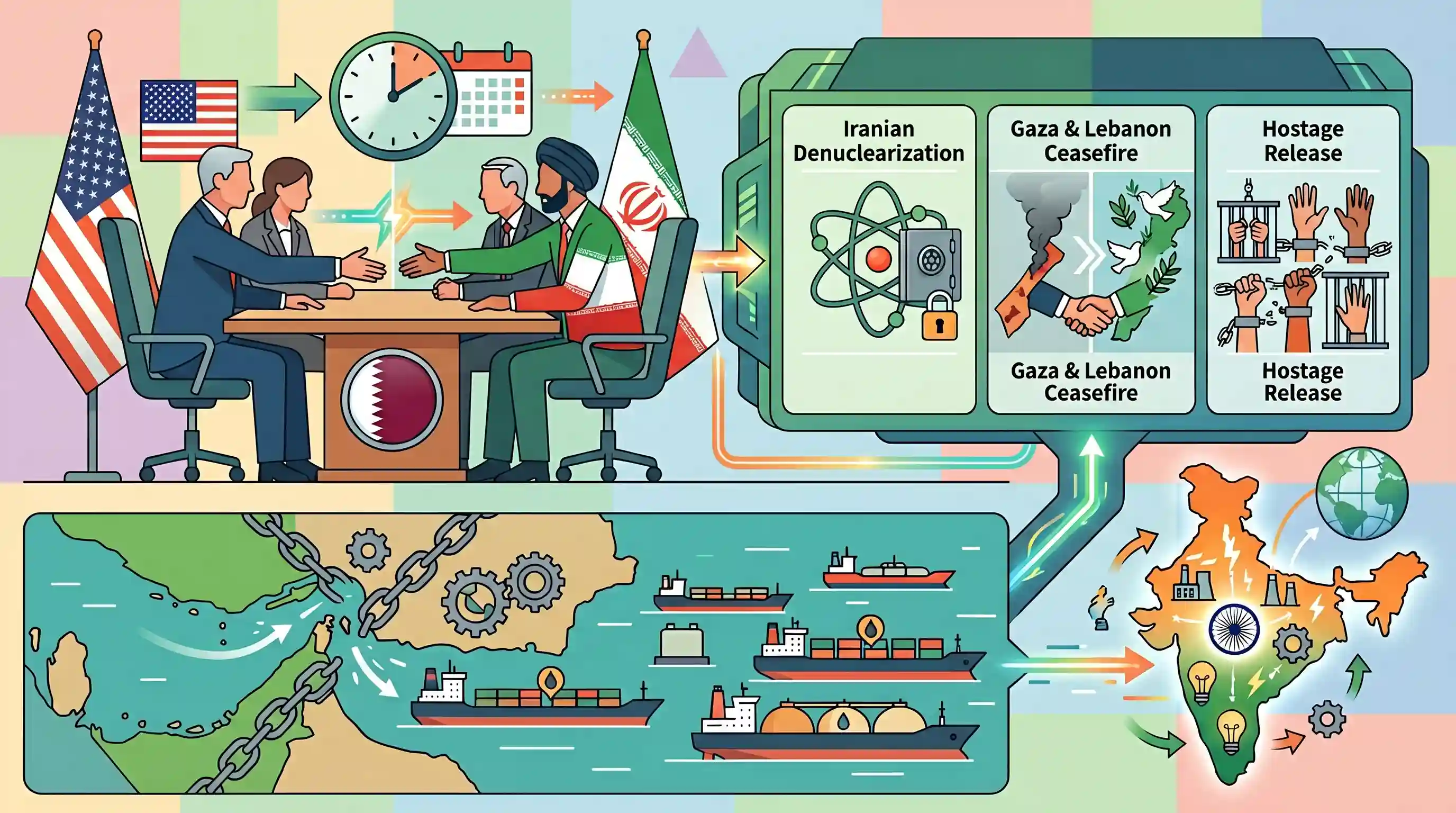
The stability of West Asia and the security of the Strait of Hormuz are critical to India's energy security, as a massive share of its oil and gas imports transits this chokepoint. Additionally, US-Iran dynamics heavily influence regional peace, directly impacting the large Indian diaspora and trade interests in the Middle East.
Summary
Secret US-Iran talks are progressing in Doha, facilitated by Qatar, ahead of Donald Trump's return to the US presidency. The negotiations aim for a comprehensive regional agreement encompassing Iran's denuclearization, a broader ceasefire in Gaza and Lebanon, and the release of hostages. A key economic and geopolitical focus of the talks is reopening and securing the Strait of Hormuz to ensure the free flow of maritime traffic, which is vital for global energy markets. This diplomatic push indicates a strategic effort to stabilize West Asia through sweeping negotiations.
Key Points
- Secret US-Iran negotiations are underway in Doha, Qatar, aiming to broker a comprehensive Middle East deal ahead of Donald Trump's presidential inauguration.
- The diplomatic agenda includes Iran's denuclearization, a regional ceasefire covering Gaza and Lebanon, and the release of hostages.
- Securing the Strait of Hormuz to guarantee unimpeded maritime traffic is a critical priority, given its importance to global energy security.
- The talks signal a pragmatic approach by the incoming US administration to stabilize the region and alter the West Asian security architecture through broad diplomatic agreements.
Important Terms
Strait of Hormuz

A narrow waterway linking the Persian Gulf and Gulf of Oman. It is the world's most critical oil chokepoint, handling one-fifth of global oil and 35% of LNG shipments.
UPSC context
GS Paper I (Geography) and GS II (IR); critical for India's energy security and fertilizer imports.
Energy Security
The reliable and affordable supply of energy resources. For India, this involves securing maritime routes to mitigate price volatility and supply shocks from regional conflicts.
UPSC context
GS Paper II (IR) and GS III (Economy); addresses India's high dependence on imported crude oil.
Denuclearization
The process of eliminating or reducing a state's nuclear weapons capabilities. Currently, it refers to Iran curbing enrichment activities in exchange for the lifting of economic sanctions.
UPSC context
GS Paper II (International Relations); concerns non-proliferation, regional stability, and the effects of US foreign policy.
Maritime Chokepoints
Strategic, narrow maritime passages on high-traffic trade routes. Disruption at these points can cause significant global economic crises and threaten freedom of navigation.
UPSC context
GS Paper I (Geography) and GS III (Security); focuses on global trade vulnerability and maritime domain awareness.
Shuttle Diplomacy
Diplomatic negotiations where a mediator travels between parties that refuse to meet directly. In 2026, Qatar and Pakistan facilitated indirect US-Iran talks using this method.
UPSC context
GS Paper II (International Relations); examines conflict resolution methods and the role of middle powers in mediation.
Strategic Autonomy
India's foreign policy principle of maintaining independent decision-making without formal alliances, allowing it to balance relationships between competing powers like the US and Iran.
UPSC context
GS Paper II (International Relations); fundamental to India's 'Think West' policy and multi-alignment strategy.
Prelims Trap
The Strait of Hormuz is a strategic chokepoint directly bordered by Saudi Arabia and Iran.
Saudi Arabia relies heavily on the Strait but does not share a coastline on it. The Strait is bordered by Iran (north) and Oman and the UAE (south).
Static Concepts Connected
What are the key maritime chokepoints in West Asia?
- Strait of Hormuz: Connects the Persian Gulf to the Gulf of Oman; a critical maritime artery for global oil and LNG transit.
- Bab el-Mandeb: Connects the Red Sea to the Gulf of Aden; a major flashpoint recently impacted by regional conflicts.
- Suez Canal: Connects the Red Sea to the Mediterranean Sea; the primary shipping route linking Asian markets to Europe.
How does Strait of Hormuz instability affect India's macroeconomic fundamentals?
- Import Dependency: India routes approximately 40% of its crude oil and over 50% of its LNG imports through this narrow waterway.
- CAD Widening: Supply disruptions spike global crude prices, directly expanding India's Current Account Deficit (CAD) and placing downward pressure on the Rupee.
- Imported Inflation: Elevated energy costs trigger cascading domestic retail inflation across sectors, directly complicating the RBI's inflation-targeting mandate.
Cross-Topic Patterns
Regional stability enabling IMEEC
A US-brokered ceasefire in Gaza and Lebanon revitalizes prospects for the India-Middle East-Europe Economic Corridor (IMEEC), which had stalled due to regional hostilities.
Qatar's middle-power diplomacy
Qatar actively leverages its neutral geopolitical posture to broker US-Iran and Afghan peace talks, exemplifying the rising influence of middle powers in resolving global security crises.

Expect a 2026 map question pairing West Asian chokepoints (Hormuz, Bab el-Mandeb) with bordering nations and global trade volume shares.
Linked PYQs · 2
Linked PYQs · 2
- 2017MainsGS2
The question of India's Energy Security constitutes the most important part of India's economic progress. Analyze India's energy policy cooperation with West Asian countries.
- 2026PrelimsGS1
Ships from which of the following countries have to cross the Strait of Hormuz to reach out to the Indian Ocean ? 1. Bahrain 2. Syria 3. Qatar 4. Egypt Select the answer using the code given below :
