West Asia Geopolitics and Strategic Maritime Choke Point Security
Source:Indian Express ↗
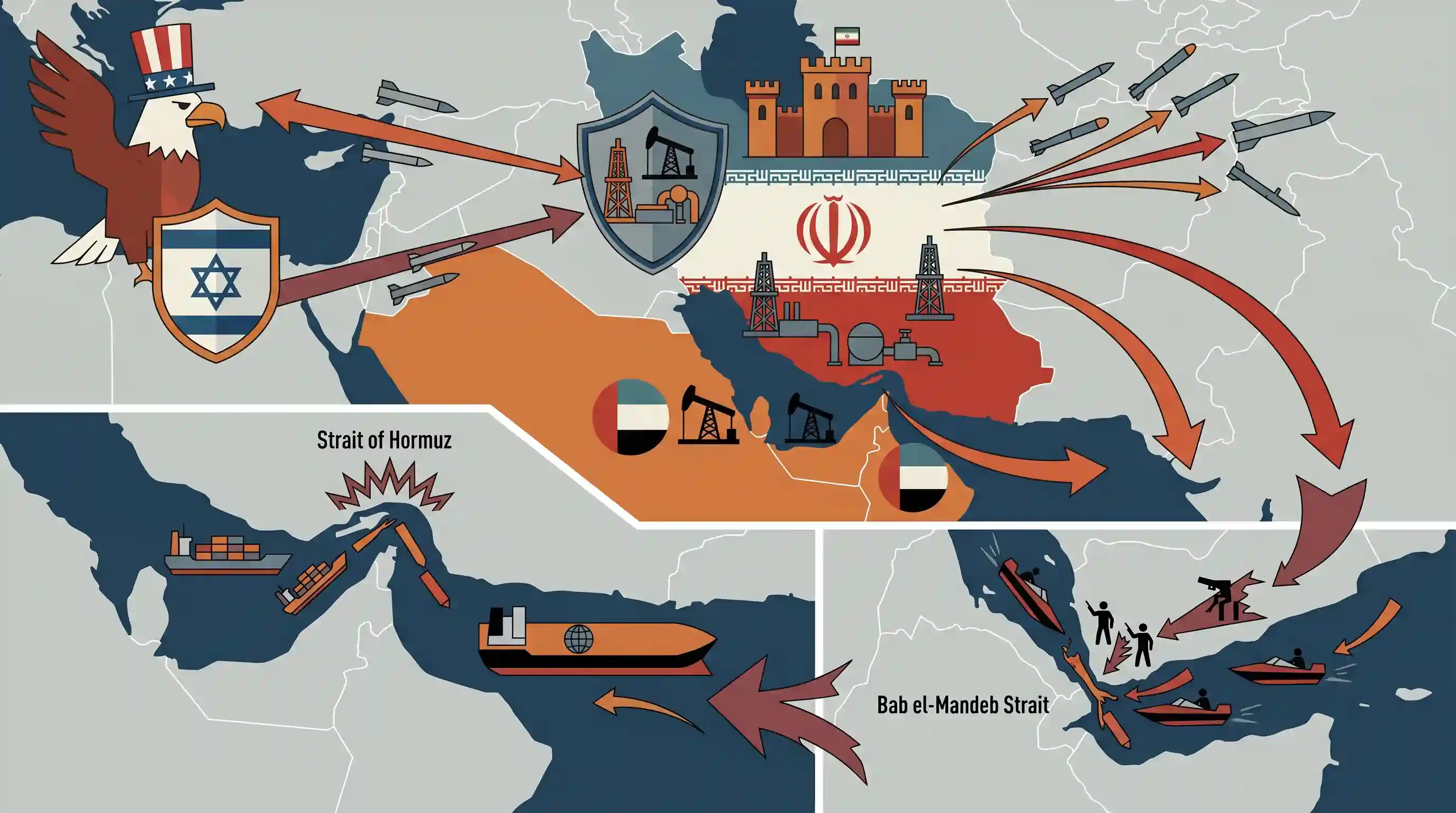
Why It Matters
The West Asian conflict has direct and profound implications for global energy security and supply chains. Understanding the strategic significance of maritime choke points like the Strait of Hormuz and Bab el-Mandeb, along with the shifting geopolitical dynamics between the US, Iran, Israel, and the Gulf States, is critical for framing India's energy and foreign policy strategies.
Summary
The article discusses Iran's strategic preparations for a potential resumption of conflict with the US and Israel following a fragile ceasefire. Anticipating high-intensity strikes against its energy infrastructure, Iran is prepared to retaliate with continuous missile and drone barrages. Furthermore, the conflict could easily spill over into neighboring Gulf states like Saudi Arabia and the UAE, whose energy facilities Iran views as legitimate targets due to their alleged complicity. Most critically for global markets, Iran and its proxies (such as the Houthi militants) could weaponize strategic maritime choke points like the Bab el-Mandeb Strait and the Strait of Hormuz to disrupt global trade and oil passage, forcing the US to fight on multiple maritime fronts.
Key Points
- Following threats of renewed US-Israel strikes, Iran is preparing for high-intensity, coordinated attacks on its energy infrastructure.
- In retaliation, Iran plans to launch massive daily missile and drone barrages to alter the strategic calculus of its adversaries.
- Iran may expand the conflict by targeting the energy infrastructure of Gulf nations like Saudi Arabia and the UAE, accusing them of enabling the US-Israel attacks.
- Iran also holds the capability to disrupt global trade and oil supplies by exerting control over crucial maritime choke points, namely the Bab el-Mandeb Strait and the Strait of Hormuz.
Important Terms
Houthi militants

An Iranian-backed Zaydi Shia militant group in Yemen; a key non-state actor in the 'Axis of Resistance' that uses maritime strikes to project regional influence.
UPSC context
GS Paper 2: International Relations; tests knowledge of non-state actors, proxy warfare, and their impact on global maritime security.
Strait of Hormuz
The world's most critical oil chokepoint, situated between Iran and Oman, connecting the Persian Gulf to the Gulf of Oman and the wider Indian Ocean.
UPSC context
GS Paper 1 (Geography) and GS Paper 2 (Energy Security); vital for India's 40% oil import dependency.
Bab el-Mandeb Strait
A strategic maritime passage between Yemen and the Horn of Africa connecting the Red Sea to the Gulf of Aden; it facilitates ~12% of global trade.
UPSC context
GS Paper 1: Geography; GS Paper 2: International Trade; tests understanding of the Red Sea crisis and global supply chain disruptions.
Maritime Choke Points
Narrow, geographically strategic sea passages (straits or canals) where high volumes of global trade are concentrated, making them critical nodes of economic and military vulnerability.
UPSC context
GS Paper 2 & 3: Global Trade and Security; tests awareness of systemic fragilities in international shipping and energy corridors.
Axis of Resistance
An informal Iranian-led political and military alliance (including Hezbollah, Houthis, and Hamas) aimed at countering Western and Israeli influence in the Middle East.
UPSC context
GS Paper 2: International Relations; essential for analyzing West Asian power dynamics and Iran's strategic depth.
Prelims Trap
Iran exercises direct territorial control over the Bab el-Mandeb Strait.
Bab el-Mandeb is bordered by Yemen, Djibouti, and Eritrea. Iran exerts influence there via Houthi proxies, not direct territorial sovereignty. Iran borders the Strait of Hormuz.
Static Concepts Connected
What are the key maritime choke points in West Asia?
- Strait of Hormuz: Connects the Persian Gulf to the Gulf of Oman and Arabian Sea. Bordered by Iran, Oman, and the UAE. Handles ~20% of global oil.
- Bab el-Mandeb Strait: Connects the Red Sea to the Gulf of Aden and Arabian Sea. Bordered by Yemen on the Arabian Peninsula, and Djibouti and Eritrea in Africa.
How do geopolitical oil supply shocks cause 'Imported Inflation' in India?
- Crude Dependence: India imports over 80% of its crude oil requirements, with a massive share coming from the Middle East, making it highly vulnerable to global price spikes.
- Cost-Push Effect: Surging global crude and maritime freight prices instantly increase domestic transportation and manufacturing costs, pushing up retail inflation.
- Currency Depreciation: A higher oil import bill widens the Current Account Deficit, putting downward pressure on the Rupee and making all other imports more expensive.
Cross-Topic Patterns
Energy Security & ISPRL
Disruptions in the Strait of Hormuz repeatedly highlight the critical need for expanding India's Strategic Petroleum Reserves (ISPRL) beyond the current 9.5-day capacity to buffer against supply shocks.
Bypassing Maritime Choke Points
The vulnerabilities of the Red Sea and Hormuz reinforce the strategic necessity of alternative land-sea transit routes like the India-Middle East-Europe Economic Corridor (IMEC) and the INSTC.

Mapping questions linking West Asian straits (Hormuz/Bab el-Mandeb) to bordering nations and exact water bodies are highly likely in 2026.
Linked PYQs · 3
Linked PYQs · 3
- 2025MainsGS2
"Energy security constitutes the dominant kingpin of India's foreign policy, and is linked with India's overarching influence in Middle Eastern countries.” How would you integrate energy security with India's foreign policy trajectories in the coming years?
- 2017MainsGS2
The question of India's Energy Security constitutes the most important part of India's economic progress. Analyze India's energy policy cooperation with West Asian countries.
- 2024MainsGS2
Discuss the geopolitical and geostrategic importance of Maldives for India with a focus on global trade and energy flows. Further also discuss how this relationship affects India's maritime security and regional stability amidst international competition ?
