US Tariff Threats Over India Russian Oil Energy Purchases
Source:Indian Express ↗
Why It Matters
The article is critical for understanding the intersection of geopolitics and trade. It highlights how India's strategic pursuit of energy security (via Russian oil) creates friction with the US, manifesting as trade protectionism that threatens India's export-driven economic growth and employment.
Summary
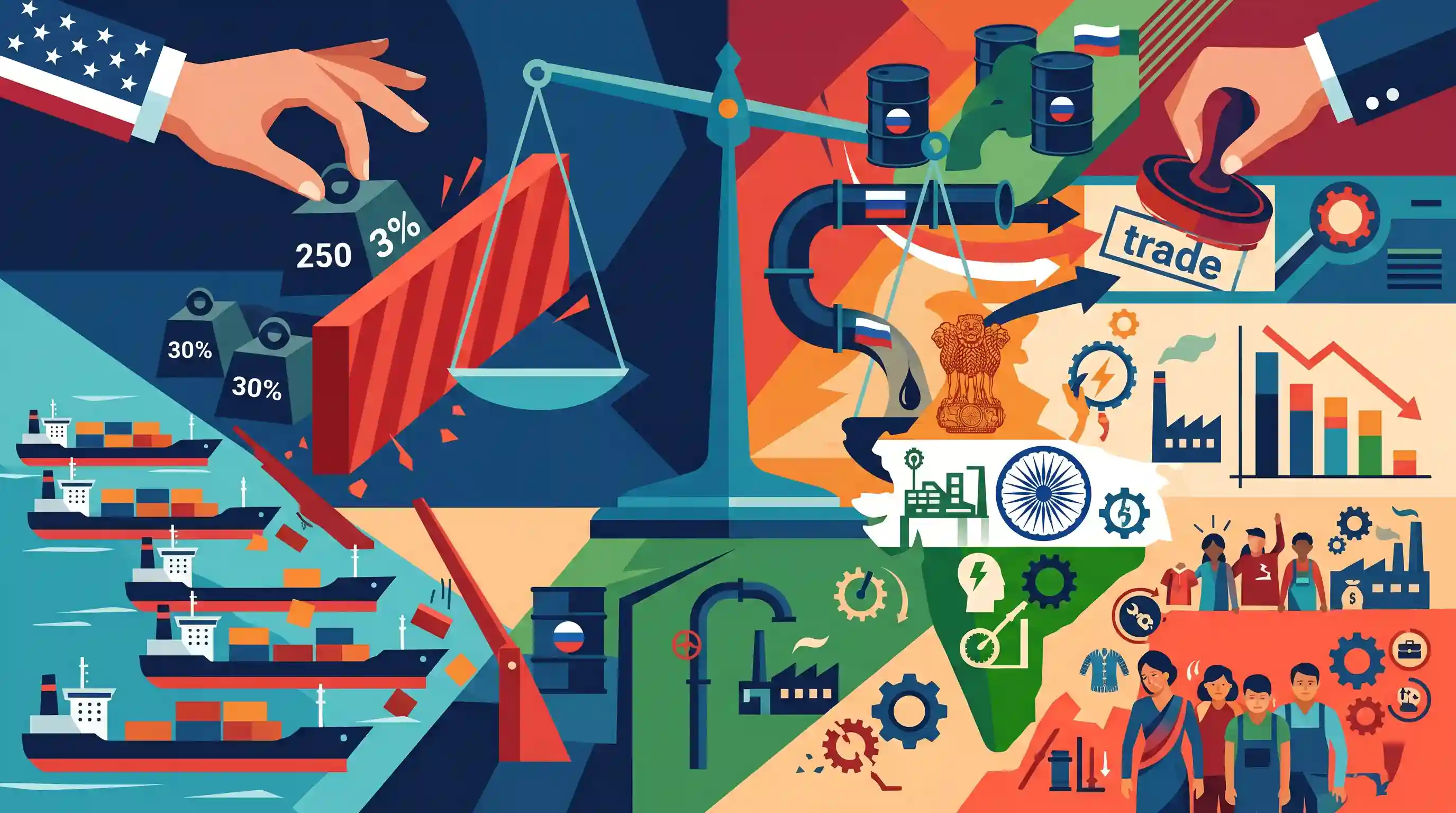
US President Donald Trump has warned that the United States could raise tariffs on Indian goods if New Delhi fails to cooperate in reducing its Russian oil imports. This comes after the US previously imposed steep tariffs of up to 50% on various Indian exports in 2025. Trade analysts project that further tariff escalations could severely impact India's export competitiveness, potentially shrinking merchandise shipments by up to 45% and threatening jobs in labour-intensive sectors. The development underscores the ongoing tension between India's pursuit of energy security through discounted Russian crude and US geopolitical efforts to isolate Moscow.
Key Points
- US President Donald Trump threatened to raise tariffs on Indian exports if India does not reduce its purchases of Russian oil.
- In 2025, the US already imposed tariffs of up to 50% on several Indian goods, citing continued Indian procurement of Russian oil and defence equipment.
- Trade analysts estimate that higher tariffs could reduce India's merchandise shipments to the US by 40-45% in 2025-26, threatening job security in labour-intensive sectors like textiles, gems, and seafood.
- The development highlights the ongoing friction between India's strategic autonomy in energy security (importing discounted Russian crude) and US geopolitical objectives.
Important Terms
Generalised System of Preferences (GSP)

A trade scheme where developed nations provide non-reciprocal, preferential (reduced or zero) tariffs on imports from developing countries to promote their economic growth and industrialization.
UPSC context
GS Paper 2 & 3: Tests understanding of trade barriers and unilateral US trade policy affecting India's export-led growth.
Trade Protectionism
Economic policies, such as high tariffs, import quotas, or subsidies, used by a government to shield domestic industries and workers from foreign competition.
UPSC context
GS Paper 3 (Economy): Relevant for analyzing global trade wars and their impact on India’s manufacturing and export competitiveness.
Strategic Autonomy
A foreign policy doctrine where a nation makes independent decisions based on its own national interests, avoiding being coerced by other states or formal military alliances.
UPSC context
GS Paper 2 (International Relations): Central to India's multi-alignment strategy and balancing relations with rival major powers.
Section 301 (Trade Act of 1974)
A US legal tool that authorizes the President to take unilateral action, including retaliatory tariffs, against foreign trade practices deemed unfair, unreasonable, or discriminatory to US commerce.
UPSC context
GS Paper 2: Tests knowledge of US trade laws and their impact on bilateral relations and India's 'Make in India' initiative.
Energy Security
The uninterrupted availability of energy sources at an affordable price, ensuring that a country's economic development and essential functions remain unaffected by geopolitical disruptions.
UPSC context
GS Paper 3: Critical for understanding India's fuel import dependence and the risks associated with diversifying supply sources.
Secondary Sanctions
Sanctions applied by one country against a third-party entity for engaging in trade with a primary sanctioned nation (e.g., targeting Indian companies for buying Russian oil).
UPSC context
GS Paper 2: Crucial for understanding the extraterritorial reach of US laws and their impact on India's strategic autonomy.
Prelims Trap
"The US utilizes CAATSA provisions to penalize India's imports of Russian crude oil."
CAATSA specifically targets transactions with Russian defense and intelligence sectors (like the S-400 deal). Crude oil faces tariff threats and G7 price caps, not CAATSA sanctions.
Static Concepts Connected
How do unilateral US tariff hikes interact with WTO rules?
- MFN Violation: Unilateral hikes against specific countries generally violate the WTO's Most-Favored-Nation (MFN) principle requiring equal tariff treatment.
- Security Exception: Countries often invoke GATT Article XXI (National Security exception) to justify unilateral tariffs outside agreed WTO bindings.
- Appellate Paralysis: Affected nations can file WTO disputes, but the prolonged US blockade of the Appellate Body restricts effective enforcement.
What are the mechanics of CAATSA?
- Core Objective: US federal law aimed at countering adversaries (Russia, Iran, North Korea) by imposing secondary sanctions on third-party nations.
- Target Sectors: Regarding Russia, it explicitly targets significant transactions with defense and intelligence sectors, distinct from general merchandise or energy trade.
- Presidential Waiver: The US President retains statutory authority to grant a waiver if it aligns with vital US national security interests.
Cross-Topic Patterns
Energy Security + Rupee Internationalization
India's massive shift to discounted Russian crude necessitated the RBI's push for Special Rupee Vostro Accounts to bypass SWIFT and manage trade without dollar reliance.
US Protectionism + FTA Diversification
The threat of a 45% export contraction to India's largest market accelerates New Delhi's urgency to finalize pending FTAs with the UK and EU to diversify its trade portfolio.

Expect a 2026 Prelims question distinguishing between CAATSA provisions, UN sanctions, and unilateral G7 oil price caps on Russian trade.
Linked PYQs · 3
Linked PYQs · 3
- 2012MainsGS2
Discuss the likely negative impact of the protectionist measures proposed by the US on India's software industry.
- 2025MainsGS2
"Energy security constitutes the dominant kingpin of India's foreign policy, and is linked with India's overarching influence in Middle Eastern countries.” How would you integrate energy security with India's foreign policy trajectories in the coming years?
- 2023PrelimsGS1
Consider the following statements: Statement-I: India accounts for 3.2% of global export of goods. Statement-II: Many local companies and some foreign companies operating in India have taken advantage of India's 'Production-linked Incentive' scheme. Which one of the following is correct in respect of the above statements?
