Strait of Hormuz Naval Blockade And Unilateral Cargo Toll Imposition
Source:Indian Express ↗
Why It Matters
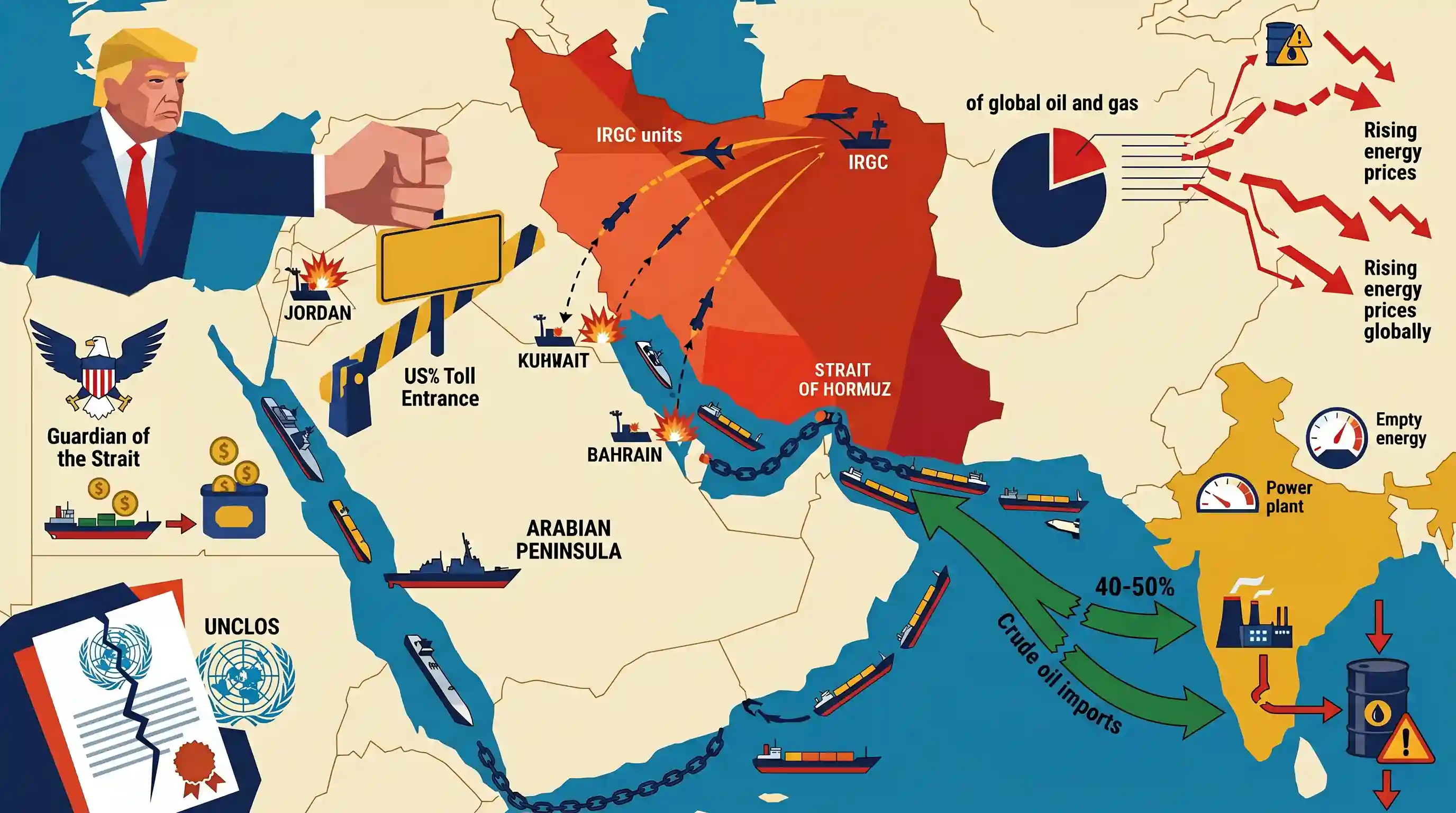
The militarization, blockade, and unilateral tolling of the Strait of Hormuz threaten the global commons and maritime transit. For India, this represents an acute energy security crisis, as nearly half of its crude imports historically transit this chokepoint. It also challenges international maritime law (UNCLOS) regarding freedom of navigation and threatens to unleash severe imported inflation due to surging crude oil prices.
Summary
US President Donald Trump announced a unilateral 20% security toll on all cargo transiting the Strait of Hormuz, designating the US military as the 'Guardian of the Strait' to secure reimbursement for patrolling the waterway. Concurrently, Trump announced the reinstatement of a naval blockade on Iranian ports. The move comes amid severe military escalations, with Iran's IRGC launching retaliatory strikes against US bases in Bahrain, Kuwait, and Jordan, and suspending commercial shipping through the Strait. This chokepoint carries 20% of global oil and gas, and its closure/taxation threatens global economic stability and heavily impacts India, which historically relied on the Strait for 40-50% of its crude oil imports.
Key Points
- US President Donald Trump announced that the United States will charge a 20% toll/reimbursement on all cargo shipped through the Strait of Hormuz, declaring the US as 'THE GUARDIAN OF THE HORMUZ STRAIT'.
- The US President also stated that the US military will reinstate a naval blockade on Iranian ports, citing broken diplomatic deals with Tehran.
- The Strait of Hormuz is the world's most critical energy chokepoint, handling approximately 20% (one-fifth) of global oil and gas transport, with a majority heading to Asian markets.
- The disruption severely impacts India, which historically imported 40% to 50% of its crude oil through the Strait of Hormuz prior to the outbreak of the US-Israel-Iran conflict.
- In response, Iran's IRGC claimed retaliatory drone and missile strikes on US military installations in Bahrain, Kuwait, and Jordan, while suspending commercial shipping through the Strait until US military intervention ceases.
- The regional blockades and military escalations have triggered a sharp spike in global oil and energy prices, exacerbating global inflationary pressures.
Important Terms
United Nations Convention on the Law of the Sea (UNCLOS)

An international treaty adopted in 1982 that establishes a comprehensive legal framework governing maritime boundaries, ocean resources, and activities across different marine zones.
UPSC context
GS Paper II (IR). Tests knowledge of global ocean governance, maritime sovereignty disputes, and trade rules.
Strait of Hormuz
A strategically vital, narrow waterway separating Iran and Oman that connects the Persian Gulf to the Gulf of Oman, serving as a critical global chokepoint for oil.
UPSC context
GS Paper I (Geography) & GS II (IR). Tests understanding of major maritime chokepoints and international energy security.
Islamic Revolutionary Guard Corps (IRGC)
A powerful, parallel branch of Iran's military established after the 1979 revolution to protect the clerical regime and project regional influence through proxy networks.
UPSC context
GS Paper II (IR). Tests knowledge of Middle Eastern geopolitics, proxy conflicts, and West Asian security dynamics.
Freedom of Navigation
A customary international law principle codified under UNCLOS, ensuring that sovereign vessels can traverse international waters and economic zones without external state interference.
UPSC context
GS Paper II (IR) & GS III (Security). Tests rules of sea transit, maritime law, and commerce security.
Naval Blockade
A military operation utilizing naval forces to restrict commercial or military vessels from entering or leaving defined maritime zones, often considered an act of war.
UPSC context
GS Paper III (Security & Defence). Tests concepts of maritime conflict, international humanitarian law, and economic warfare.
Prelims Trap
Iran is legally bound by UNCLOS transit passage rules because it signed the convention, preventing it from policing ships in Hormuz.
Iran signed UNCLOS in 1982 but never ratified it. Thus, it asserts only 'innocent passage' (which permits temporary suspension and domestic policing) applies to its territorial waters in the Strait, not the broader 'transit passage'.
Static Concepts Connected
What is the difference between Transit Passage and Innocent Passage under UNCLOS?
- Transit passage: Applies to straits used for international navigation. It is non-suspendable and permits continuous, expeditious passage of all ships and aircraft.
- Innocent passage: Applies to territorial seas. Coastal states can temporarily suspend it for security, and submarines must navigate on the surface showing their flag.
- Iran's legal position: Iran signed but did not ratify UNCLOS, holding that only innocent passage applies to its territorial waters within the Strait of Hormuz.
What are the key geographical features and bypass routes of the Strait of Hormuz?
- Geographic layout: Connects the Persian Gulf to the Gulf of Oman. Bordered north by Iran and south by Oman's Musandam Peninsula exclave.
- Bypass pipelines: Saudi Arabia's East-West Pipeline (to Red Sea) and UAE's ADCOP pipeline (to Fujairah) can bypass the Strait.
- Landlocked export dependence: Iraq, Kuwait, Qatar, and Bahrain are almost completely dependent on the Strait of Hormuz for sea-based energy exports.
Cross-Topic Patterns
Energy security vs. Strategic Petroleum Reserves
Disruptions in West Asian chokepoints test India’s phase-based Strategic Petroleum Reserves (SPR) capacity, exposing the limits of financial hedging during real-world shipping blockades.
Maritime law vs. Unilateral naval enforcement
Unilateral tolling and blockades challenge the UNCLOS freedom of navigation paradigm, reflecting a shift from international rule-of-law to raw maritime enforcement by major powers.

UNCLOS transit passage rights vs. innocent passage claims in key chokepoints like Hormuz likely to be tested in 2026 Prelims.
Linked PYQs · 3
Linked PYQs · 3
- 2026PrelimsGS1
Ships from which of the following countries have to cross the Strait of Hormuz to reach out to the Indian Ocean ? 1. Bahrain 2. Syria 3. Qatar 4. Egypt Select the answer using the code given below :
- 2025MainsGS2
"Energy security constitutes the dominant kingpin of India's foreign policy, and is linked with India's overarching influence in Middle Eastern countries.” How would you integrate energy security with India's foreign policy trajectories in the coming years?
- 2025MainsGS3
Why is maritime security vital to protect India's sea trade? Discuss maritime and coastal security challenges and the way forward.
