US rejects NATO assistance for Strait of Hormuz security
Source:Indian Express ↗
Why It Matters
The article provides a real-world example of shifting US foreign policy under Trump, particularly the prioritization of unilateralism over multilateral alliances like NATO. This directly relates to GS2 topics on global geopolitics and the changing dynamics of the US-Europe strategic partnership. Additionally, the security of the Strait of Hormuz is a recurring theme in UPSC's focus on global energy security and economic geography (GS1/GS3).
Summary
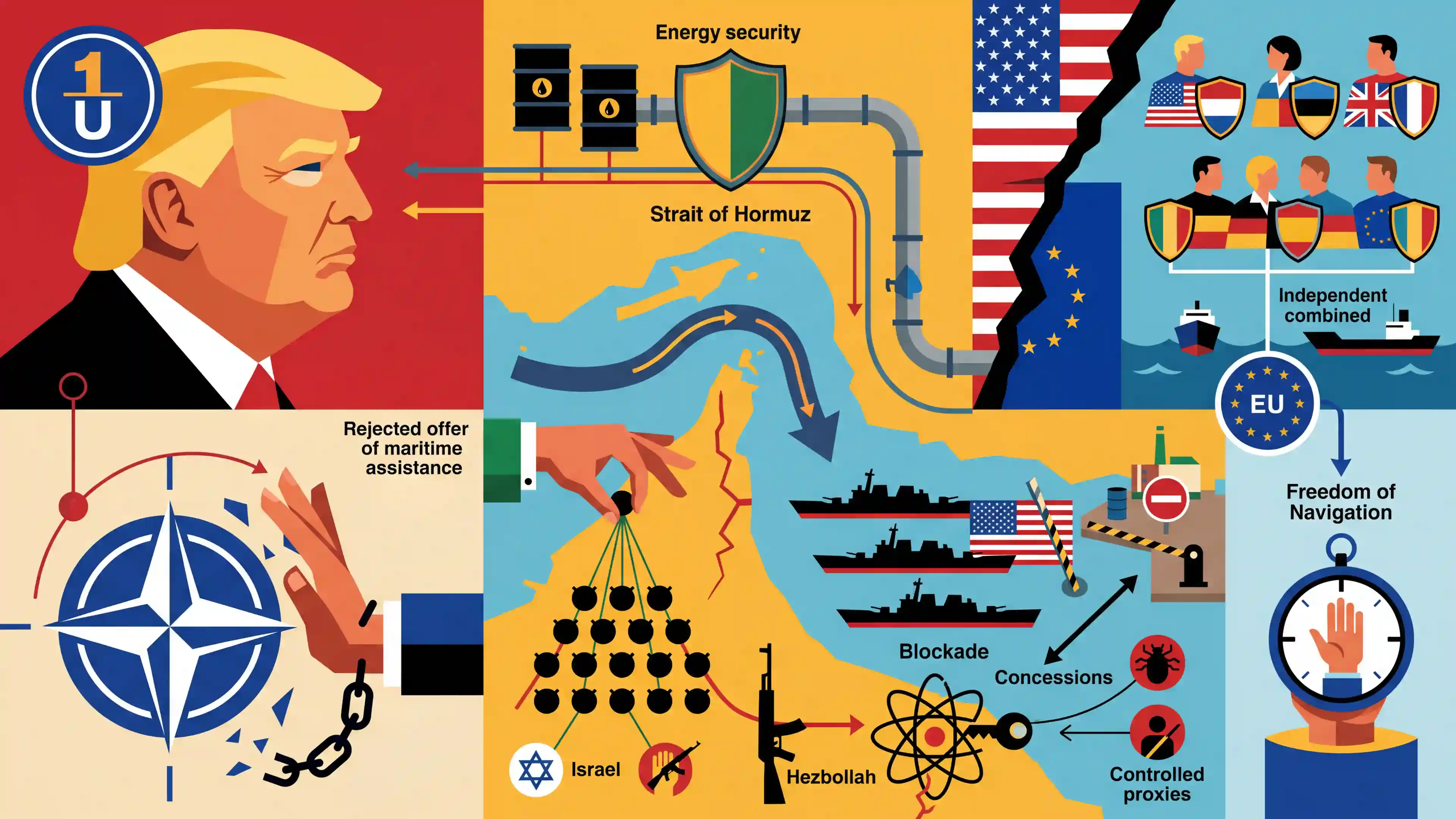
The article highlights President-elect Donald Trump's unilateral approach to securing the Strait of Hormuz, as he sharply rejected an offer of maritime assistance from NATO. Although the critical oil waterway is reopening after Iran removed sea mines linked to recent Middle East conflicts (involving Israel and Hezbollah), Trump warned that a US naval blockade on Iranian ports will continue. This blockade aims to force comprehensive concessions from Iran concerning its nuclear ambitions and regional proxy activities. The situation underscores a deepening transatlantic divide, with European nations opting to organize their own independent mission to protect freedom of navigation.
Key Points
- President-elect Donald Trump rejected NATO's offer to assist in securing the Strait of Hormuz, disparaging the alliance as a 'paper tiger' and indicating a preference for unilateral US action.
- The Strait of Hormuz is reopening after Iran cleared sea mines deployed during the recent conflict involving Israel, Hezbollah, and Iran.
- Despite the reopening, Trump stated that a US naval blockade on Iranian ports will persist until a comprehensive 'transaction' regarding Iran's nuclear program and regional influence is fully completed.
- European powers, including France, the UK, and Germany, are launching an alternative mission to safeguard freedom of navigation, highlighting a growing transatlantic divide in strategic approaches.
Important Terms
NATO

An intergovernmental military alliance of 32 North American and European countries founded in 1949. It operates on the principle of collective defense, where an attack on one member is an attack on all.
UPSC context
GS Paper 2: International Organizations. Tests understanding of collective security, Article 5, and the impact of its expansion on global and Indian strategic interests.
Strait of Hormuz
A strategically vital maritime chokepoint between Oman and Iran connecting the Persian Gulf to the Gulf of Oman. It handles roughly 20% of the world's daily oil consumption.
UPSC context
GS Paper 2: West Asia Geopolitics. Tests knowledge of energy security, maritime chokepoints, and India's dependency on this route for crude oil imports.
Freedom of Navigation
The international legal principle that ships from any state have the right to navigate international waters and certain straits without interference, typically governed by UNCLOS.
UPSC context
GS Paper 2: International Law. Crucial for understanding maritime security, the rules-based international order, and disputes involving UNCLOS in contested waterways.
Hezbollah
A Shia Islamist political and militant group in Lebanon. Supported by Iran, it is a major regional actor often described as an Iranian proxy in the "Axis of Resistance."
UPSC context
GS Paper 2: International Relations. Relevant for West Asia conflict analysis, non-state actors, and the strategic rivalry between Iran and Israel.
Transatlantic Relations
The historic security and economic partnership between the United States and European nations. It has been the cornerstone of the post-WWII liberal world order.
UPSC context
GS Paper 2: Effect of Policies of Developed Countries. Tests understanding of shifting global alliances and the emergence of European strategic autonomy.
Nuclear Proliferation
The spread of nuclear weapons and technology to nations not recognized as "Nuclear Weapon States" by the NPT. It is a central issue in US-Iran relations.
UPSC context
GS Paper 2: Global Treaties & Agreements. Key for discussing the JCPOA (Iran Deal), regional stability, and international disarmament frameworks.
Prelims Trap
The Strait of Hormuz is bordered by Iran to the north and Saudi Arabia to the south.
The Strait of Hormuz separates Iran from Oman (the Musandam Peninsula) and the UAE. Saudi Arabia relies heavily on it but does not border it.
Static Concepts Connected
What are the primary maritime chokepoints in the Middle East?
- Strait of Hormuz: Connects the Persian Gulf to the Gulf of Oman and Arabian Sea, flanked by Iran, Oman, and UAE.
- Bab el-Mandeb: Connects the Red Sea to the Gulf of Aden, flanked by Yemen on the Arabian Peninsula and Djibouti/Eritrea in Africa.
- Suez Canal: Artificial sea-level waterway in Egypt connecting the Mediterranean Sea to the Red Sea.
How does UNCLOS regulate navigation through international straits?
- Transit Passage: Vessels and aircraft of all states enjoy unimpeded transit passage through straits used for international navigation.
- Submerged Navigation: Unlike 'innocent passage' in territorial waters, submarines are permitted to remain submerged during transit passage through straits.
- Coastal State Limits: Bordering states cannot suspend transit passage, but they can enforce internationally approved maritime safety and pollution regulations.
Cross-Topic Patterns
Chokepoints + India's SPRs
Disruptions in Hormuz highlight India's crude oil vulnerability, prompting UPSC to link global chokepoints with the locations and capacities of India's Strategic Petroleum Reserves (Mangalore, Padur, Visakhapatnam).
EU Strategic Autonomy + Multipolarity
Europe launching an independent maritime mission outside NATO reflects a growing transatlantic divide and a shift toward European 'strategic autonomy', a concept highly relevant to Mains GS-2 multipolarity themes.

Middle East straits mapping + UNCLOS transit rights + Iran proxy conflicts will likely merge into a hybrid Geography/IR question in 2026.
Linked PYQs · 3
Linked PYQs · 3
- 2023MainsGS2
‘The expansion and strengthening of NATO and a stronger US-Europe strategic partnership works well for India.’ What is your opinion about this statement ? Give reasons and examples to support your answer.
- 2024PrelimsGS1
Consider the following statements : Statement-I : Sumed pipeline is a strategic route for Persian Gulf oil and natural gas shipments to Europe. Statement-II : Sumed pipeline connects the Red Sea with the Mediterranean Sea. Which one of the following is correct in respect of the above statements?
- 2023PrelimsGS1
Consider the following pairs: Regions often mentioned in news Reason for being in news 1. North Kivu and Ituri : War between Armenia and Azerbaijan 2. Nagorno-Karabakh : Insurgency in Mozambique 3. Kherson and Zaporizhzhia : Dispute between Israel and Lebanon How many of the above pairs are correctly matched?
