US State of the Union Address and Global Trade Policy Impacts
Source:The Hindu ↗
Why It Matters
The State of the Union address outlines the strategic priorities of the US, which heavily influence global geopolitics and macroeconomics. Trump's extreme protectionist proposals (tariffs replacing income tax) pose significant implications for global trade, supply chains, and India's export economy. Furthermore, the acknowledgment of the high energy demands of AI data centres introduces a critical new intersection of technology and environmental policy. His foreign policy stances on the Middle East, Iran, and NATO signify evolving global alignments that affect India's strategic and energy interests.
Summary
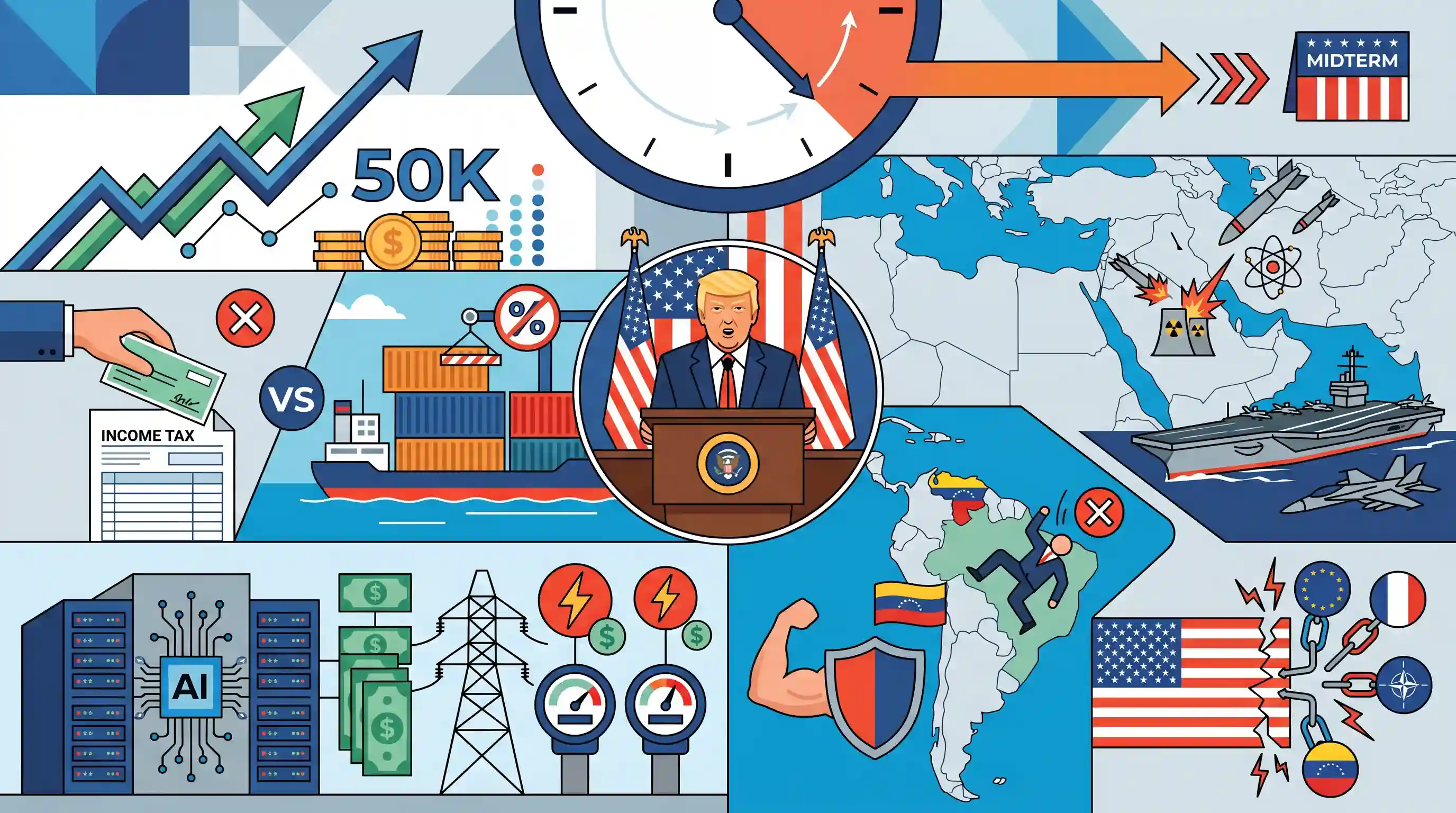
During his State of the Union address on February 24, 2026, US President Donald Trump delivered a record-breaking 101-minute speech to outline his administration's achievements and policy direction ahead of the midterm elections. Trump celebrated domestic economic milestones such as the Dow Jones crossing 50,000 and proposed radical shifts in fiscal policy by advocating for tariffs to replace the income tax system. He also announced a novel policy requiring tech companies to pay elevated electricity rates for their AI data centres. On the global stage, his address highlighted a muscular foreign policy, pointing to the dispatch of US carriers to the Middle East, airstrikes against Iranian nuclear facilities, and the ousting of Venezuela's leadership, while reflecting strained relations with traditional NATO allies.
Key Points
- US President Donald Trump delivered the longest-ever State of the Union address, lasting 1 hour and 41 minutes, aimed at bolstering his approval ratings ahead of the November midterm elections.
- Trump emphasized a robust US economy, highlighting that the Dow Jones Industrial Average had crossed the 50,000 mark for the first time.
- Addressing the energy footprint of emerging technologies, Trump announced an agreement where tech companies will pay higher electricity rates for their AI data centres.
- He fiercely defended trade protectionism, predicting that broad tariffs on imports would eventually replace the modern income tax system, and vowed to use alternative laws to enforce them despite recent Supreme Court pushback.
- On foreign policy, Trump highlighted the deployment of aircraft carriers to the Middle East amid tensions with Iran, lauded strikes on Tehran's nuclear capabilities, and mentioned the ousting of Venezuela's Nicolas Maduro alongside a ceasefire in Gaza.
Important Terms
NATO

A 32-member intergovernmental military alliance. In 2026, it faced existential strain as the Trump administration questioned the US commitment, potentially creating a strategic vacuum and opening defense export opportunities for India.
UPSC context
GS Paper II (International Relations). Tests understanding of global security architecture and its impact on India’s strategic autonomy and defense industry.
DHS (Department of Homeland Security)
The US federal department responsible for public security, border control, and immigration. In 2026, it experienced a record-breaking shutdown due to funding disputes over mass deportation and border policies.
UPSC context
GS Paper II (International Relations). Relevant for analyzing US domestic policies on immigration and visas that affect the Indian diaspora.
Hamas
A Palestinian militant and political organization. Trump’s 2026 address highlighted a US-brokered ceasefire in Gaza and the return of hostages, signaling shifts in US mediation in West Asia.
UPSC context
GS Paper II (International Relations). Tests knowledge of West Asian conflicts and their implications for India’s energy security and regional stability.
Supreme Court (US)
The highest judicial body in the United States. In early 2026, it ruled against the administration's use of emergency powers to impose broad tariffs, acting as a check on executive authority.
UPSC context
GS Paper II (Comparative Constitution). Relevant for studying the separation of powers and judicial oversight of trade and executive actions.
Republican Party
A major US political party characterized by the 'America First' platform. In 2026, it advocated for replacing income tax with tariffs and enforcing muscular unilateral foreign policy.
UPSC context
GS Paper II (International Relations). Important for assessing how protectionist US political ideologies impact India’s trade and strategic interests.
Democratic Party
A major US political party that, in 2026, opposed the Trump administration's immigration and tariff policies, contributing to a partial government shutdown over the DHS budget.
UPSC context
GS Paper II (International Relations). Tests awareness of political polarization in developed nations and its influence on global governance and bilateral relations.
Prelims Trap
"Artificial Intelligence inherently reduces global carbon emissions by optimizing industrial energy efficiency."
While AI optimizes certain systems, training models and running data centers are extremely energy- and water-intensive, significantly adding to global carbon footprints and grid strain.
Static Concepts Connected
Why are AI data centers considered an emerging environmental concern?
- Energy Intensity: Training large language models requires massive computing power, consuming electricity on a scale comparable to small cities.
- Water Footprint: Data centers consume millions of gallons of fresh water for cooling server racks to prevent overheating, stressing local water tables.
- Hardware Obsolescence: Rapid upgrading of specialized AI hardware accelerates the generation of electronic waste containing toxic heavy metals.
What are the key WTO rules regarding unilateral tariff impositions?
- MFN Principle: Unilateral tariffs generally violate Most-Favored-Nation rules unless justified under strict national security exceptions (Article XXI).
- Trade Remedies: Anti-dumping or countervailing duties are permitted only after rigorous WTO-defined investigations, not as arbitrary executive actions to replace domestic taxes.
- Retaliatory Measures: The WTO Dispute Settlement Body (DSB) can authorize affected nations to impose counter-tariffs if unilateral actions are found to violate agreements.
Cross-Topic Patterns
AI infrastructure vs. Net-Zero targets
India's push for sovereign AI (IndiaAI Mission) must be weighed against its Panchamrit climate goals, making green data center policies and elevated commercial power tariffs a regulatory necessity.
US Protectionism vs. Indian Exports
Substituting US income tax with broad import tariffs would severely hit India's labor-intensive export sectors (textiles, gems) and IT services, disrupting the bilateral trade balance and violating WTO norms.
Middle East crises and Strait of Hormuz
US airstrikes on Iran escalate risks at the Strait of Hormuz, a critical chokepoint handling a fifth of global oil, directly threatening India's import-dependent energy security.

A Prelims question linking AI's massive water/energy footprint to global net-zero climate goals and green data centers is highly likely.
Linked PYQs · 4
Linked PYQs · 4
- 2012MainsGS2
Discuss the likely negative impact of the protectionist measures proposed by the US on India's software industry.
- 2023MainsGS3
Introduce the concept of Artificial Intelligence (AI). How does Al help clinical diagnosis? Do you perceive any threat to privacy of the individual in the use of Al in healthcare?
- 2025MainsGS2
"The reform process in the United Nations remains unresolved, because of the delicate imbalance of East and West and entanglement of the USA vs. Russo-Chinese alliance.” Examine and critically evaluate the East-West policy confrontations in this regard.
- 2018MainsGS2
“India’s relations with Israel have, of late, acquired a depth and diversity, which cannot be rolled back.” Discuss.
