United States imposes tariff threats on nations trading with Iran
Source:The Hindu ↗
Why It Matters
The use of secondary sanctions through unilateral tariffs by the U.S. disrupts global trade and forces third countries to comply with American foreign policy objectives. For India, such measures can complicate its strategic investments in Iran (like Chabahar Port), its energy security matrix, and its pursuit of strategic autonomy in a multipolar world.
Summary
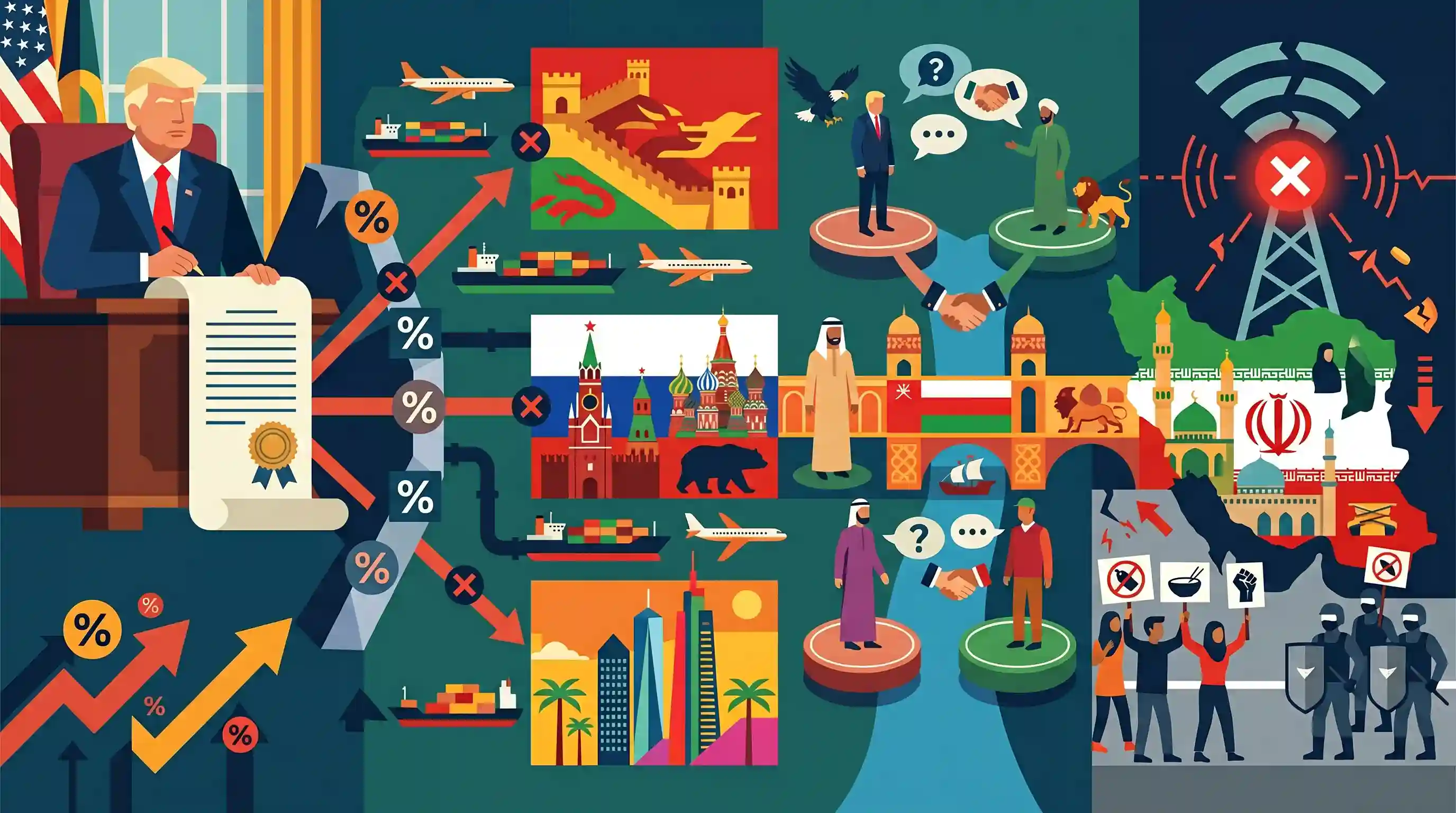
U.S. President Donald Trump has signed an executive order authorizing 25% tariffs on goods imported from countries that maintain trade relations with Iran. This mechanism of secondary sanctions targets major Iranian trade partners such as China, Russia, and the UAE, escalating U.S. economic pressure. The order is issued alongside ongoing, Oman-mediated indirect talks in Muscat between the U.S. and Iran, following recent military escalations. Concurrently, Iran is facing intense domestic turmoil, marked by internet blackouts and a severe crackdown on economic protests.
Key Points
- U.S. President Donald Trump signed an executive order creating a framework to impose 25% tariffs on countries that conduct business with Iran.
- Secretary of State Marco Rubio is directed to identify Iran's trading partners, which could target major countries like China (which accounts for over a quarter of Iran's trade), Russia, the UAE, Turkey, and Germany.
- Indirect talks between the U.S. and Iran are currently taking place in Muscat, mediated by Oman, marking the first diplomatic engagement since the U.S. struck Iranian nuclear sites in June.
- Iran faces severe internal unrest, characterized by a massive internet blackout and a deadly government crackdown on economic protests that has reportedly resulted in over 6,500 deaths.
Important Terms
Secondary Sanctions

Economic penalties imposed by one country on third-party nations or entities that trade with a target country. They force global actors to choose between the sanctioning nation's market and the target's.
UPSC context
GS-II: International Relations. Tests understanding of how US foreign policy impacts India's strategic trade and energy security with sanctioned nations.
Extraterritorial Jurisdiction
The legal principle allowing a state to exercise authority or apply its laws beyond its physical borders, often used to justify global enforcement of domestic sanctions.
UPSC context
GS-II: International Relations. Relevant for analyzing challenges to national sovereignty and the legal mechanics of global trade wars.
HRANA (Human Rights Activists News Agency)
A 24/7 news agency founded by Iranian activists to document and disseminate reports on human rights violations, arrests, and protests within Iran.
UPSC context
GS-II: International Organizations/Agencies. Tests awareness of monitoring bodies that provide data on regional instability and civil rights in West Asia.
Economic Statecraft
The use of economic instruments—like tariffs, sanctions, and investment rules—as primary tools of foreign policy to influence other states and secure national interests.
UPSC context
GS-II: Effect of policies of developed countries. Tests the conceptual shift from military power to economic coercion in modern geopolitics.
Muscat-mediated talks
Oman's long-standing diplomatic role as a neutral intermediary, facilitating indirect negotiations and de-escalation between the U.S. and Iran to maintain regional stability.
UPSC context
GS-II: Regional Groupings. Tests knowledge of diplomatic channels in West Asia that affect global energy markets and India's interests.
Prelims Trap
Secondary sanctions are imposed under the mandate of the UN Security Council or WTO.
Secondary sanctions are unilateral, extraterritorial economic tools used by individual countries (primarily the US leveraging the dollar), not by multilateral organizations.
Static Concepts Connected
What is the difference between Primary and Secondary Sanctions?
- Primary Sanctions: Restrict citizens and domestic companies of the sanctioning nation from trading with the target country.
- Secondary Sanctions: Target third-party nations and foreign entities, punishing them for doing business with the sanctioned target.
- Extraterritoriality: Relies on global dependence on a currency (e.g., US Dollar) or financial system to force global compliance beyond sovereign borders.
Why is Chabahar Port strategically critical for India's geopolitical interests?
- Strategic Access: Located on the Gulf of Oman, it allows India to bypass Pakistan for direct access to Afghanistan and Central Asia.
- INSTC Integration: Acts as a crucial maritime-to-land node for the International North-South Transport Corridor (INSTC) linking India to Russia.
- Sanctions Vulnerability: India's operations and equipment procurement at Chabahar heavily depend on securing specific US sanction waivers or 'carve-outs'.
Cross-Topic Patterns
Secondary Sanctions + Chabahar Exemption
The US weaponization of trade via secondary sanctions directly threatens India's strategic investments like Chabahar, testing India's multi-alignment policy and energy security matrix.
Oman's Backchannel Diplomacy
Oman's unique Ibadi sect and neutral foreign policy make Muscat the prime mediator for US-Iran and Saudi-Houthi conflicts in a polarized Middle East.

US secondary sanctions and extraterritorial tariffs on Iran trade will likely form a multi-statement IR question testing India's Chabahar waivers.
Linked PYQs · 3
Linked PYQs · 3
- 2018MainsGS2
In what ways would the ongoing US-Iran Nuclear Pact Controversy affect the national interest of India? How should India respond to this situation?
- 2012MainsGS2
How have the US sanctions against Iran affected India's bilateral relations with Iran?
- 2025MainsGS2
"Energy security constitutes the dominant kingpin of India's foreign policy, and is linked with India's overarching influence in Middle Eastern countries.” How would you integrate energy security with India's foreign policy trajectories in the coming years?
