US Nuclear Doctrine Shifts and Multilateral Arms Control Impact
Source:The Hindu ↗
Why It Matters
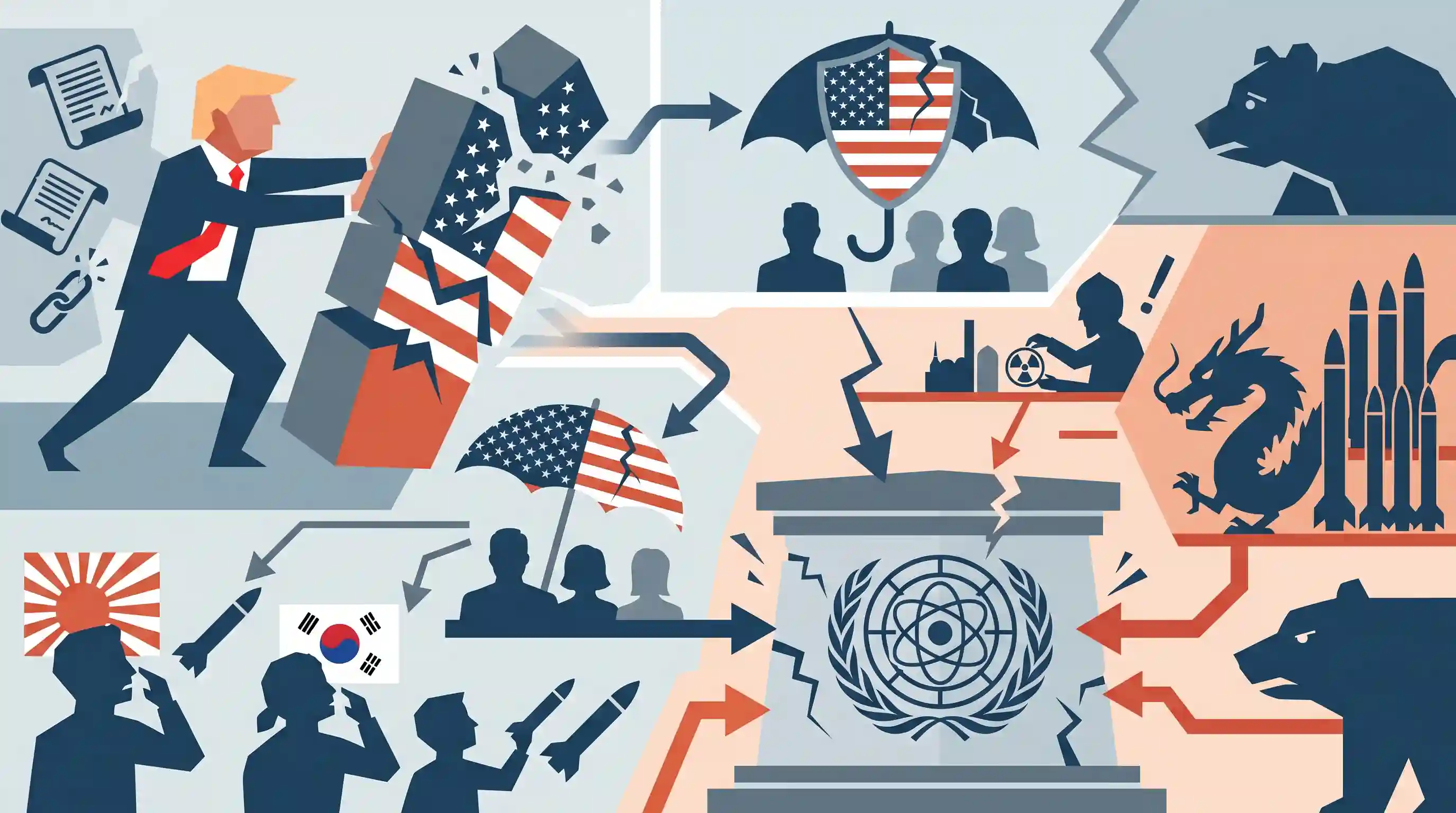
The global nuclear order and non-proliferation treaties are foundational to international peace and security. Changes in US nuclear posture directly impact the strategic calculus of China and Pakistan, which in turn profoundly affects India's national security, nuclear doctrine, and broader foreign policy alignments.
Summary
The article analyzes the potential destabilizing impact of Donald Trump's approach on the global nuclear order. Driven by his transactional 'America First' foreign policy, Trump's leadership threatens to dismantle the remnants of traditional arms control, notably the New START treaty with Russia. His skepticism towards multilateralism and alliance commitments could weaken the US nuclear umbrella, potentially prompting nations like Japan and South Korea to develop their own nuclear deterrents. Concurrently, confronting China's growing nuclear arsenal and dealing with a nuclear-capable Iran risk sparking a multipolar arms race. Ultimately, this shift marks a significant departure from global disarmament norms, placing immense pressure on the Non-Proliferation Treaty (NPT) framework and reshaping international security dynamics.
Key Points
- Donald Trump's 'America First' doctrine and transactional approach to diplomacy threaten traditional arms control frameworks, most notably the New START treaty with Russia, which is set to expire in 2026.
- The credibility of the US nuclear umbrella (extended deterrence) may weaken, potentially compelling key allies like South Korea and Japan to pursue their own independent nuclear arsenals.
- In response to China's rapid nuclear expansion and Russia's assertive posturing, the Trump administration is likely to aggressively modernize and expand the US nuclear triad, fueling a new multipolar arms race.
- A renewed hardline stance on Iran's nuclear program—following Trump's earlier withdrawal from the JCPOA—could heighten geopolitical instability and energy security concerns in the Middle East.
- The global non-proliferation regime, anchored by the NPT, faces severe strain as major nuclear powers pivot decisively from disarmament efforts toward deterrence and arms buildup.
Important Terms
Non-Proliferation Treaty (NPT)

A 1968 treaty aiming to prevent the spread of nuclear weapons and promote disarmament. It recognizes only five nuclear weapon states (US, Russia, UK, France, China).
UPSC context
GS II (International Relations). Tests knowledge of India's 'discriminatory' stance and refusal to sign the treaty to maintain strategic autonomy.
New START
The last major US-Russia arms control treaty limiting deployed strategic warheads. It officially expired on February 5, 2026, following years of suspension and failed extension negotiations.
UPSC context
GS II (Global Groupings). Crucial for understanding the breakdown of the post-Cold War security architecture and the shift toward a multipolar arms race.
Joint Comprehensive Plan of Action (JCPOA)
The 2015 'Iran Nuclear Deal' designed to curb Iran's enrichment activities for sanctions relief. Its effectiveness collapsed after US withdrawal (2018), leading to its formal 2025 expiration.
UPSC context
GS II (Effect of Politics). Impacts India's energy security, West Asian stability, and strategic interests like the Chabahar Port project.
International Atomic Energy Agency (IAEA)
The UN's global nuclear watchdog that promotes peaceful nuclear technology and verifies that member states do not divert nuclear materials toward weapons programs through 'safeguards.'
UPSC context
GS II (International Institutions). Key for Prelims regarding India's unique arrangement where only civilian reactors using imported fuel are under safeguards.
Intermediate-Range Nuclear Forces (INF) Treaty
A 1987 treaty between the US and USSR banning ground-launched missiles with ranges of 500-5,500 km. Both nations withdrew in 2019, ending a key disarmament pillar.
UPSC context
GS II (International Treaties). Illustrates the erosion of bilateral arms control and its replacement by broader, more complex regional security dilemmas.
Nuclear Umbrella
A security guarantee where a nuclear-armed state pledges to defend a non-nuclear ally with its nuclear arsenal, deterring attacks on the ally by a common adversary.
UPSC context
GS II (Effect of Developed Countries' Policies). Vital for analyzing US-Japan/South Korea alliances and the risk of regional states pursuing independent nuclear deterrents.
Prelims Trap
New START is a multilateral treaty that caps the nuclear arsenals of the US, Russia, and China.
New START is strictly a bilateral treaty between the US and Russia. China has consistently refused to join it, despite past US pressure to make it trilateral.
Static Concepts Connected
Who are the recognized 'Nuclear Weapon States' under the NPT?
- NPT Criteria: Only states that manufactured and exploded a nuclear weapon or explosive device prior to January 1, 1967.
- The Recognized Five: The US, Russia, UK, France, and China (the P5) are the only recognized NWS.
- India's Stance: India refuses to sign the NPT, arguing the arbitrary 1967 cutoff makes the treaty inherently discriminatory by creating nuclear 'haves' and 'have-nots'.
What is 'Extended Deterrence' in international security?
- Definition: A commitment by a nuclear-armed state to use its nuclear arsenal to deter attacks on its non-nuclear allies.
- Nuclear Umbrella: Commonly refers to US security guarantees extended to NATO members, Japan, and South Korea.
- Non-Proliferation Objective: It inherently prevents nuclear proliferation by assuring allies they do not need to develop their own independent nuclear weapons to stay safe.
Cross-Topic Patterns
JCPOA collapse & India's energy stakes
A US hardline stance on Iran directly restricts India's crude oil sourcing options and heavily complicates strategic, sanctions-free operations of the Chabahar Port and the INSTC.
AUKUS as a nuclear deterrent shift
If the US 'nuclear umbrella' weakens in East Asia, traditional bilateral defense treaties may be superseded by aggressive minilateral groupings like AUKUS and independent nuclearization by Japan or South Korea.

With New START expiring in 2026, expect a multi-statement Prelims question merging bilateral arms control (START) with NPT provisions.
Linked PYQs · 4
Linked PYQs · 4
- 2018MainsGS2
In what ways would the ongoing US-Iran Nuclear Pact Controversy affect the national interest of India? How should India respond to this situation?
- 2025MainsGS2
"The reform process in the United Nations remains unresolved, because of the delicate imbalance of East and West and entanglement of the USA vs. Russo-Chinese alliance.” Examine and critically evaluate the East-West policy confrontations in this regard.
- 2015PrelimsGS1
Consider the following countries: 1. China 2. France 3. India 4. Israel 5. Pakistan Which among the above are Nuclear Weapons States as recognized by the Treaty on the Non-Proliferation of Nuclear Weapons, commonly known as Nuclear Non-Proliferation Treaty (NPT)?
- 2018PrelimsGS1
In the Indian context, what is the implication of ratifying the 'Additional Protocol' with the 'International Atomic Energy Agency (IAEA)'?
