US and Iran Peace Proposal: Strait of Hormuz Geopolitics
Source:The Hindu ↗
Why It Matters
The blockade of the Strait of Hormuz and the ensuing spike in global oil prices have massive implications for India's macroeconomic stability and energy security. The geopolitical realignment and potential nuclear dimensions in the Middle East directly affect India's strategic calculations in the region.
Summary
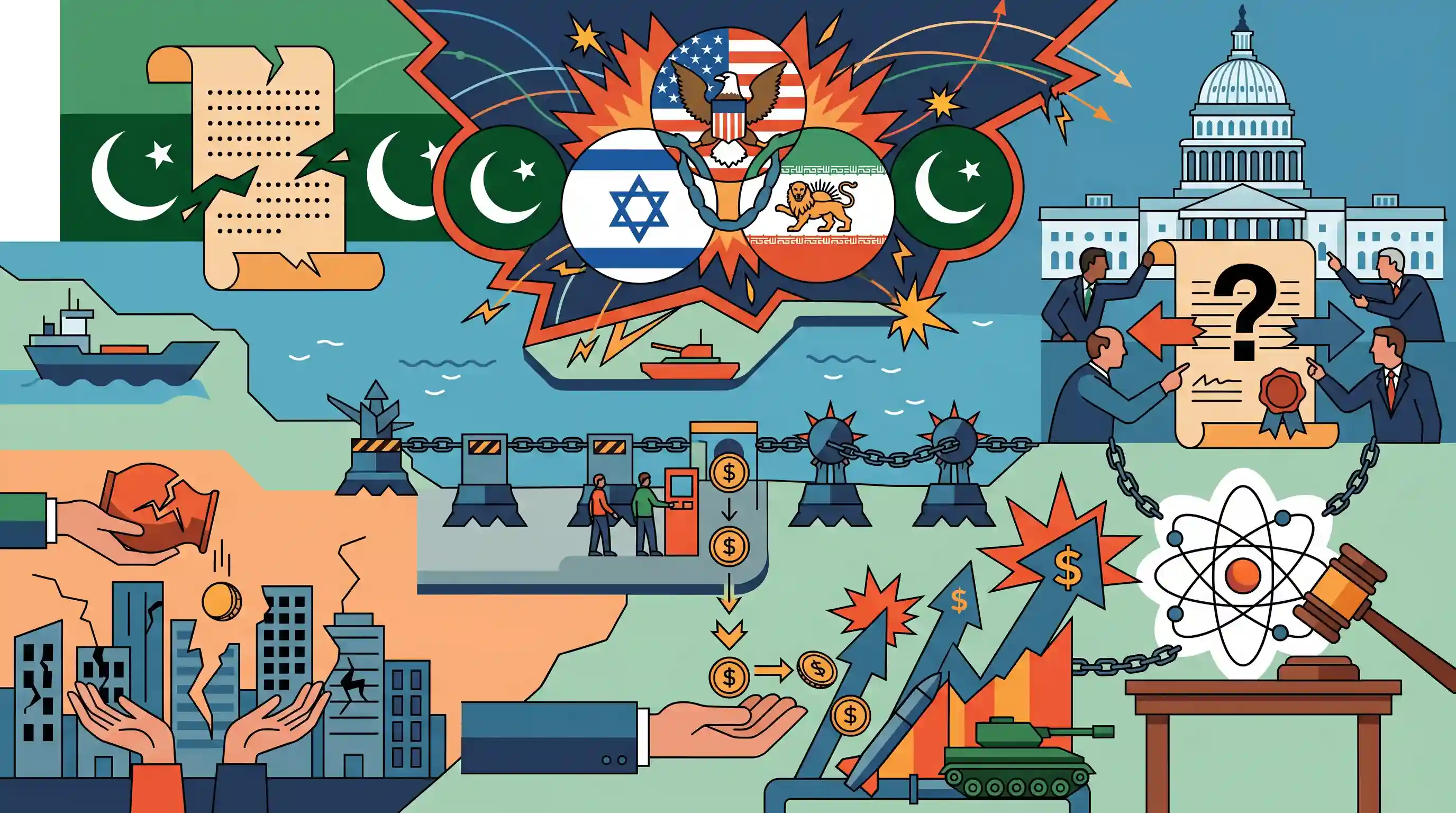
The United States is unlikely to accept a new 14-point peace proposal from Iran, mediated by Pakistan, as the conflict between the U.S., Israel, and Iran continues to disrupt global stability. Central to the stalemate is Iran's continued blockade of the Strait of Hormuz, a vital maritime chokepoint, which has driven global oil prices up by 50%. Iran has demanded a new framework to manage the strait, even proposing legislation to collect tolls to fund its military. Meanwhile, the U.S. insists on putting Iran's nuclear program back on the negotiating table. The conflict's economic toll is deepening in Iran, while in Washington, lawmakers are debating whether the U.S. administration breached the War Powers Act by engaging in the conflict without congressional consent.
Key Points
- U.S. President Donald Trump expressed doubt over a new 14-point Iranian peace proposal facilitated by Pakistan, suggesting the US is unlikely to accept the terms.
- Iran continues its blockade of the strategic Strait of Hormuz, leading to a 50% spike in global oil prices by restricting flows of oil, gas, and fertilizers.
- A central element of Iran's proposal is a new management framework for the Strait of Hormuz, including a plan to levy tolls—30% of which would fund Iranian military infrastructure.
- U.S. envoys have insisted that Iran's nuclear program be included in any negotiation framework, which Tehran has rejected as hypocritical.
- The prolonged conflict has triggered debates in the U.S. Congress over whether the executive branch violated the War Powers resolution by entering hostilities without congressional approval.
Important Terms
Iranian 14-point peace proposal

A 2026 roadmap mediated by Pakistan, demanding U.S. troop withdrawal, lifting of naval blockades, and a new framework for managing the Strait of Hormuz to end regional hostilities.
UPSC context
GS Paper II: West Asia Geopolitics. Tests diplomacy, regional peace initiatives, and India's strategic interests in the Persian Gulf.
US War Powers Act
A 1973 U.S. law restricting the President’s power to commit forces to hostilities for over 60 days without Congressional authorization; central to legal debates over the U.S.-Iran conflict.
UPSC context
GS Paper II: Comparative Constitution. Tests understanding of executive-legislative power balance and its impact on international law.
Strait of Hormuz
A critical maritime chokepoint handling roughly 20% of global oil and LNG trade. Its closure drives energy inflation, threatening India's energy security and fiscal stability.
UPSC context
GS Paper I & II: Geography and IR. Tests knowledge of strategic waterways and their role in global energy security.
IAEA (International Atomic Energy Agency)
The UN nuclear watchdog established in 1957. It verifies that nuclear programs are peaceful; its inspections are a core U.S. demand in any settlement with Iran.
UPSC context
GS Paper II: International Institutions. Tests understanding of global governance and nuclear non-proliferation regimes.
US Congress
The U.S. legislative branch holding the constitutional power to declare war; currently deadlocked over whether to authorize or terminate military operations against Iran.
UPSC context
GS Paper II: Comparative Polity. Tests understanding of the separation of powers and legislative oversight in major democracies.
Prelims Trap
Under UNCLOS, coastal states possess the sovereign right to levy transit tolls on foreign vessels passing through international chokepoints.
UNCLOS designates straits like Hormuz under the 'transit passage' regime, guaranteeing non-suspendable navigation. Coastal states cannot levy arbitrary tolls merely for transit.
Static Concepts Connected
What is the 'Transit Passage' regime under UNCLOS for international straits?
- Continuous navigation: Grants all ships and aircraft the non-suspendable right of continuous and expeditious transit through international straits.
- Toll restrictions: Prohibits coastal states from levying arbitrary fees merely for transit; fees can only be charged for specific maritime services rendered.
How does a crude oil price shock impact India's macroeconomic stability?
- Widens CAD: India imports over 80% of its crude; higher prices sharply inflate the import bill, expanding the Current Account Deficit (CAD).
- Imported inflation: Rising fuel prices increase freight and logistics costs, which cascade broadly into higher wholesale and consumer inflation.
- Currency depreciation: Increased dollar demand for costly oil imports exerts downward pressure on the Indian Rupee, causing depreciation.
Cross-Topic Patterns
War Powers: US vs Indian Polity
US congressional debates over war powers present a direct comparative polity contrast with India’s parliamentary executive, where military actions inherently rely on legislative confidence.
Iran's nuclear program and IAEA protocols
US demands to revive nuclear talks connect directly to the IAEA’s Additional Protocol, a frequent Prelims topic regarding international safeguards and peaceful nuclear use verification.

Expect a Prelims question combining UNCLOS 'transit passage' rules with the geographical mapping of West Asian maritime chokepoints.
Linked PYQs · 4
Linked PYQs · 4
- 2025MainsGS2
"Energy security constitutes the dominant kingpin of India's foreign policy, and is linked with India's overarching influence in Middle Eastern countries.” How would you integrate energy security with India's foreign policy trajectories in the coming years?
- 2017MainsGS2
The question of India's Energy Security constitutes the most important part of India's economic progress. Analyze India's energy policy cooperation with West Asian countries.
- 2023PrelimsGS1
Consider the following statements: Statement-I: Israel has established diplomatic relations with some Arab States. Statement-II: The 'Arab Peace Initiative' mediated by Saudi Arabia was signed by Israel and Arab League. Which one of the following is correct in respect of the above statements?
- 2018PrelimsGS1
In the Indian context, what is the implication of ratifying the 'Additional Protocol' with the 'International Atomic Energy Agency (IAEA)'?
