US and Israeli Airstrikes Target Iranian Nuclear Enrichment Sites
Source:The Hindu ↗
Why It Matters
The Middle East is highly significant for global energy security, and conflict involving the US, Israel, and Iran directly impacts global oil prices, shipping lanes, and regional stability. For India, escalating tensions pose challenges to energy security, diaspora safety, and its strategic balancing act in the region. Furthermore, the targeting of nuclear sites brings the issue of global nuclear proliferation and non-proliferation norms to the forefront.
Summary
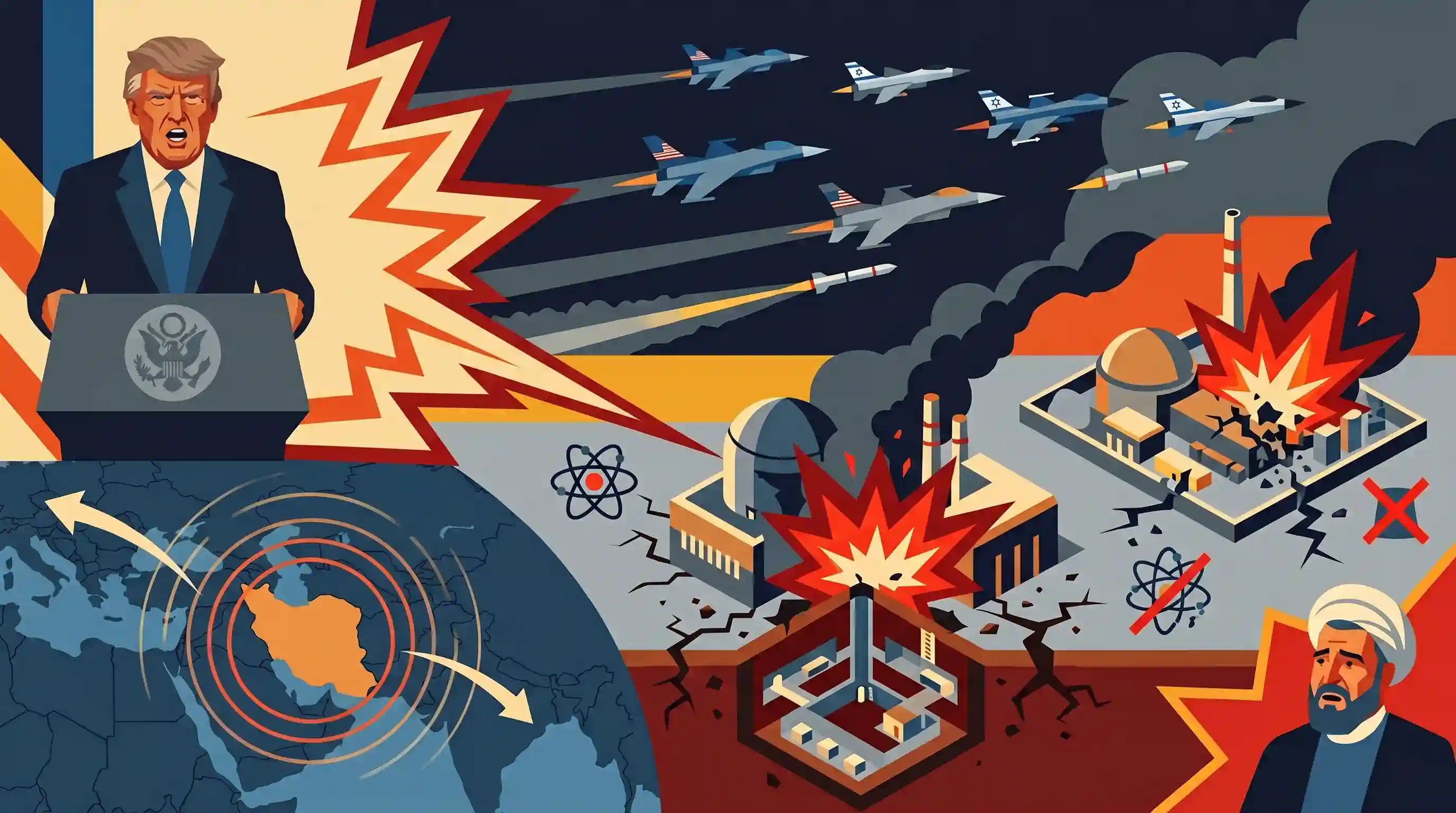
US President Donald Trump declared that unprecedented joint US-Israeli air strikes have successfully destroyed Iran's primary nuclear enrichment sites, specifically targeting Fordo, Natanz, and Isfahan. The strikes were executed to permanently neutralize Iran's ability to construct nuclear weapons. Amidst the destruction, Trump warned of additional military actions should Iran seek retaliation, marking a severe escalation in Middle Eastern conflicts with profound implications for global security and geopolitical stability.
Key Points
- US President Donald Trump announced that joint US-Israeli air strikes have obliterated Iran's main nuclear enrichment facilities.
- The targeted sites include crucial nuclear infrastructure located at Fordo, Natanz, and Isfahan.
- The explicit goal of the military action was to eliminate Iran's capacity to develop nuclear weapons.
- Trump issued a warning of further strikes if Iran retaliates, significantly escalating geopolitical tensions in the Middle East.
Important Terms
Breakout Time

The time required for a country to produce enough weapons-grade fissile material (90% U-235) for one nuclear weapon. It measures the proximity to nuclear weaponization capability.
UPSC context
GS Paper II (International Relations); tests understanding of nuclear proliferation risks and the effectiveness of international safeguards or military interventions.
Strait of Hormuz
A critical maritime chokepoint between the Persian Gulf and the Gulf of Oman, through which approximately 20% of global oil consumption passes daily.
UPSC context
GS Paper I (World Geography) and GS II (Geopolitics); vital for understanding global energy security and regional trade stability.
International Atomic Energy Agency (IAEA)
An autonomous international organization within the UN system that promotes peaceful nuclear energy and inspects facilities to prevent the diversion of nuclear material for weapons.
UPSC context
GS Paper II (International Institutions); essential for questions on global governance and nuclear non-proliferation frameworks.
Highly Enriched Uranium (HEU)
Uranium enriched to 20% or higher U-235. Weapons-grade uranium typically requires 90% enrichment, but 60% enrichment (as reported in Iran) is a significant threshold.
UPSC context
GS Paper III (Science and Tech/Internal Security); relates to nuclear technology and the technical benchmarks of weaponization.
Natanz, Fordow, and Isfahan
Iran's three primary nuclear facilities: Natanz (pilot enrichment), Fordow (hardened underground enrichment), and Isfahan (nuclear research and technology center for fuel production).
UPSC context
GS Paper I (Places in News); critical for understanding the geography of West Asian conflict and the technical layout of Iran's nuclear program.
Prelims Trap
"Uranium enriched to 20% U-235 is considered weapons-grade and is sufficient to construct a nuclear bomb."
Weapons-grade uranium requires approximately 90% U-235 enrichment. 20% enrichment is classified as Highly Enriched Uranium (HEU) but is primarily used for research reactors, not viable weapons.
Static Concepts Connected
What are the varying grades of Uranium enrichment?
- Natural Uranium: Contains about 0.7% of the fissile U-235 isotope, requiring heavy water reactors (like India's PHWRs) to sustain a chain reaction without enrichment.
- Low-Enriched (LEU): Enriched to 3-5% U-235; primarily used to fuel commercial light-water civilian power reactors globally.
- Weapons-Grade: Enriched to roughly 90% U-235; strictly necessary to provide the critical mass for a viable nuclear weapon explosion.
What is the IAEA's mandate regarding nuclear non-proliferation?
- Organizational Status: An autonomous international organization (not a UN specialized agency) that reports to both the UN General Assembly and the Security Council.
- Safeguards System: Conducts physical inspections and material accounting to ensure civilian nuclear facilities are not secretly diverting fissile material for military uses.
- Additional Protocol: A voluntary agreement granting the IAEA expanded legal rights to investigate undeclared nuclear facilities and conduct short-notice or snap inspections.
Cross-Topic Patterns
Middle East conflict + Imported Inflation
Strikes on Iran risk spiking Brent crude prices, directly widening India's Current Account Deficit, inflating import bills, and putting downward pressure on the Rupee.
Places in News: West Asian Flashpoints
UPSC frequently tests exact locations of West Asian flashpoints. Fordo, Natanz, and Isfahan will likely appear in a 'Region/Country' matching format alongside Syrian or Yemeni sites.

A 2026 Prelims pairs-matching question on West Asian nuclear sites (Fordo, Natanz) or U-235 enrichment grades is highly likely.
Linked PYQs · 3
Linked PYQs · 3
- 2022PrelimsGS1
The term "Levant" often heard in the news roughly corresponds to which of the following regions?
- 2018MainsGS2
“India’s relations with Israel have, of late, acquired a depth and diversity, which cannot be rolled back.” Discuss.
- 2025MainsGS2
"Energy security constitutes the dominant kingpin of India's foreign policy, and is linked with India's overarching influence in Middle Eastern countries.” How would you integrate energy security with India's foreign policy trajectories in the coming years?
