US Iran Sanctions and Strategic Energy Security Chokepoints
Source:Indian Express ↗
Why It Matters
The aggressive US-Israel posture against Iran and the threatened closure of the Strait of Hormuz directly impact global oil prices and supply chain stability. For India, these developments are critical for its energy security framework, as West Asia remains a primary source of crude oil imports. The situation highlights the cascading effects of great-power politics on regional stability.
Summary
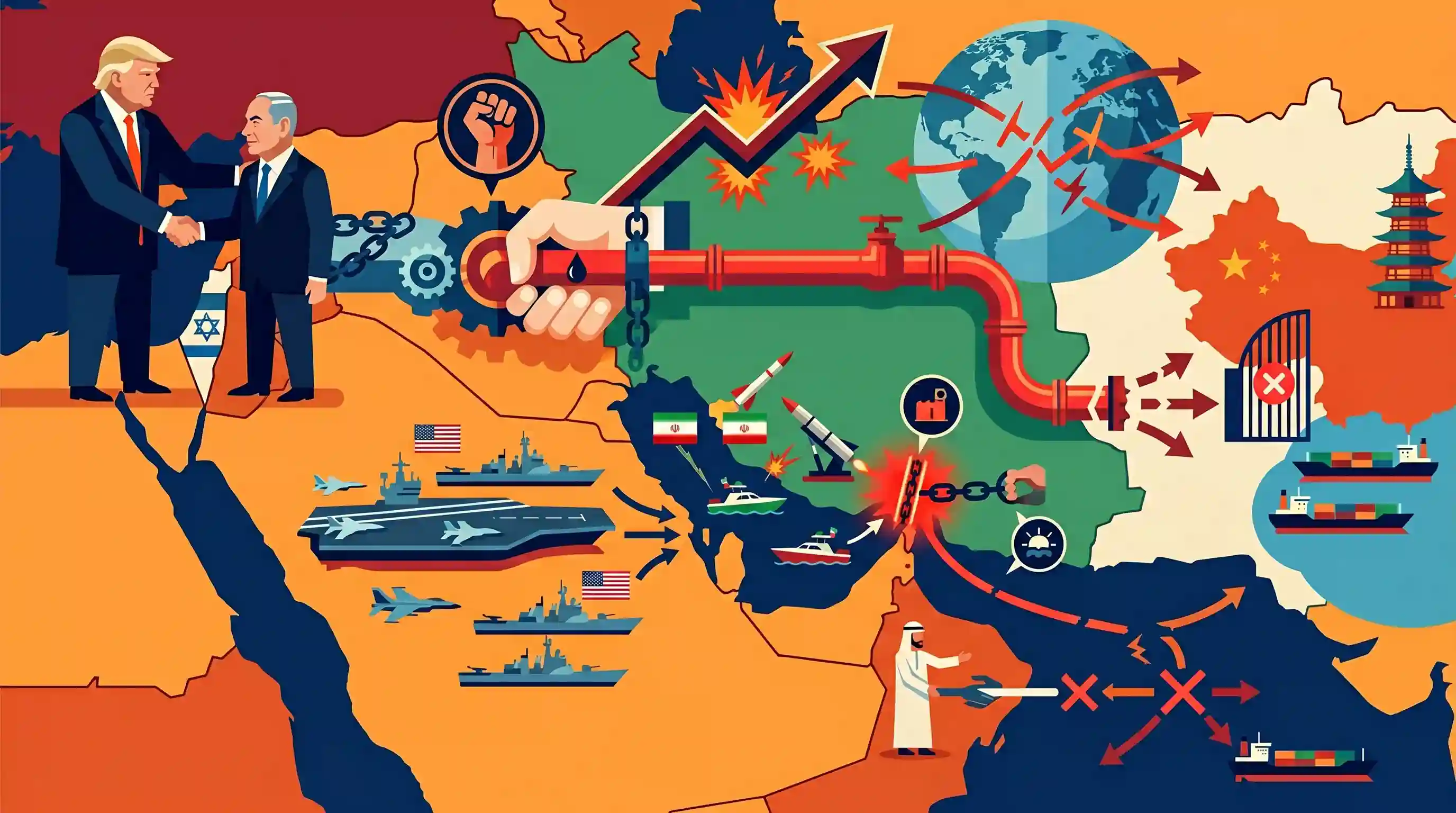
US President Donald Trump and Israeli PM Benjamin Netanyahu have agreed to escalate a 'maximum pressure' campaign against Iran, specifically aiming to cut off its crucial oil exports to China, which constitute over 80% of Iranian oil sales. Amidst stalled diplomatic talks mediated by Oman, the geopolitical situation in West Asia has intensified, characterized by the US deploying a naval flotilla and Iran threatening to block the Strait of Hormuz. The standoff threatens to disrupt global energy markets and heightens the risk of conflict in a vital maritime chokepoint.
Key Points
- US President Donald Trump and Israeli PM Benjamin Netanyahu agreed to aggressively target Iran's oil exports, specifically focusing on sales to China.
- China currently accounts for more than 80% of Iran's oil exports, making it a critical lifeline for the Iranian economy.
- The escalation comes despite recent diplomatic efforts between US and Iranian officials mediated by Oman to revive nuclear talks.
- The US has positioned a naval flotilla in the region, while Iran has threatened to retaliate by closing the Strait of Hormuz, a critical global oil chokepoint.
Important Terms
Maximum Pressure Campaign

A U.S. foreign policy strategy using crippling economic sanctions and diplomatic isolation to force Iran to renegotiate its nuclear program, ballistic missile development, and regional activities.
UPSC context
GS Paper II (International Relations); tests understanding of coercive diplomacy and U.S.-West Asia dynamics.
Strait of Hormuz
The world's most critical oil chokepoint, a narrow waterway between Oman and Iran connecting the Persian Gulf with the Gulf of Oman and the Arabian Sea.
UPSC context
GS Paper I (Geography) and GS II (IR); vital for mapping and India's energy security.
Maritime Chokepoints
Narrow, strategic sea passages (like straits or canals) where global shipping traffic is concentrated, making them highly vulnerable to blockades or geopolitical disruptions.
UPSC context
GS Paper I/II/III; relates to global trade routes, maritime security, and supply chain resilience.
Energy Security
The uninterrupted availability of energy sources at an affordable price, ensuring that a nation's economic growth and strategic autonomy are not compromised by supply disruptions.
UPSC context
GS Paper III (Economy/Environment); crucial for understanding India's import dependence and transition to self-reliance.
Economic Sanctions
Non-military measures, such as trade barriers or asset freezes, imposed by countries to pressure a target state to change its political or military behavior.
UPSC context
GS Paper II (International Relations); tests knowledge of foreign policy tools and their global economic impact.
Prelims Trap
The 'Maximum Pressure' campaign is a UN-mandated international sanction regime against Iran.
The 'Maximum Pressure' campaign is driven entirely by unilateral US secondary sanctions, not the UN. UN nuclear sanctions were largely lifted under the 2015 JCPOA.
Static Concepts Connected
What are the key maritime chokepoints in West Asia?
- Strait of Hormuz: Connects the Persian Gulf to the Gulf of Oman and Arabian Sea. It is bordered by Iran, Oman (Musandam Peninsula), and the UAE.
- Bab el-Mandeb: Connects the Red Sea to the Gulf of Aden. It is bordered by Yemen on the Arabian Peninsula, and Djibouti and Eritrea in the Horn of Africa.
How do US 'secondary sanctions' operate against third-party nations?
- Mechanism: They target non-US entities (like Indian banks or oil PSUs) doing business with sanctioned nations, threatening to block their access to the US dollar and American financial system.
- Impact on India: Forces import-dependent nations to halt cheaper oil imports to avoid global financial exclusion, directly impacting domestic inflation, current account deficits, and energy security.
Cross-Topic Patterns
Sanctions and De-dollarization
Aggressive US secondary sanctions on Iran compel third-party nations to explore non-dollar trade settlements (like rupee-rial) and bolster alternative financial architectures within BRICS.
China's Strategic Vacuum Filling
By absorbing 80% of Iran's sanctioned oil, China secures cheap energy while deepening its geopolitical leverage in West Asia, recently demonstrated by its brokering of the Iran-Saudi detente.

Map questions on the Strait of Hormuz paired with secondary sanctions' impact on India's energy security are highly probable in 2026.
Linked PYQs · 3
Linked PYQs · 3
- 2025MainsGS2
"Energy security constitutes the dominant kingpin of India's foreign policy, and is linked with India's overarching influence in Middle Eastern countries.” How would you integrate energy security with India's foreign policy trajectories in the coming years?
- 2017MainsGS2
The question of India's Energy Security constitutes the most important part of India's economic progress. Analyze India's energy policy cooperation with West Asian countries.
- 2018MainsGS2
“India’s relations with Israel have, of late, acquired a depth and diversity, which cannot be rolled back.” Discuss.
