Strait of Hormuz Crisis and Geopolitical Impacts on Oil Prices
Source:Indian Express ↗
Why It Matters
The Strait of Hormuz is a vital artery for global oil supplies; any disruption directly impacts India's energy security and inflation. Furthermore, shifting US perspectives on NATO and Middle Eastern diplomacy profoundly influence the broader global security architecture that India must navigate.
Summary
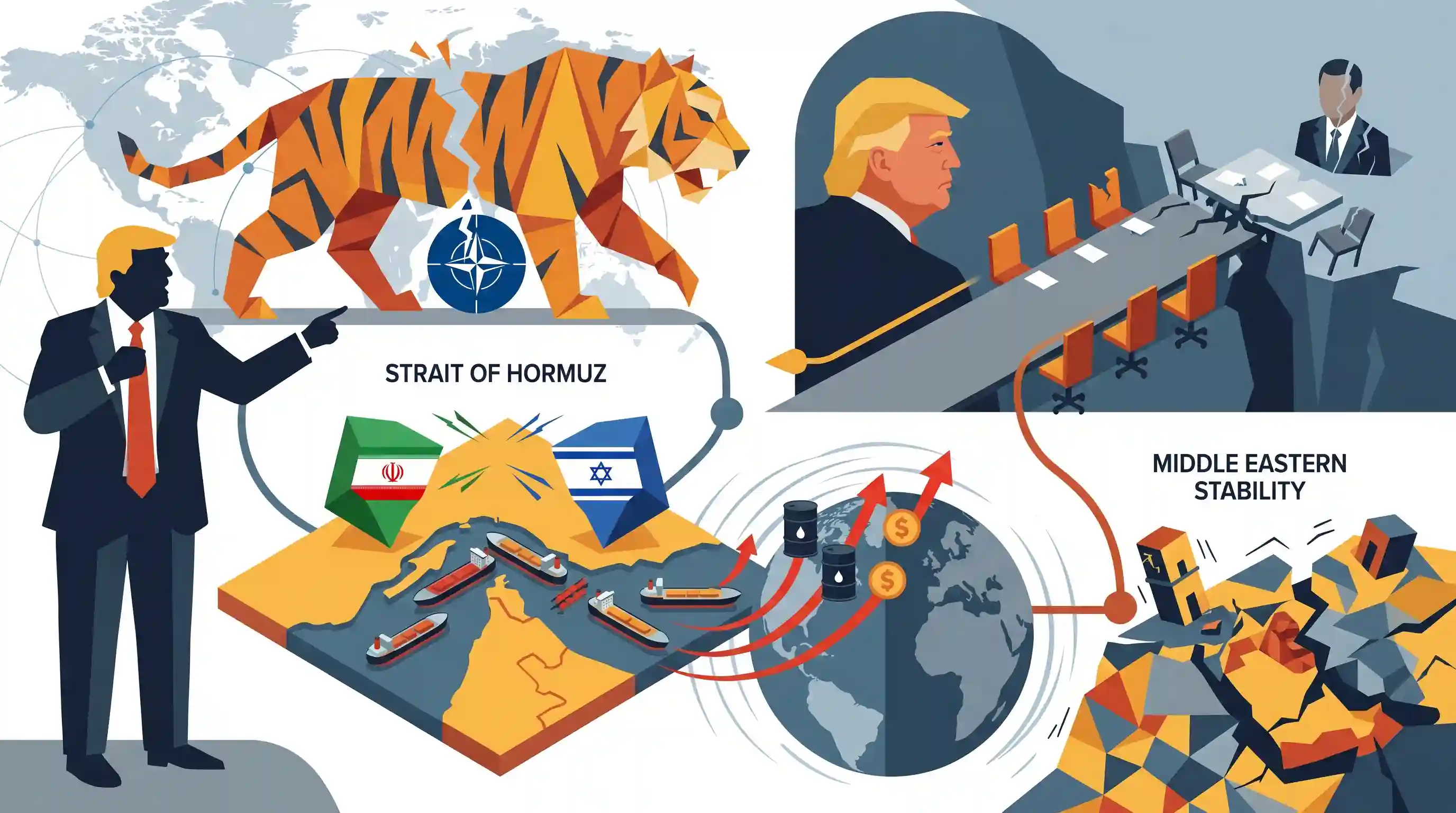
Former US President Donald Trump criticized NATO, labeling it a "paper tiger" for its perceived inaction regarding the crisis in the Strait of Hormuz amid escalating tensions between Iran and Israel. He emphasized the severe implications of the regional logjam on global oil prices and energy security. Furthermore, Trump expressed frustration over the lack of diplomatic avenues with Iran, claiming there are "no leaders left to talk to" as the conflict continues to threaten broader Middle Eastern stability.
Key Points
- Donald Trump heavily criticized NATO's handling of the Middle East crisis, labeling the military alliance a "paper tiger" and implying it fails to effectively secure global maritime routes.
- The escalating conflict between Iran and Israel threatens to create a logjam in the Strait of Hormuz, a critical maritime chokepoint, raising severe concerns over surging global oil prices and energy security.
- Trump highlighted a diplomatic vacuum in Tehran, asserting that there are "no leaders left to talk to" as the geopolitical standoff deepens.
- The situation underscores the vulnerability of international energy supply chains to Middle Eastern instability and signals potential shifts in US foreign policy and alliance burden-sharing under a future Trump administration.
Important Terms
Strait of Hormuz

A narrow, strategically vital waterway connecting the Persian Gulf to the Gulf of Oman. It is the world's most critical oil transit point, handling ~20% of global petroleum consumption.
UPSC context
GS Paper 1 (Geography) & GS Paper 2 (International Relations); critical for India’s energy security as ~70% of its oil imports transit this route.
NATO (North Atlantic Treaty Organization)
An intergovernmental military alliance established by the 1949 Washington Treaty. It operates on the principle of collective defense (Article 5), where an attack on one member is considered an attack on all.
UPSC context
GS Paper 2 (International Relations); global security architecture and groupings affecting India's interests.
Maritime Chokepoint
A narrow, geographically constrained sea route through which large volumes of global trade pass. Disruption at these points can cause cascading shocks to global supply chains and energy markets.
UPSC context
GS Paper 3 (Economy/Internal Security); tests understanding of global trade vulnerabilities and maritime security.
Energy Security
The uninterrupted availability of energy sources at an affordable price. It involves diversifying energy sources and securing maritime routes to prevent supply disruptions and price volatility.
UPSC context
GS Paper 3 (Infrastructure/Energy); a pillar of India's economic stability and strategic autonomy.
Paper Tiger
A metaphorical term (originating from the Chinese 'zhilaohu') describing a person, nation, or organization that appears powerful or threatening but is actually weak or ineffectual when challenged.
UPSC context
GS Paper 2 (International Relations); relevant to diplomatic rhetoric and the analysis of perceived weaknesses in international alliances.
Prelims Trap
The Strait of Hormuz connects the Red Sea to the Arabian Sea and is bordered by Iran and Saudi Arabia.
Aspirants confuse Middle Eastern straits. Hormuz connects the Persian Gulf to the Gulf of Oman, and is bordered by Iran and Oman, not Saudi Arabia. Bab el-Mandeb connects the Red Sea.
Static Concepts Connected
What are the primary global maritime chokepoints for energy transit?
- Strait of Hormuz: Connects the Persian Gulf to the Gulf of Oman, handling approx 20% of global oil consumption. Bordered by Iran and Oman.
- Bab el-Mandeb: Connects the Red Sea to the Gulf of Aden and Arabian Sea. Critical for Europe-Asia trade via the Suez Canal.
- Strait of Malacca: Connects the Indian Ocean to the South China Sea, serving as the primary energy artery for East Asian economies.
How do global oil supply shocks affect India's macroeconomic indicators?
- Widening CAD: A higher crude import bill directly increases India's Current Account Deficit (CAD), straining foreign exchange reserves.
- Imported Inflation: Elevated fuel costs cascade into higher freight and production costs, driving up retail inflation across sectors.
- Currency Depreciation: Increased demand for US dollars to pay for expensive oil imports leads to the depreciation of the Indian Rupee.
Cross-Topic Patterns
Hormuz vulnerability + INSTC strategic value
Disruptions in the Strait of Hormuz amplify the strategic value of the International North-South Transport Corridor (INSTC) and Chabahar port for securing alternative, resilient trade routes.
West Asia polarization + India's de-hyphenation
Escalating direct Iran-Israel conflicts test India's de-hyphenation policy, forcing a delicate balance between Israeli defense technology ties and Iranian connectivity imperatives.

Expect a paired-mapping Prelims question linking Middle Eastern maritime chokepoints (Hormuz, Bab el-Mandeb) with bordering nations.
Linked PYQs · 3
Linked PYQs · 3
- 2023MainsGS2
‘The expansion and strengthening of NATO and a stronger US-Europe strategic partnership works well for India.’ What is your opinion about this statement ? Give reasons and examples to support your answer.
- 2025MainsGS2
"Energy security constitutes the dominant kingpin of India's foreign policy, and is linked with India's overarching influence in Middle Eastern countries.” How would you integrate energy security with India's foreign policy trajectories in the coming years?
- 2024PrelimsGS1
Consider the following statements : Statement-I : Sumed pipeline is a strategic route for Persian Gulf oil and natural gas shipments to Europe. Statement-II : Sumed pipeline connects the Red Sea with the Mediterranean Sea. Which one of the following is correct in respect of the above statements?
