US Iran Conflict Escalation and Middle East Security Dynamics
Source:Indian Express ↗
Why It Matters
The escalation of conflict between the US and Iran directly impacts the geopolitical stability of the Middle East, a region critical for global energy security and trade. Understanding these dynamics is crucial for evaluating India's foreign policy, diaspora safety, and energy security strategies in West Asia.
Summary
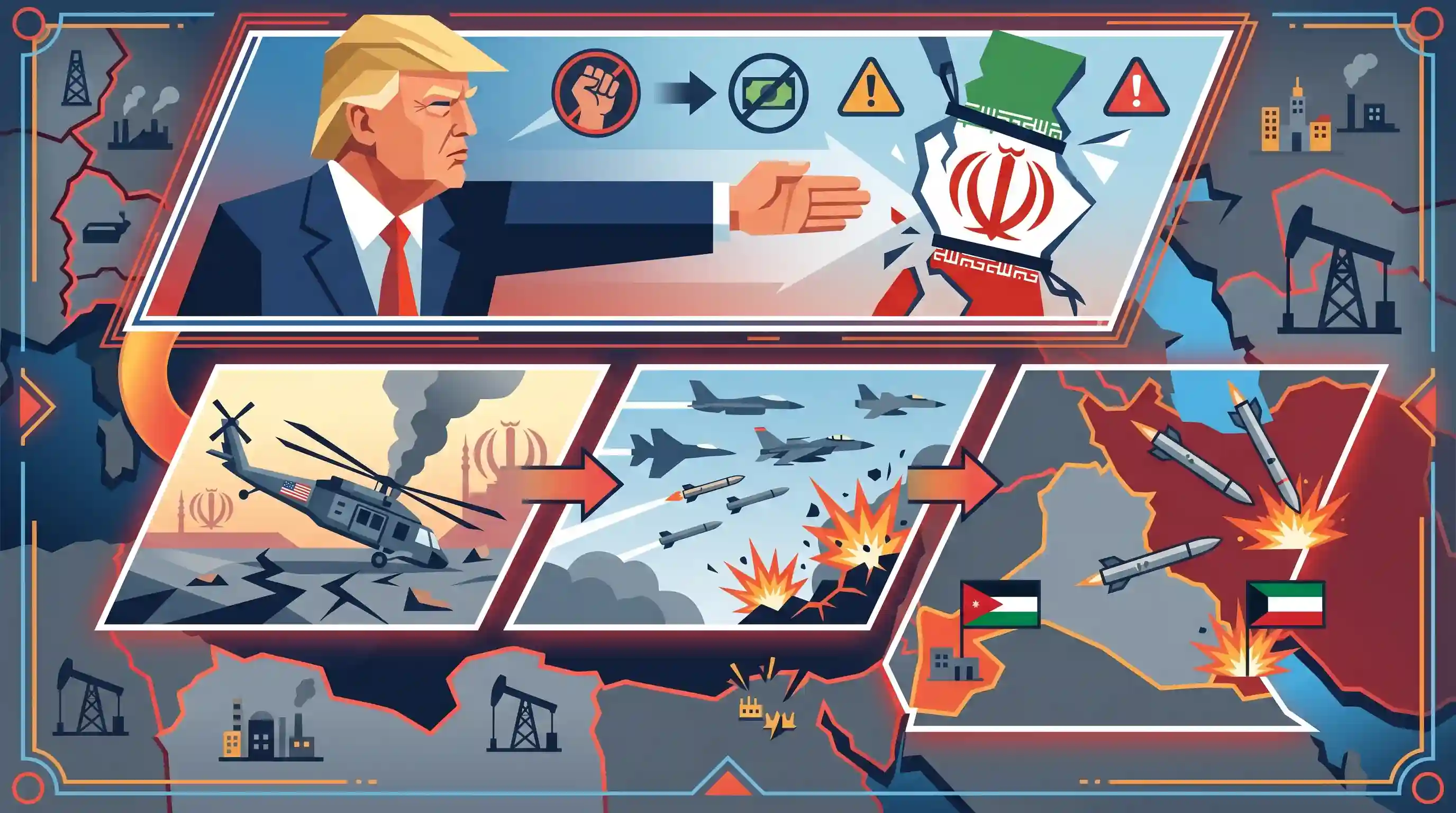
Former US President Donald Trump issued a severe warning to Iran following US retaliatory strikes on Tehran, which were triggered by a US Army helicopter crash he attributed to Iranian actions. The conflict escalated further as Iran retaliated by attacking regional nations, including Jordan and Kuwait. Trump asserted that the Iranian military is defeated and warned that Iran will 'pay the price' for its actions, signaling a major intensification of geopolitical tensions in the Middle East.
Key Points
- US President Donald Trump issued a stern warning to Iran following retaliatory US strikes on Tehran.
- The US strikes were triggered by a US Army helicopter crash, which Trump blamed on Iran.
- In retaliation, Iran launched attacks on regional countries, including Jordan and Kuwait, significantly escalating tensions.
- Trump declared the Iranian military 'completely defeated' and stated that the 'Bully of the Middle East is dead'.
Important Terms
West Asia

A neutral, geographically accurate term for the Middle East region. It includes major energy producers like Iran, Saudi Arabia, and the UAE.
UPSC context
GS Paper 2: International Relations; critical for India's energy security, diaspora welfare, and 'Look West' policy.
Strait of Hormuz
A strategic maritime chokepoint between the Persian Gulf and Gulf of Oman. It is the transit route for 20% of the world's oil supply.
UPSC context
GS Paper 1 (Geography) and GS Paper 3 (Energy Security); tests knowledge of global trade arteries.
Maximum Pressure Policy
A US foreign policy strategy using aggressive economic sanctions and military posturing to force Iran to renegotiate its nuclear and regional activities.
UPSC context
GS Paper 2: Effect of policies of developed countries on India's interests and strategic autonomy.
US Central Command (CENTCOM)
The US military's unified combatant command responsible for operations in the Middle East, Central Asia, and parts of South Asia.
UPSC context
GS Paper 3: Regional security and strategic environment; its actions directly impact stability in India's extended neighborhood.
Proportional Response
A legal principle requiring that military force used in retaliation must be commensurate with the injury received or the threat posed.
UPSC context
GS Paper 2 & 4: International Law and Ethics; relevant for analyzing the legality of 'self-defense' strikes.
US-Iran Relations
The complex geopolitical dynamic between Washington and Tehran, characterized by nuclear disputes, sanctions, and proxy conflicts.
UPSC context
GS Paper 2: Bilateral relations; impacts India's connectivity projects like Chabahar and its regional energy balance.
Operation Epic Fury
The 2026 US military operation launched against Iran following regional escalations and the downing of a US Army helicopter.
UPSC context
GS Paper 2: Contemporary international events; serves as a case study for conflict escalation and regional warfare.
Prelims Trap
"Jordan, as part of the Levant region, shares a strategic coastline with the Mediterranean Sea."
Jordan is almost completely landlocked. Its only maritime access is a narrow outlet to the Gulf of Aqaba (Red Sea), not the Mediterranean Sea.
Static Concepts Connected
What are the key geographical features and chokepoints of the Persian Gulf?
- Strait of Hormuz: It acts as the sole sea passage from the Persian Gulf to the open ocean, bordered by Iran to the north and Oman/UAE to the south.
- Littoral States: Eight countries share the Persian Gulf coastline: Iran, Iraq, Kuwait, Saudi Arabia, Bahrain, Qatar, UAE, and Oman.
- Kuwait's Borders: Kuwait is strategically located at the northern tip of the Gulf, sharing land boundaries exclusively with Iraq and Saudi Arabia, not Iran.
How do geopolitical oil supply shocks affect India's macroeconomic stability?
- Widening CAD: An inflated import bill for crude oil directly widens the Current Account Deficit (CAD), putting downward pressure on the Rupee.
- Imported Inflation: Elevated global fuel prices increase domestic transport and production costs, which cascades into broader retail (CPI) inflation.
- Fiscal Strain: The government may cut excise duties on petroleum to shield retail consumers, thereby reducing tax revenues and straining the fiscal deficit.
Cross-Topic Patterns
INSTC & Central Asia Access
Escalation involving Iran jeopardizes the viability of Chabahar Port, stalling India's strategic, non-Pakistan transit route to Afghanistan and the Central Asian Republics via the INSTC.
Diaspora & Evacuation Operations
Conflict in nations like Kuwait triggers immediate concerns for the Indian expatriate workforce, potentially necessitating complex naval/air evacuation protocols akin to Operations Rahat and Ajay.

Expect a multi-statement Prelims question mixing Persian Gulf littoral geography with the macroeconomic effects of imported inflation.
Linked PYQs · 4
Linked PYQs · 4
- 2017PrelimsGS1
Mediterranean Sea is a border of which of the following countries? 1. Jordan 2. Iraq 3. Lebanon 4. Syria Select the correct answer using the code given below:
- 2003PrelimsGS1
Israel has common borders with
- 2025PrelimsGS1
With reference to India's defence, consider the following pairs : Aircraft type Description I. Dornier-228 : Maritime patrol aircraft II. IL-76 : Supersonic combat aircraft III. C-17 Globemaster III : Military transport aircraft How many of the pairs given above are correctly matched?
- 2025MainsGS2
"The reform process in the United Nations remains unresolved, because of the delicate imbalance of East and West and entanglement of the USA vs. Russo-Chinese alliance.” Examine and critically evaluate the East-West policy confrontations in this regard.
