Strait of Hormuz Control in US Iran Negotiations
Source:Indian Express ↗
Why It Matters
The Strait of Hormuz is a critical global chokepoint for crude oil transit. Any disruption or change in its control directly impacts global energy security, including India's. Furthermore, the evolving dynamics involving the US, Iran, China, and Pakistan reflect significant geopolitical shifts in West Asia that can affect regional stability and Indian interests.
Summary
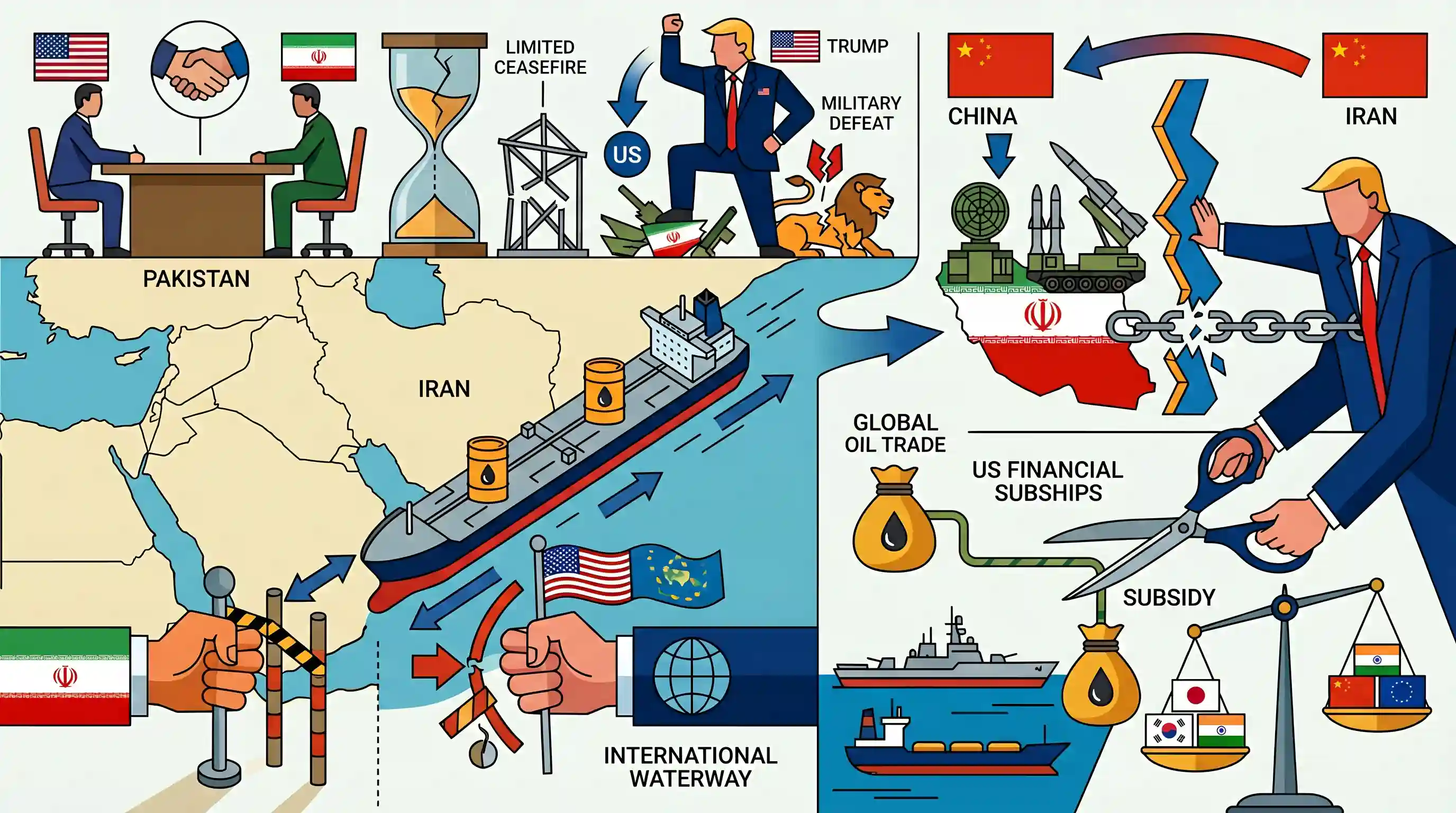
US President Donald Trump revealed that the US and Iran are engaging in peace negotiations in Pakistan under a fragile two-week ceasefire. Claiming that the US has "militarily defeated" Iran, Trump asserted that he remains indifferent to the outcome of the talks, emphasizing America's dominant position. A major point of contention is the control over the Strait of Hormuz, a critical chokepoint for global oil trade. While Iran seeks partial control over the strait, the US insists it must remain an international waterway. Furthermore, Trump issued a stern warning to China against supplying air defense systems to Iran, threatening a complete rupture in US-China relations. He also indicated support for Vice President JD Vance's proposal that the US should stop subsidizing the security of maritime trade routes, suggesting that countries benefiting from US protection in the Strait of Hormuz should bear the costs.
Key Points
- Peace negotiations between the US and Iran are currently taking place in Pakistan during a fragile two-week ceasefire.
- Control over the Strait of Hormuz has emerged as a major sticking point, with the US strictly rejecting Iranian demands for partial control over the vital global oil route.
- President Trump issued a strong warning to China, threatening severe consequences if Beijing supplies air defense systems or nuclear assistance to Tehran.
- The US administration hinted at a shift in maritime security policy, suggesting that countries relying on US protection for shipping in the Strait of Hormuz should pay for it.
Prelims Trap
"The Strait of Hormuz is an international waterway located entirely outside the territorial jurisdiction of any state."
Hormuz is not "international waters"; its narrowest points fall entirely within the territorial waters of Iran and Oman. Ships navigate it using the UNCLOS right of "transit passage."
Static Concepts Connected
What is the right of 'Transit Passage' under UNCLOS?
- Definition: Freedom of navigation solely for continuous and expeditious transit through an international strait connecting high seas or EEZs.
- Military vessels: Unlike 'innocent passage', submarines are allowed to transit submerged, and military aircraft retain overflight rights.
- Coastal State limits: Bordering states (like Iran/Oman) retain sovereignty over the waters but cannot legally suspend or impede transit passage.
What are the key maritime chokepoints of the Middle East?
- Strait of Hormuz: Connects the Persian Gulf to the Gulf of Oman and the Arabian Sea. Crucial for global oil flows.
- Bab-el-Mandeb: Connects the Red Sea to the Gulf of Aden and the Arabian Sea. Gateway to the Suez Canal.
- Suez Canal: Artificial waterway connecting the Mediterranean Sea to the Red Sea, bypassing the Cape of Good Hope.
Cross-Topic Patterns
US maritime withdrawal & Indian Navy's role
If the US transitions to a 'user pays' maritime model, India's independent naval deployments (like Operation Sankalp) and its role as a net security provider in the IOR become critical for energy security.
Pakistan's renewed diplomatic leveraging
Pakistan hosting US-Iran talks mirrors its historic Cold War utility (as a bridge to China), potentially revitalizing its geopolitical relevance and complicating India's strategy to diplomatically isolate Islamabad.

Expect a 2026 Prelims map question on West Asian straits, or a GS2 Mains question on India's energy security amid US maritime withdrawal.
Linked PYQs · 2
Linked PYQs · 2
- 2025MainsGS2
"Energy security constitutes the dominant kingpin of India's foreign policy, and is linked with India's overarching influence in Middle Eastern countries.” How would you integrate energy security with India's foreign policy trajectories in the coming years?
- 2017MainsGS2
The question of India's Energy Security constitutes the most important part of India's economic progress. Analyze India's energy policy cooperation with West Asian countries.
