US-Iran Escalation and Strait of Hormuz Energy Supply Risk
Source:Indian Express ↗
Why It Matters
The Strait of Hormuz is a critical global maritime chokepoint. Its closure and the escalating US-Iran conflict directly threaten global energy security, oil prices, and supply chains, posing severe economic and strategic challenges for energy-importing nations like India.
Summary
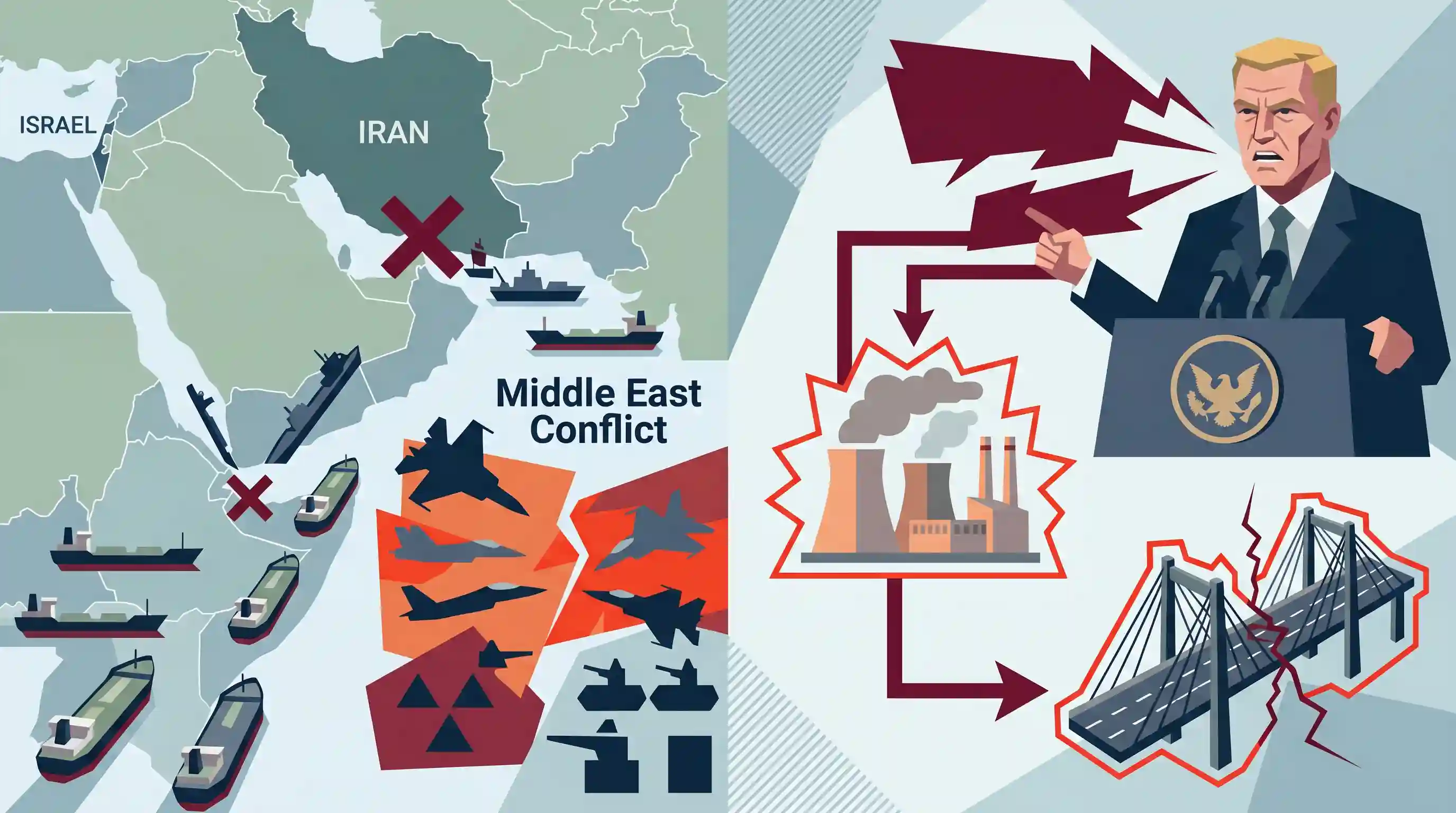
US President Donald Trump has issued a severe, expletive-laden ultimatum to Iran, threatening to target the nation's power plants and bridges if the Strait of Hormuz is not reopened by Tuesday morning. The critical maritime chokepoint, responsible for a fifth of global oil shipments, has been closed since a war erupted between the US, Israel, and Iran in late February. The closure has significantly escalated regional tensions and disrupted global energy supply chains.
Key Points
- US President Donald Trump issued a strict ultimatum to Iran, demanding the reopening of the Strait of Hormuz by 6 AM Tuesday.
- Trump threatened widespread destruction of Iran's infrastructure, specifically targeting power plants and bridges, referring to the deadline as 'Power Plant Day'.
- The Strait of Hormuz has been closed following the outbreak of war between the US-Israel coalition and Iran on February 28.
- The closure of the Strait, which accounts for approximately 20% of global oil passage, represents a massive disruption to global energy security and shipping routes.
Prelims Trap
The Strait of Hormuz connects the Persian Gulf to the Red Sea and is bordered by Iran and Saudi Arabia.
It connects the Persian Gulf to the Gulf of Oman/Arabian Sea. Crucially, it is bordered by Iran and Oman (Musandam exclave), not Saudi Arabia or UAE.
Static Concepts Connected
What are the key maritime chokepoints in the Middle East?
- Strait of Hormuz: Connects the Persian Gulf to the Gulf of Oman and Arabian Sea. Bordered by Iran and Oman.
- Bab el-Mandeb: Connects the Red Sea to the Gulf of Aden and Arabian Sea. Bordered by Yemen, Djibouti, and Eritrea.
- Suez Canal: An artificial sea-level waterway in Egypt connecting the Mediterranean Sea to the Red Sea.
How does India mitigate macroeconomic shocks from crude oil supply disruptions?
- Strategic Petroleum Reserves: India maintains underground rock caverns in Visakhapatnam, Mangaluru, and Padur to hold emergency crude oil reserves.
- ISPRL Management: The Indian Strategic Petroleum Reserves Limited (ISPRL) manages these facilities under the Ministry of Petroleum and Natural Gas.
- Import Diversification: Increasing sourcing from Russia, the Americas, and Africa to reduce overwhelming dependency on the Middle East.
Cross-Topic Patterns
Chokepoint blockades & imported inflation
A prolonged Strait of Hormuz closure directly triggers imported inflation in India, widening the Current Account Deficit (CAD) and depreciating the Rupee due to higher crude prices.
UNCLOS transit passage vs. blockades
Blockades of strategic straits raise UNCLOS debates over the right of "transit passage" for foreign vessels, a theme that mirrors ongoing navigational disputes in the South China Sea.

Expect Prelims pair-matching questions linking Middle Eastern chokepoints (Hormuz, Bab el-Mandeb) to bordering nations and connected seas.
Linked PYQs · 3
Linked PYQs · 3
- 2025MainsGS2
"Energy security constitutes the dominant kingpin of India's foreign policy, and is linked with India's overarching influence in Middle Eastern countries.” How would you integrate energy security with India's foreign policy trajectories in the coming years?
- 2024PrelimsGS1
Consider the following statements : Statement-I : Sumed pipeline is a strategic route for Persian Gulf oil and natural gas shipments to Europe. Statement-II : Sumed pipeline connects the Red Sea with the Mediterranean Sea. Which one of the following is correct in respect of the above statements?
- 2024MainsGS2
Discuss the geopolitical and geostrategic importance of Maldives for India with a focus on global trade and energy flows. Further also discuss how this relationship affects India's maritime security and regional stability amidst international competition ?
