Donald Trump rejects lifting Iranian sanctions upfront for peace deal
Source:Indian Express ↗
Why It Matters
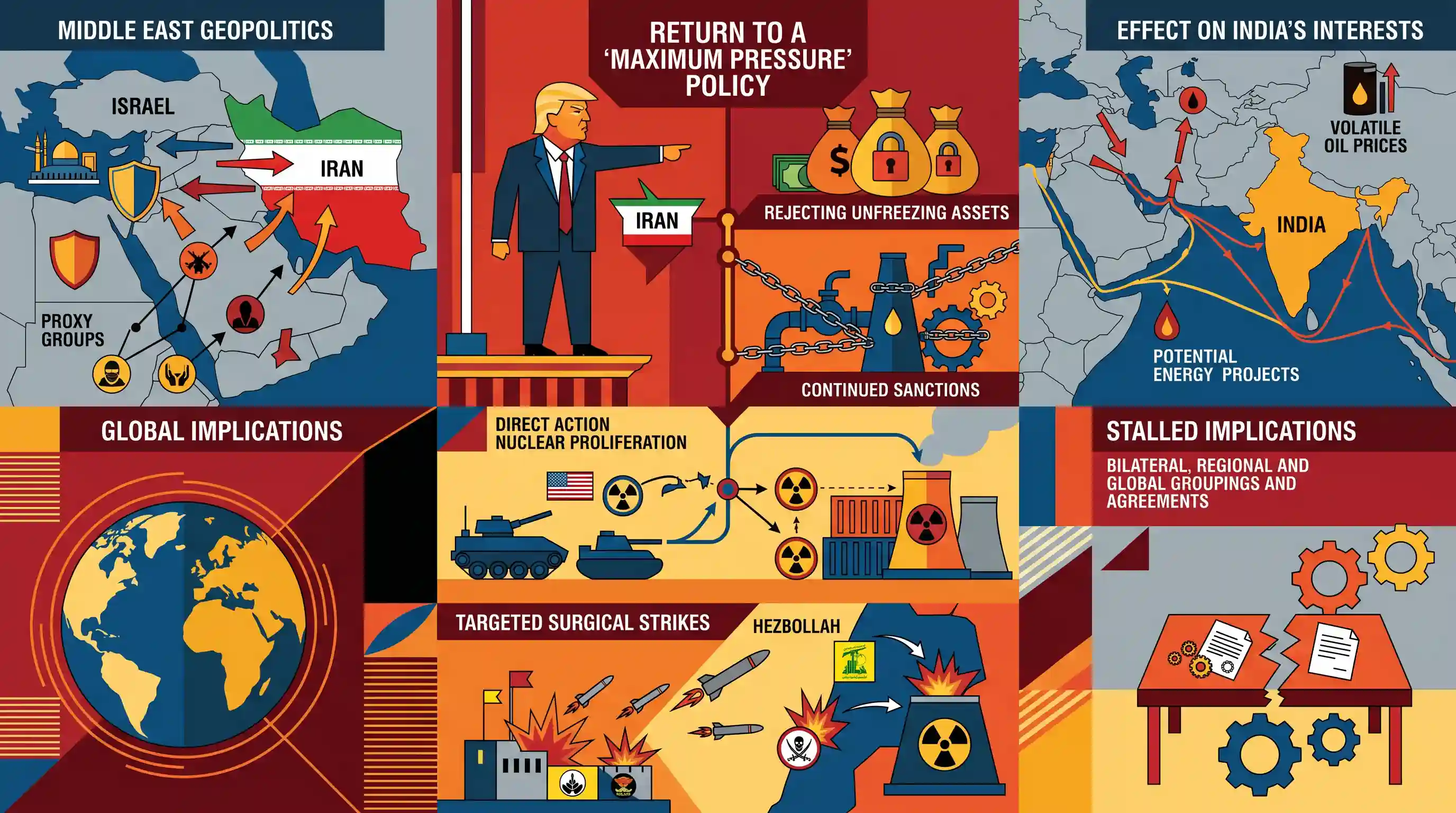
The US 'maximum pressure' strategy on Iran and its stance on Middle Eastern proxy conflicts directly impact global energy security, regional stability, and India's strategic balancing act between the US, Israel, and Iran (including interests like the Chabahar port).
Summary
President-elect Donald Trump has firmly rejected the idea of unfreezing Iranian assets or lifting economic sanctions upfront to secure a peace deal. In a recent interview, he emphasized a hardline approach, stating that the US intends to seize and destroy Iran's growing stockpile of highly enriched uranium to prevent nuclear proliferation. Furthermore, Trump advocated for continued and targeted 'surgical' strikes against the Iran-backed militant group Hezbollah in Lebanon. These statements indicate a return to a 'maximum pressure' campaign, carrying significant implications for Middle Eastern stability, the stalled nuclear negotiations, and ongoing proxy conflicts involving Israel and Iran.
Key Points
- President-elect Donald Trump rejected unfreezing Iranian assets or lifting sanctions upfront as a precondition for any peace deal.
- Trump's administration plans to seize and destroy Iran's stockpile of highly enriched uranium, which currently exceeds 400 kg.
- Trump encouraged more 'surgical' military strikes against Hezbollah, an Iran-backed militant group in Lebanon.
- The comments come amid escalating Middle East tensions, including recent Israeli airstrikes targeting Hezbollah infrastructure in Beirut.
Important Terms
Joint Comprehensive Plan of Action (JCPOA)

A 2015 multilateral agreement (P5+1 and Iran) to limit Iran's nuclear program in exchange for sanctions relief. The US withdrew in 2018, leading to current regional instability.
UPSC context
GS Paper II: International Relations; crucial for understanding Middle East diplomacy and India's strategic autonomy.
Maximum Pressure Campaign
The US policy of using aggressive economic sanctions and diplomatic isolation to force Iran to renegotiate its nuclear and ballistic missile programs.
UPSC context
GS Paper II: Effect of policies of developed countries on India's interests and energy security.
US Sanctions on Iran
Economic penalties targeting Iran's oil, banking, and shipping sectors. These often carry 'secondary' effects, penalizing third-party countries (like India) for doing business with Iran.
UPSC context
GS Paper II: Bilateral relations; impacts India’s energy imports and the Chabahar Port project.
Hezbollah
A Lebanon-based Shiite militant group and political party backed by Iran. It is a key player in the 'Axis of Resistance' against Israel and Western influence.
UPSC context
GS Paper II: International Relations; vital for studying regional conflicts and non-state actors in West Asia.
Highly Enriched Uranium (HEU)
Uranium containing 20% or more of the isotope U-235. While natural uranium has <1%, HEU is a critical threshold for developing nuclear weapons (90%+).
UPSC context
GS Paper III: Science & Technology and Internal Security; GS II: Nuclear non-proliferation.
Nuclear Proliferation
The spread of nuclear weapons, fissionable material, and weapons-applicable nuclear technology to nations not recognized as 'Nuclear Weapon States' by the NPT.
UPSC context
GS Paper II: Important International institutions and global security agreements.
Prelims Trap
Uranium enriched above 20% (Highly Enriched Uranium) is considered weapons-grade and directly usable in nuclear warheads.
This is a trap. While >20% U-235 is classified as Highly Enriched Uranium (HEU), true weapons-grade uranium requires approximately 90% enrichment. Iran's current stockpile is concerning but requires further enrichment.
Static Concepts Connected
What distinguishes Low Enriched, Highly Enriched, and Weapons-Grade Uranium?
- Isotope ratio: Enrichment artificially increases the concentration of the fissile U-235 isotope relative to the heavier, non-fissile U-238 isotope.
- LEU: Low-Enriched Uranium (3-5% U-235) is the standard fuel for commercial light-water nuclear power reactors.
- HEU & Weapons-Grade: HEU is enriched beyond 20%. Weapons-grade is a specific, highly refined subset of HEU requiring roughly 90% enrichment.
How do US secondary sanctions impact India's strategic and economic interests?
- Zero oil imports: India halted its Iranian crude oil imports in 2019 to avoid US financial penalties under mechanisms like CAATSA, forcing India to diversify energy sources.
- Chabahar bottlenecks: Though Chabahar port received a narrow US sanctions carve-out, broader financial restrictions deter private investors and heavy equipment suppliers.
Cross-Topic Patterns
Secondary Sanctions vs. INSTC Connectivity
Renewed 'maximum pressure' on Iran threatens the expansion of the International North-South Transport Corridor and Chabahar, complicating India's counter to China's BRI in Central Asia.
Asset Freezes and De-dollarization
The unilateral freezing of sovereign Iranian assets by the US reinforces the weaponization of the SWIFT financial system, accelerating UPSC mains discussions around de-dollarization and BRICS currency alternatives.

Expect a 2026 Prelims pairing of Middle East non-state actors (Hezbollah, Houthis) with their geographic bases and nuclear tech thresholds.
Linked PYQs · 4
Linked PYQs · 4
- 2018MainsGS2
In what ways would the ongoing US-Iran Nuclear Pact Controversy affect the national interest of India? How should India respond to this situation?
- 2012MainsGS2
How have the US sanctions against Iran affected India's bilateral relations with Iran?
- 2023PrelimsGS1
Consider the following statements: Statement-I: India, despite having uranium deposits, depends on coal for most of its electricity production. Statement-II: Uranium, enriched to the extent of at least 60%, is required for the production of electricity. Which one of the following is correct in respect of the above statements?
- 2018MainsGS2
“India’s relations with Israel have, of late, acquired a depth and diversity, which cannot be rolled back.” Discuss.
