Strait of Hormuz Reopening and Impact on Energy Security
Source:Indian Express ↗
Why It Matters
The Strait of Hormuz is a strategic chokepoint vital to global oil markets. Its status directly impacts India's energy security, crude oil prices, and overall macroeconomic stability. Furthermore, shifts in US-Iran relations significantly influence the geopolitical balance in West Asia, affecting India's diaspora and strategic investments in the region.
Summary
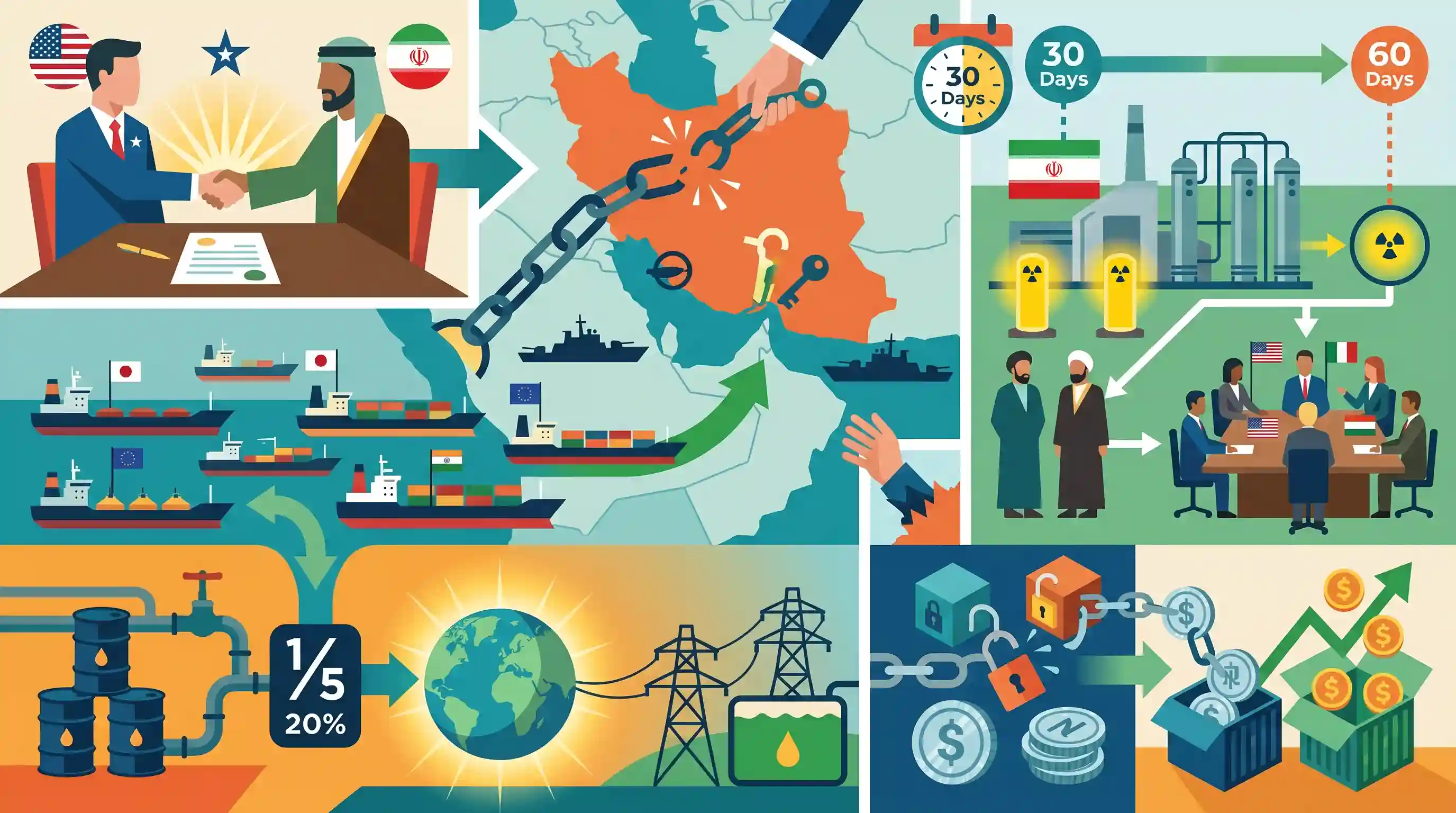
A potential US-Iran peace agreement currently under negotiation could lead to the reopening of the Strait of Hormuz, restoring commercial shipping to pre-war levels within 30 days. The proposed framework includes the US lifting its naval blockade on Iranian ports and unfreezing Tehran's assets through sanctions waivers. In exchange, further negotiations regarding Iran's enriched uranium stockpile would occur over the next 30 to 60 days. The Strait is a critical maritime chokepoint responsible for 20% of global oil shipments, making its reopening crucial for international energy security and freedom of navigation.
Key Points
- A potential US-Iran peace framework could reopen the Strait of Hormuz, aiming to restore commercial shipping to pre-war levels within 30 days.
- The Strait of Hormuz is a vital global maritime chokepoint, handling approximately 20% of the world's daily oil supply.
- Proposed deal conditions include the US lifting its naval blockade on Iranian ports and issuing sanctions waivers to unfreeze Iranian assets.
- In return, negotiations concerning the fate of Iran's enriched uranium stockpile would commence within a 30 to 60-day timeframe.
- The agreement touches upon freedom of navigation under international law, despite Iranian assertions of a legal right to manage the Strait for national security.
Important Terms
Strait of Hormuz

A narrow waterway between Iran and Oman connecting the Persian Gulf to the Gulf of Oman; it carries approximately 20% of global oil shipments.
UPSC context
GS-1 (Geography) and GS-2 (IR); tests strategic mapping and India’s energy security vulnerabilities in West Asia.
Maritime Chokepoint
A narrow, strategic geographical feature such as a strait or canal that acts as a vital bottleneck for global shipping and energy supplies.
UPSC context
GS-1 (Geography) and GS-3 (Security); tests understanding of global trade bottlenecks and maritime security threats.
Freedom of Navigation
An international legal principle, codified in UNCLOS, allowing ships to navigate and roam international waters freely without interference from coastal states.
UPSC context
GS-2 (International Relations); tests knowledge of UNCLOS and maritime law, particularly in disputed or strategic waters.
Sanctions Waivers
Legal exemptions issued by a government allowing specific countries or entities to conduct restricted trade (e.g., oil) with a sanctioned nation without penalty.
UPSC context
GS-2 (IR); tests the impact of US-Iran policies on India’s strategic autonomy and energy imports.
Enriched Uranium
Uranium in which the concentration of the fissile isotope U-235 has been increased for use in nuclear power (3-20%) or weapons (~90%).
UPSC context
GS-3 (Science & Tech); tests scientific literacy regarding the nuclear fuel cycle and proliferation concerns.
Naval Blockade
The use of maritime forces to prevent ships from entering or leaving a port or coast, typically to cut off trade or communication.
UPSC context
GS-2 (IR/Security); tests understanding of maritime conflict management and international trade disruptions.
Prelims Trap
Coastal states like Iran can legally suspend navigation through the Strait of Hormuz to protect national security.
The Strait of Hormuz is governed by the UNCLOS regime of "transit passage", not "innocent passage." Transit passage guarantees continuous navigation and cannot be legally suspended by coastal states.
Static Concepts Connected
What are the key maritime chokepoints in the West Asian region?
- Strait of Hormuz: Connects the Persian Gulf to the Gulf of Oman and Arabian Sea. Bordered by Iran to the north, and Oman and the UAE to the south.
- Bab-el-Mandeb: Connects the Red Sea to the Gulf of Aden and Arabian Sea. Bordered by Yemen on the Arabian Peninsula, and Djibouti and Eritrea in Africa.
- Suez Canal: An artificial sea-level waterway in Egypt connecting the Red Sea to the Mediterranean Sea, offering the shortest maritime route between Europe and Asia.
How does UNCLOS differentiate 'Transit Passage' from 'Innocent Passage'?
- Innocent Passage: Applies to territorial waters. Passage must not prejudice the peace or security of the coastal state. The coastal state can temporarily suspend it for security reasons.
- Transit Passage: Applies to straits used for international navigation. It guarantees continuous and expeditious transit for all ships and aircraft, and coastal states cannot legally suspend it.
Cross-Topic Patterns
Energy Security + Macroeconomic Stability
Disruptions in Hormuz directly inflate India's oil import bill, widening the Current Account Deficit (CAD) and inducing cost-push inflation, complicating the RBI's monetary policy and exchange rate management.
Chabahar Port + INSTC Alternatives
The vulnerability of the Strait of Hormuz underscores India's strategic rationale for developing the Chabahar Port and the International North-South Transport Corridor (INSTC) as alternative, resilient trade routes.

Expect a 2026 prelims map-based question matching West Asian straits (Hormuz, Bab-el-Mandeb) to bordering nations and water bodies.
Linked PYQs · 4
Linked PYQs · 4
- 2025MainsGS2
"Energy security constitutes the dominant kingpin of India's foreign policy, and is linked with India's overarching influence in Middle Eastern countries.” How would you integrate energy security with India's foreign policy trajectories in the coming years?
- 2018MainsGS2
In what ways would the ongoing US-Iran Nuclear Pact Controversy affect the national interest of India? How should India respond to this situation?
- 2012MainsGS2
How have the US sanctions against Iran affected India's bilateral relations with Iran?
- 2014MainsGS2
With respect to the South China sea, maritime territorial disputes and rising tension affirm the need for safeguarding maritime security to ensure freedom of navigation and over flight throughout the region. In this context, discuss the bilateral issues between India and China.
