US Iran Nuclear Diplomacy and Strait of Hormuz Geopolitics
Source:Indian Express ↗
Why It Matters
The reopening of the Strait of Hormuz and a US-Iran truce are highly consequential for India's energy security and macroeconomic stability, as India heavily relies on the Persian Gulf for crude oil imports. Additionally, the lifting of sanctions on Iran could revitalize India's strategic investments in the region, such as the Chabahar Port, and reshape alignments in West Asia.
Summary
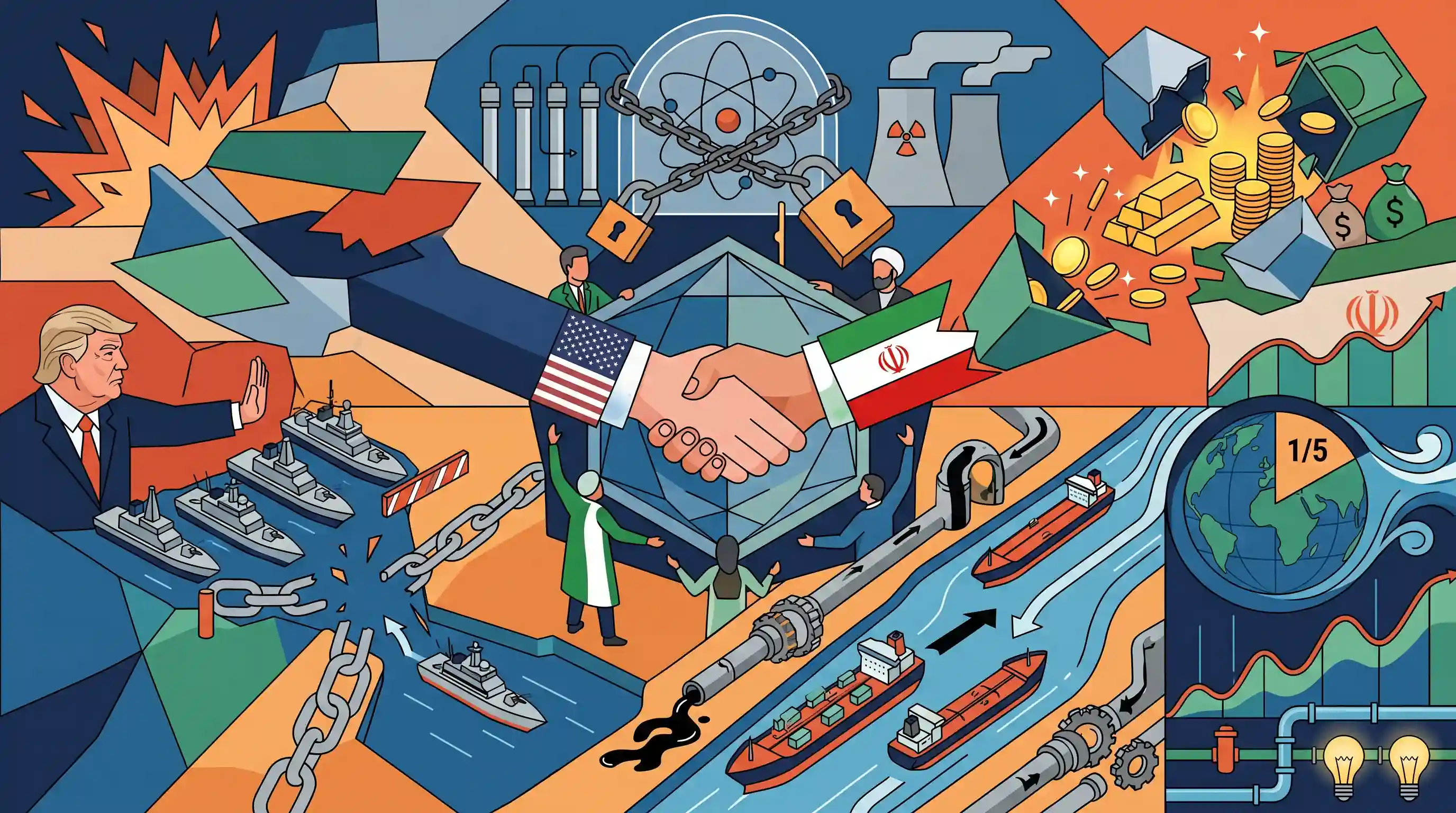
The United States and Iran are reportedly nearing a consensus on a 14-point memorandum of understanding (MoU) aimed at ending the ongoing war in West Asia. US President Donald Trump has paused 'Project Freedom'—a naval operation designed to escort commercial vessels through the Strait of Hormuz—to allow negotiations to proceed. The talks, facilitated by intermediaries including Pakistan, revolve around a moratorium on Iran's nuclear enrichment in exchange for the lifting of US sanctions and the unfreezing of billions of dollars in Iranian assets. Crucially, the agreement seeks to reopen the Strait of Hormuz, a vital maritime chokepoint handling one-fifth of global oil, which Iran closed in late February. A ceasefire currently holds, marking a significant potential de-escalation in regional tensions that could stabilize global energy markets.
Key Points
- The US and Iran are negotiating a 14-point Memorandum of Understanding to end the ongoing conflict in West Asia, with Pakistan acting as a key intermediary.
- US President Donald Trump paused 'Project Freedom', a naval escort mission, to facilitate diplomatic dialogue.
- The proposed MoU includes a moratorium on Iran's nuclear enrichment in exchange for the lifting of US sanctions and the release of billions in frozen Iranian funds.
- A central aim of the agreement is the reopening of the Strait of Hormuz, which was closed by Iran in late February, disrupting roughly 20% of the global oil supply.
Important Terms
Project Freedom

A U.S. naval operation launched in May 2026 to escort merchant vessels through the Strait of Hormuz during an Iranian blockade, ensuring global energy transit.
UPSC context
GS II (International Relations) and GS III (Security). Tests knowledge of maritime security and U.S. intervention strategies in West Asia.
Strait of Hormuz
A strategic maritime passage between the Persian Gulf and Gulf of Oman, handling approximately 20-25% of the world’s seaborne oil and liquefied natural gas trade.
UPSC context
GS I (World Geography) and GS II (IR). Essential for understanding global energy security and maritime chokepoints.
14-point Memorandum of Understanding
A 2026 preliminary diplomatic framework aimed at halting hostilities, initiating a 30-day negotiation period for a comprehensive nuclear and sanctions-lifting agreement between the US and Iran.
UPSC context
GS II (International Relations). Relates to bilateral diplomacy, conflict resolution, and West Asia peace processes.
Nuclear Enrichment Moratorium
A formal agreement to temporarily halt the increasing concentration of U-235 in uranium, often used as a diplomatic tool to de-escalate nuclear tensions.
UPSC context
GS II (IR) and GS III (Security). Key to nuclear non-proliferation and technical aspects of international treaties.
Maritime Chokepoint
A narrow sea route that is vital for transit and trade. Controlling these points grants significant geopolitical leverage over global supply chains and energy flows.
UPSC context
GS I (Geography) and GS III (Economics/Security). Relates to global shipping routes and resource security.
Operation Epic Fury
The primary U.S.-led military offensive against Iran in early 2026, which preceded the defensive escort operations of Project Freedom.
UPSC context
GS II/III. Contextual background for understanding the transition from active warfare to diplomatic de-escalation in West Asia.
Prelims Trap
"The Strait of Hormuz is a vital chokepoint bordered by Iran, Saudi Arabia, and the UAE."
Saudi Arabia does not border the Strait of Hormuz. The strait is strictly bounded by Iran to the north and Oman (the Musandam Peninsula) to the south.
Static Concepts Connected
What are the geographical coordinates of West Asia's primary maritime chokepoints?
- Strait of Hormuz: Connects the Persian Gulf to the Gulf of Oman and Arabian Sea. It is bordered by Iran to the north and Oman to the south.
- Bab-el-Mandeb: Connects the Red Sea to the Gulf of Aden and the Arabian Sea. It is bordered by Yemen, Djibouti, and Eritrea.
How do US secondary sanctions on Iran impact India's strategic interests?
- Energy Imports: Halts India's access to discounted Iranian crude oil, forcing reliance on alternative suppliers and straining the national oil import bill.
- Chabahar Port: Creates significant banking and operational hurdles for India's strategic connectivity investments, delaying timelines for Chabahar Port and the INSTC.
Cross-Topic Patterns
Chabahar Port & INSTC connectivity
Lifting US sanctions removes critical banking and logistical barriers for India, accelerating the operationalization of Chabahar Port and the broader International North-South Transport Corridor.
Oil prices & Macroeconomic stability
Reopening the Strait of Hormuz cools global crude prices, which directly aids India by easing the Current Account Deficit (CAD) and curbing imported inflation.

Map-based questions linking West Asian chokepoints (Hormuz/Bab-el-Mandeb) with global supply chain disruptions are highly probable.
Linked PYQs · 5
Linked PYQs · 5
- 2018MainsGS2
In what ways would the ongoing US-Iran Nuclear Pact Controversy affect the national interest of India? How should India respond to this situation?
- 2012MainsGS2
How have the US sanctions against Iran affected India's bilateral relations with Iran?
- 2017MainsGS2
The question of India's Energy Security constitutes the most important part of India's economic progress. Analyze India's energy policy cooperation with West Asian countries.
- 2025MainsGS2
"Energy security constitutes the dominant kingpin of India's foreign policy, and is linked with India's overarching influence in Middle Eastern countries.” How would you integrate energy security with India's foreign policy trajectories in the coming years?
- 2024PrelimsGS1
Consider the following statements : Statement-I : Sumed pipeline is a strategic route for Persian Gulf oil and natural gas shipments to Europe. Statement-II : Sumed pipeline connects the Red Sea with the Mediterranean Sea. Which one of the following is correct in respect of the above statements?
