US launches Major Combat Operations against Iran Nuclear Goals
Source:The Hindu ↗
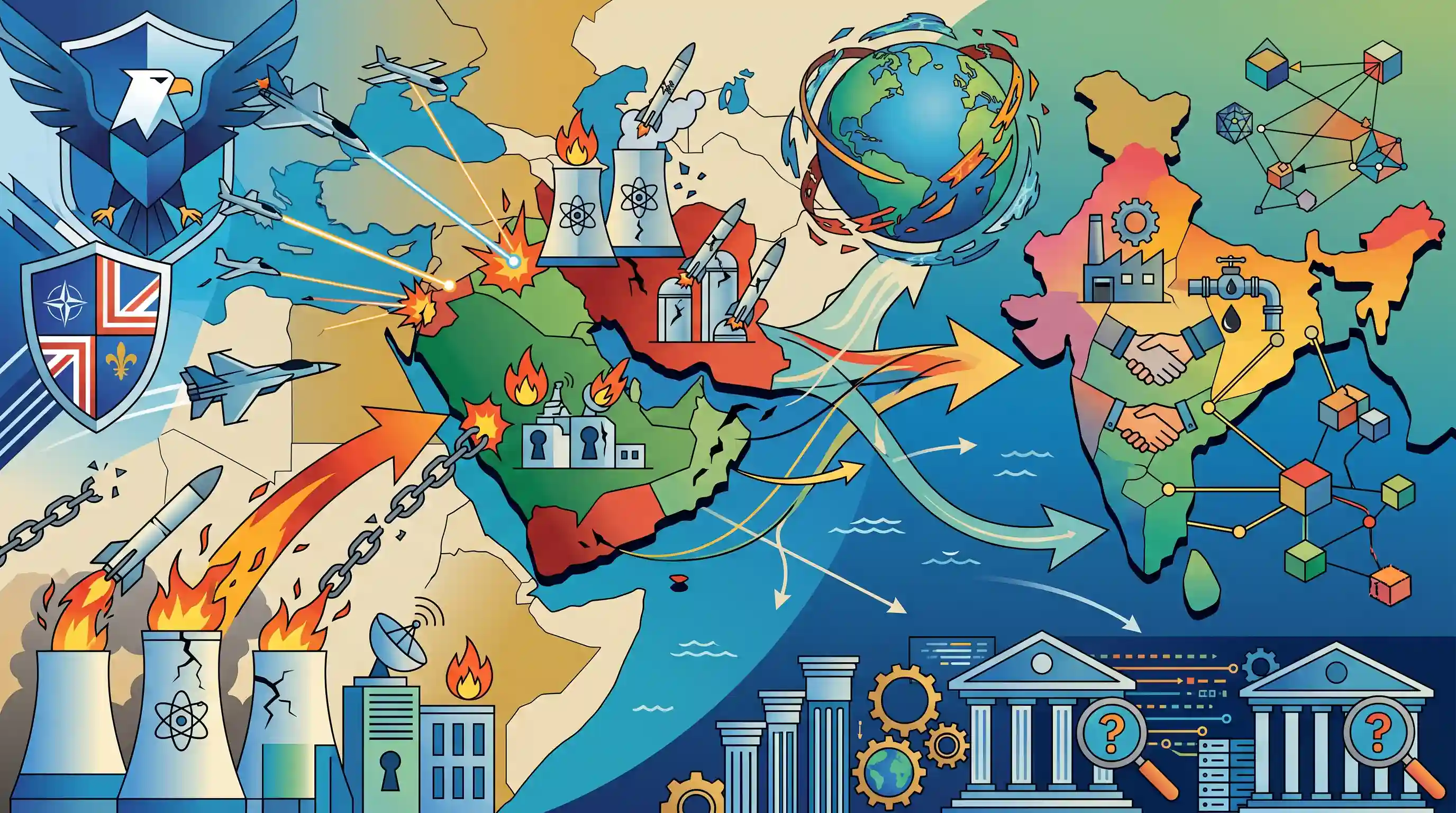
Why It Matters
Direct military conflict between the US and Iran profoundly destabilizes West Asia. For India, this threatens energy security due to potential disruptions in oil supply from the Middle East, risks the safety of the large Indian diaspora in the region, and complicates strategic connectivity investments like the Chabahar Port. It also impacts the global nuclear non-proliferation discourse.
Summary
US President Donald Trump announced the commencement of "major combat operations" against Iran, following recent Israeli strikes. The military campaign is designed to eliminate imminent threats posed by the Iranian regime, with a primary focus on dismantling its nuclear and ballistic missile programs, as well as targeting military and intelligence assets. Trump emphasized that the operation is aimed at the regime's capability to develop weapons of mass destruction and not the Iranian people. The direct military confrontation marks a severe escalation in West Asian geopolitics, with widespread implications for global security and nuclear non-proliferation.
Key Points
- The United States has launched major combat operations against Iran, aiming to neutralize imminent threats from the Iranian regime.
- The military campaign specifically targets Iran's nuclear and ballistic missile programs, alongside military, intelligence, and government symbols.
- This escalation follows recent Israeli strikes and repeated warnings from both the US and Israel regarding Iran's continued nuclear ambitions.
- US President Donald Trump stated the objective is defensive, aiming to prevent Iran from acquiring a nuclear weapon, while emphasizing the US has no quarrel with the Iranian people.
- The conflict significantly escalates tensions in West Asia, raising profound concerns for global security, nuclear non-proliferation, and energy markets.
Important Terms
War Powers Resolution

A 1973 US law requiring the President to notify Congress within 48 hours of committing armed forces and limiting their deployment to 60 days without legislative approval.
UPSC context
Relevant for GS-II: Effect of policies of developed countries; tests understanding of foreign constitutional checks on executive war powers.
Strait of Hormuz
A critical maritime chokepoint between the Persian Gulf and the Gulf of Oman, essential for global oil and gas transit, frequently threatened during regional conflicts.
UPSC context
GS-I (Geography) and GS-II (IR): Strategic maritime locations and their impact on global trade and India's energy supply.
Strategic Autonomy
A foreign policy doctrine where a state makes independent decisions based on national interest without being constrained by alliances or external pressures from major powers.
UPSC context
GS-II: Core tenet of Indian Foreign Policy; tests ability to analyze India's balancing act between rival global powers.
Nuclear Non-Proliferation Treaty (NPT)
A landmark 1968 international treaty aimed at preventing the spread of nuclear weapons, promoting peaceful nuclear energy use, and fostering the goal of disarmament.
UPSC context
GS-II: International treaties and agreements; tests knowledge of global security regimes and India's principled non-signatory position.
Chabahar Port
A key port in southeastern Iran developed with Indian assistance to provide a trade route to Afghanistan and Central Asia, bypassing Pakistan.
UPSC context
GS-II: India's neighbourhood and connectivity projects; tests understanding of strategic assets and their vulnerability to regional sanctions/conflict.
Energy Security
The uninterrupted availability of energy sources at an affordable price, particularly critical for India which imports over 85% of its crude oil.
UPSC context
GS-III: Infrastructure and Energy; tests analysis of how geopolitical shocks in West Asia affect domestic economic stability.
Prelims Trap
"Chabahar port is situated in the Persian Gulf and its shipping relies on the Strait of Hormuz."
Chabahar is located on the Gulf of Oman. India strategically chose it precisely because it lies completely outside the vulnerable Strait of Hormuz chokepoint.
Static Concepts Connected
What was the JCPOA and who constitutes the P5+1?
- P5+1 members: The five permanent members of the UN Security Council (China, France, Russia, UK, US) plus Germany.
- Core agreement: Iran agreed to curtail its nuclear enrichment program and allow strict IAEA inspections in exchange for the lifting of international economic sanctions.
- Collapse: The framework broke down after the US unilaterally withdrew in 2018, prompting Iran to gradually resume and increase its uranium enrichment.
Why is the Strait of Hormuz geographically and economically critical?
- Geographical location: It connects the Persian Gulf to the Gulf of Oman and the Arabian Sea, flanked by Iran to the north and Oman/UAE to the south.
- Global energy chokepoint: It facilitates the transit of approximately 20% of global petroleum consumption, making it the world's most important oil transit chokepoint.
Cross-Topic Patterns
West Asia volatility and India's SPRs
Escalations test India's energy resilience, linking directly to the static syllabus topic of India's Strategic Petroleum Reserves (SPR) expansion at Chandikhol and Padur to buffer crude supply shocks.
Connectivity: INSTC vs. IMEC
A war-torn Iran stalls the International North-South Transport Corridor (INSTC), potentially accelerating India's diplomatic pivot toward the alternative India-Middle East-Europe Economic Corridor (IMEC).
Diaspora security and Evacuation Ops
Large-scale conflict in the Middle East triggers questions on India's disaster management protocols and historical Non-Combatant Evacuation Operations (e.g., Operation Rahat, Operation Ajay).

Expect 2026 mapping questions linking Persian Gulf chokepoints (Hormuz) with the operational status of INSTC/Chabahar amid US sanctions.
Linked PYQs · 3
Linked PYQs · 3
- 2025MainsGS2
"Energy security constitutes the dominant kingpin of India's foreign policy, and is linked with India's overarching influence in Middle Eastern countries.” How would you integrate energy security with India's foreign policy trajectories in the coming years?
- 2025MainsGS2
"The reform process in the United Nations remains unresolved, because of the delicate imbalance of East and West and entanglement of the USA vs. Russo-Chinese alliance.” Examine and critically evaluate the East-West policy confrontations in this regard.
- 2022PrelimsGS1
The term "Levant" often heard in the news roughly corresponds to which of the following regions?
