US Naval Armada Deployed Near Iran Escalates Middle East Tensions
Source:Indian Express ↗
Why It Matters
The threat of a US military strike on Iran is a major geopolitical event that could trigger a regional war, disrupting global oil supplies through the Strait of Hormuz. For UPSC aspirants, this highlights the fragility of India's energy security and tests India's foreign policy maneuvering in the Middle East.
Summary
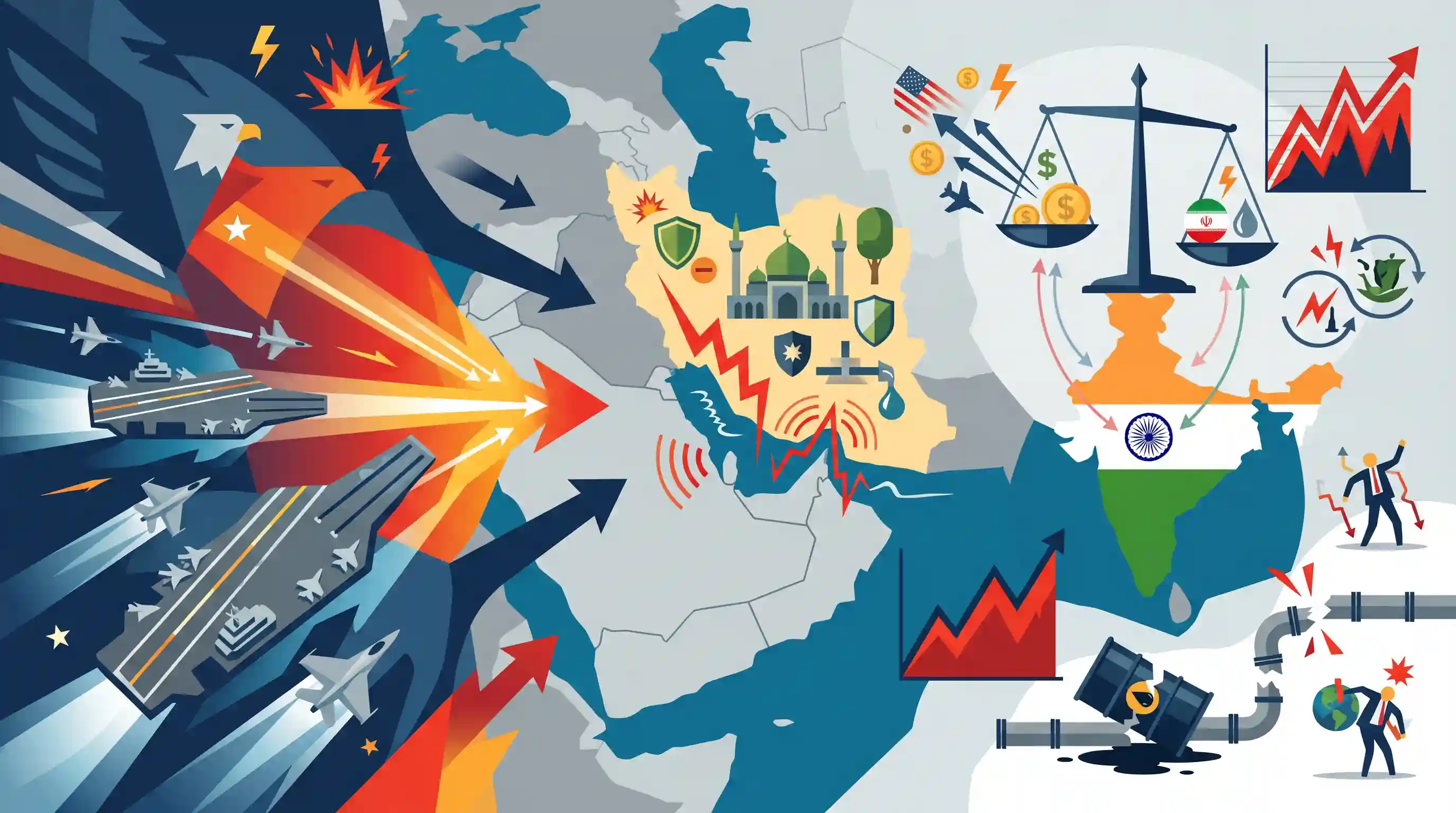
US President Donald Trump has ordered the deployment of a formidable naval "Armada," featuring the USS Abraham Lincoln and USS Gerald R. Ford carrier strike groups, positioning the US military for a potential strike on Iran. This aggressive posture has drastically escalated tensions in the Middle East, raising the specter of an imminent armed conflict in the Persian Gulf. For India, the unfolding crisis poses profound challenges, threatening to destabilize global energy markets, spike crude oil prices, and force a delicate diplomatic balancing act between the US and Iran.
Key Points
- The US has deployed major naval assets, including the USS Abraham Lincoln and USS Gerald R. Ford carrier strike groups, threatening a potential military strike on Iran.
- The concentration of US forces in the region significantly raises the risk of armed conflict in the Persian Gulf and the Middle East.
- A military conflict involving Iran threatens the security of the Strait of Hormuz, a crucial chokepoint for global oil transit.
- Any disruption in oil supplies or spikes in crude oil prices will have severe implications for India's energy security and macroeconomic stability.
- India faces a complex diplomatic challenge in balancing its strategic partnership with the United States and its historical ties and energy reliance on the Middle East.
Important Terms
Carrier Strike Group (CSG)

A naval operational formation centering on an aircraft carrier, escorted by cruisers, destroyers, and submarines, used for global power projection and maritime deterrence.
UPSC context
Relevant for GS Paper-III (Security) as a tool for power projection and maritime deterrence.
Strait of Hormuz
A critical maritime chokepoint connecting the Persian Gulf to the Gulf of Oman, through which nearly one-fifth of global oil and gas passes daily.
UPSC context
Tested in GS Paper-II (IR) and Geography (Mapping); vital for India's energy security and LPG/LNG imports.
Strategic Autonomy
India's foreign policy approach of maintaining independence in sovereign decision-making without aligning rigidly with any power bloc, balancing ties between competing global powers.
UPSC context
Core concept in GS Paper-II (IR) regarding India’s balancing act between the U.S., Israel, and Iran.
Strategic Petroleum Reserves (SPR)
Government-maintained emergency stockpiles of crude oil held in underground rock caverns to safeguard against sudden supply disruptions or price spikes.
UPSC context
Vital for GS Paper-III (Energy Security). Tests knowledge of India's resilience to external oil supply shocks.
Operation Sankalp
A maritime security operation launched by the Indian Navy in June 2019 to ensure the safe passage of Indian-flagged merchant vessels through the Persian Gulf.
UPSC context
Important for GS Paper-III (Security) as an example of India’s proactive maritime diplomacy and 'Net Security Provider' role.
Energy Security
The uninterrupted availability of energy sources at an affordable price, critical for national development and mitigating economic shocks from global conflicts.
UPSC context
A recurring theme in GS Paper-II and III, focusing on India's vulnerability to West Asian import disruptions.
Prelims Trap
"The Strait of Hormuz connects the Persian Gulf to the Red Sea, transiting roughly 20% of global oil."
The Strait of Hormuz connects the Persian Gulf to the Gulf of Oman and Arabian Sea. Aspirants often confuse it with the Bab-el-Mandeb strait, which connects the Red Sea to the Gulf of Aden.
Static Concepts Connected
What are the primary macroeconomic impacts of a global crude oil price spike on India?
- Imported Inflation: Higher fuel costs cascade into logistics and manufacturing, driving up both WPI and CPI (imported inflation).
- CAD Widening: India imports ~85% of its crude; expensive oil inflates the import bill, significantly widening the Current Account Deficit.
- Rupee Depreciation: A higher import bill increases the demand for US Dollars, putting immediate depreciating pressure on the Indian Rupee.
What is the status of India's Strategic Petroleum Reserve (SPR) program?
- Purpose: To provide an emergency buffer against short-term global crude oil supply disruptions, managed by ISPRL.
- Phase I Locations: Phase I consists of underground rock caverns in Visakhapatnam (AP), Mangaluru (Karnataka), and Padur (Karnataka).
- Capacity Buffer: The current Phase I capacity of 5.33 MMT can meet approximately 9.5 days of India's national crude oil requirement.
Cross-Topic Patterns
Middle East conflict + Chabahar/INSTC
US-Iran military tensions directly threaten the viability of India's strategic investments in the Chabahar port and the International North-South Transport Corridor (INSTC), both crucial for accessing Central Asia.
Geopolitics + Strategic Petroleum Reserves (SPR)
Geopolitical oil shocks repeatedly highlight the urgent need for India's transition to renewable energy and the expansion of its Strategic Petroleum Reserves (SPR) under Phase II (Chandikhol and Padur).

Map questions on Persian Gulf chokepoints (Hormuz) paired with economy statements on CAD and SPR capacity are highly likely in 2026.
Linked PYQs · 3
Linked PYQs · 3
- 2025MainsGS2
"Energy security constitutes the dominant kingpin of India's foreign policy, and is linked with India's overarching influence in Middle Eastern countries.” How would you integrate energy security with India's foreign policy trajectories in the coming years?
- 2012MainsGS2
How have the US sanctions against Iran affected India's bilateral relations with Iran?
- 2024PrelimsGS1
Consider the following statements : Statement-I : Sumed pipeline is a strategic route for Persian Gulf oil and natural gas shipments to Europe. Statement-II : Sumed pipeline connects the Red Sea with the Mediterranean Sea. Which one of the following is correct in respect of the above statements?
