US Administration Defies Supreme Court Tariff Ruling on Indian Imports
Source:Indian Express ↗
Why It Matters
This development is pivotal for UPSC aspirants as it intersects International Relations (US-India trade friction), Indian Economy (impact of protectionism), and Comparative Polity (executive vs. judiciary dynamics in the US compared to India's checks and balances).
Summary
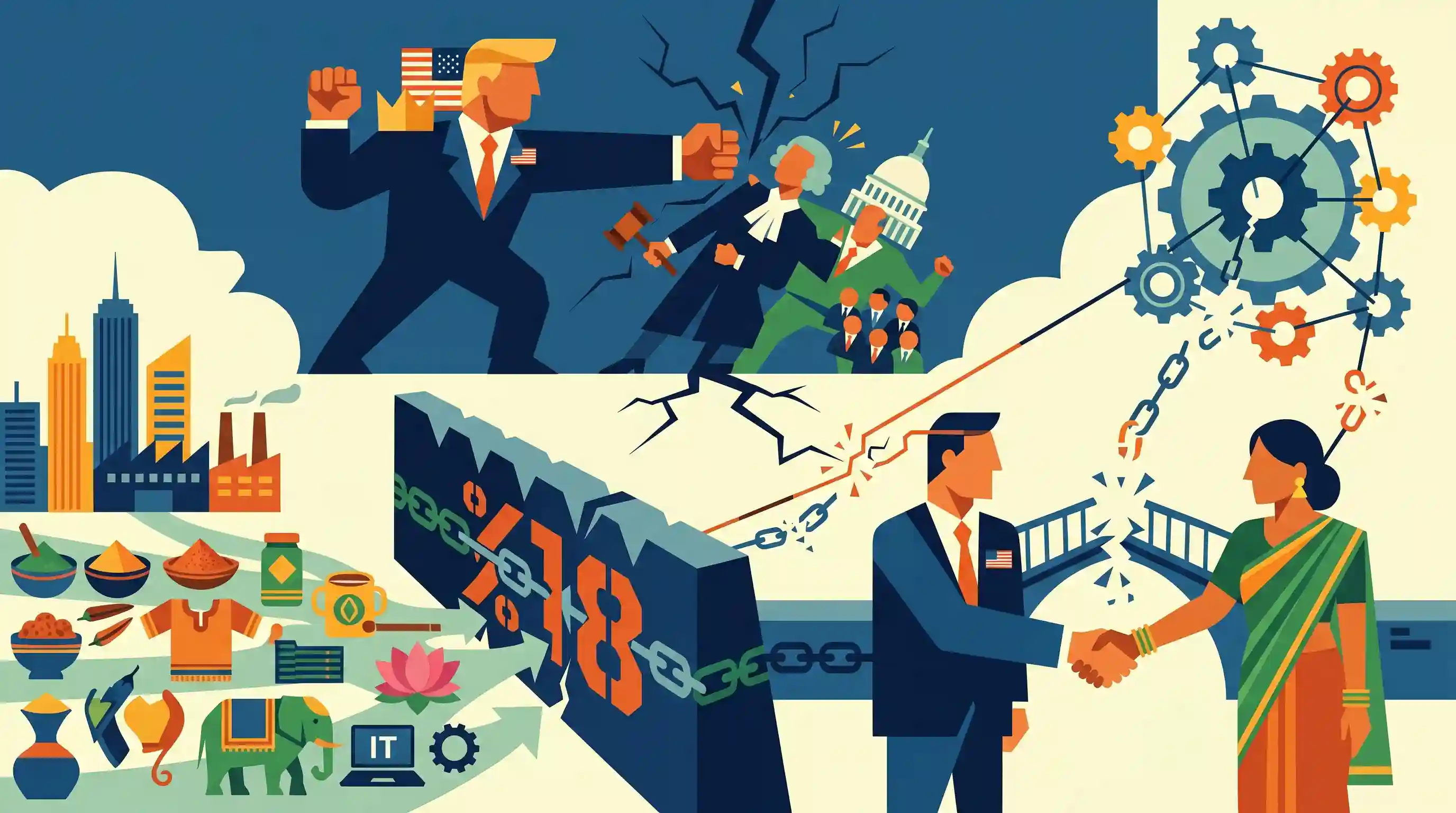
US President Donald Trump has defied a US Supreme Court ruling by keeping an 18% tariff on Indian goods, stating that 'nothing changes' in his administration's trade policy. This unprecedented move not only escalates trade protectionism—impacting US-India economic relations and challenging the multilateral trading system—but also creates a severe constitutional crisis in the US by testing the limits of executive power and the doctrine of separation of powers.
Key Points
- Donald Trump defied a US Supreme Court ruling to maintain an 18% tariff on imports from India, emphasizing that his protectionist trade stance remains unchanged.
- The move underscores the growing trend of US trade protectionism, posing direct challenges to India's export economy and macroeconomic stability.
- The executive defiance of the judiciary highlights profound constitutional friction in the US, serving as a critical case study for separation of powers and checks and balances.
- Such unilateral tariff impositions threaten the multilateral trading system and introduce significant friction into US-India bilateral relations.
Important Terms
World Trade Organization (WTO)

The only global international organization dealing with the rules of trade between nations, ensuring trade flows smoothly, predictably, and freely through negotiated agreements and dispute settlement.
UPSC context
GS Paper 2 (International Institutions) and GS Paper 3 (Economy). Tests understanding of multilateralism vs bilateralism.
Separation of Powers
A constitutional doctrine dividing government into three branches—legislative, executive, and judicial—to provide checks and balances and prevent the concentration of absolute power in one individual or organ.
UPSC context
GS Paper 2 (Comparison of the Indian constitutional scheme with other countries). Core concept in US-India comparative polity.
Trade Protectionism
Economic policy of restricting imports from other countries through methods such as tariffs on imported goods, import quotas, and various other government regulations to protect domestic industries.
UPSC context
GS Paper 3 (Economy - Effects of liberalization on the economy). Tests impact of global trade wars on India's export-led growth.
International Emergency Economic Powers Act (IEEPA)
A 1977 US law granting the President authority to regulate international commerce during a declared national emergency; its use for broad-based tariffs was struck down as executive overreach.
UPSC context
GS Paper 2 (Comparative Constitutions). Exemplifies the limits of delegated legislation and executive authority in a presidential system.
Section 122 (Trade Act of 1974)
A provision of the US Trade Act of 1974 allowing the President to impose temporary tariffs (up to 15% for 150 days) to address serious balance-of-payments deficits.
UPSC context
GS Paper 2/3 (Trade Policy). Tests knowledge of specific legal instruments used in global trade disputes and their impact on India.
Strategic Autonomy
A country's ability to pursue its national interests and adopt its own preferred foreign policy without being constrained by other states, especially during global geopolitical or trade conflicts.
UPSC context
GS Paper 2 (IR - Effect of policies of developed countries on India's interests). Tests India's balancing act between the US and Russia.
Reciprocal Tariffs
A trade policy where a country imposes import duties on another nation’s goods at the same rate that the other nation imposes on its exports, aimed at achieving "fair" trade.
UPSC context
GS Paper 3 (Economy - Trade). Relevant for understanding 'transactional diplomacy' and its impact on Indian textile and manufacturing exports.
Prelims Trap
The US Constitution explicitly mandates executive authorities to enforce Supreme Court judgments, similar to India.
The US Constitution relies on institutional conventions, completely lacking a direct textual equivalent to India's Article 144 which mandates enforcement.
Static Concepts Connected
How does the Indian Constitution prevent executive defiance of the Supreme Court?
- Article 141: Declares that the law established by the Supreme Court is binding on all courts within the territory of India.
- Article 144: Explicitly mandates all civil and judicial authorities in India to act in aid of the Supreme Court.
- Article 129: Empowers the Supreme Court as a Court of Record to punish for its contempt, ensuring executive compliance.
How do unilateral tariffs conflict with core WTO frameworks?
- MFN Principle: Targeted unilateral tariffs violate the Most-Favoured-Nation rule, which requires equal trade treatment for all WTO member nations.
- Bound Tariffs: Arbitrary executive tariffs frequently exceed the negotiated 'bound tariff rates' a country legally committed to at the WTO.
- Bypassing the DSM: Unilateral action ignores the WTO's Dispute Settlement Mechanism, fundamentally undermining the rules-based multilateral trading order.
Cross-Topic Patterns
Strategic synergy vs. Economic friction
While US-India defense ties strengthen through initiatives like Quad and iCET, bilateral relations are simultaneously tested by persistent trade protectionism and arbitrary tariff disputes.
Separation of powers vs Checks and balances
The US crisis highlights the vulnerability of a rigid separation of powers, contrasting sharply with India's integrated checks and balances under explicit constitutional mandates.

Comparative constitutional schemes (US separation of powers vs India's Art 144) will likely be a multi-statement Prelims question in 2026.
Linked PYQs · 5
Linked PYQs · 5
- 2018MainsGS3
How would the recent phenomena of protectionism and currency manipulations in world trade affect macroeconomic stability of India?
- 2025MainsGS3
What are the challenges before the Indian economy when the world is moving away from free trade and multilateralism to protectionism and bilateralism? How can these challenges be met?
- 2019MainsGS2
‘What introduces friction into the ties between India and the United States is that Washington is still unable to find for India a position in its global strategy, which would satisfy India's national self-esteem and ambitions.’ Explain with suitable examples.
- 2019MainsGS2
Do you think that Constitution of India does not accept principle of strict separation of powers rather it is based on the principle of 'checks and balance'? Explain.
- 2012MainsGS2
Discuss the likely negative impact of the protectionist measures proposed by the US on India's software industry.
