India and United States reach trade agreement on tariffs and energy
Source:The Hindu ↗
Why It Matters
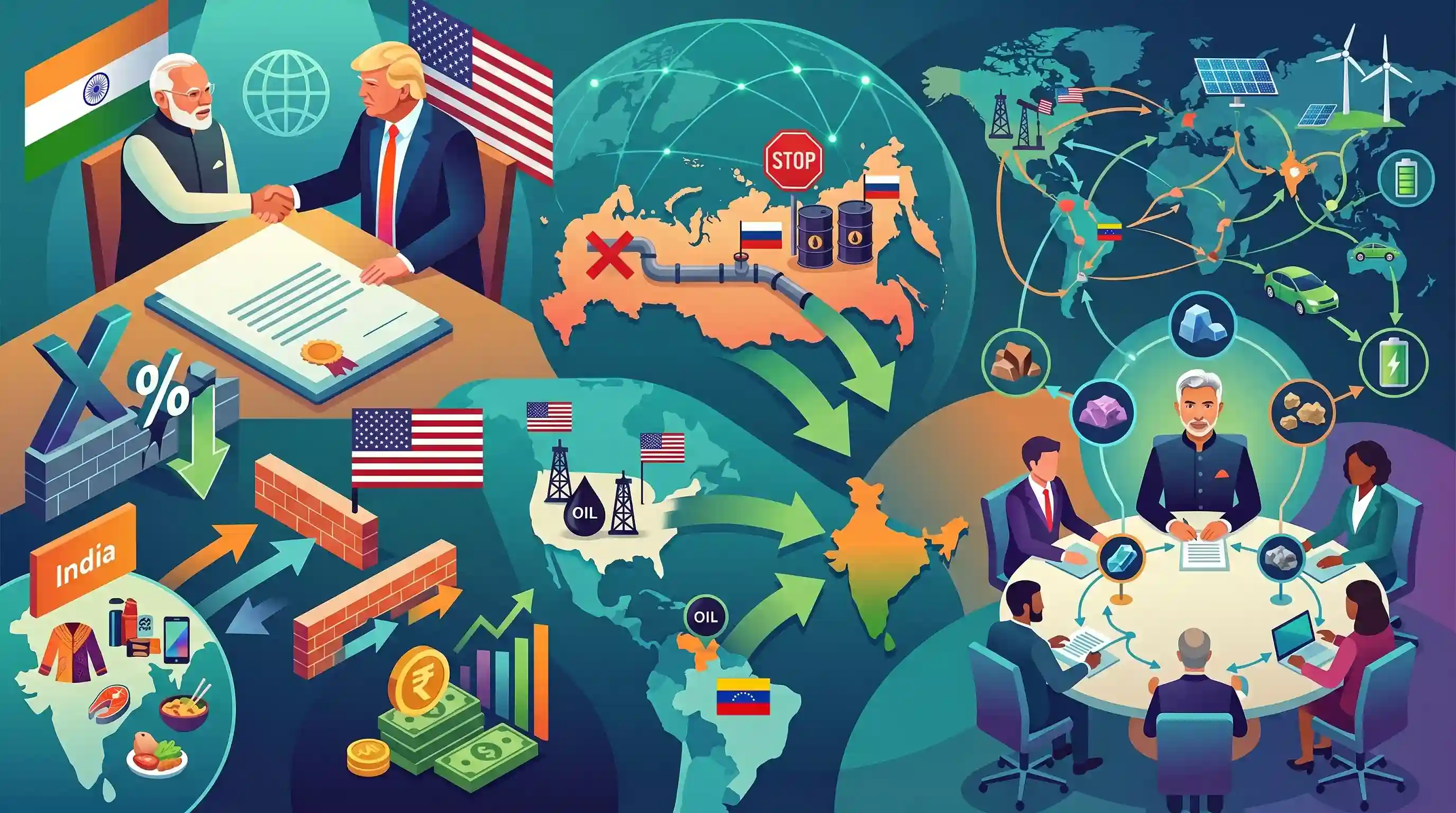
This development represents a major recalibration of India's foreign and economic policies, balancing trade concessions with strategic energy pivots. It directly impacts India-US bilateral ties, energy security strategies (moving away from Russia), and the geopolitical contest over critical mineral supply chains dominated by China.
Summary
Prime Minister Narendra Modi and US President Donald Trump have reached a significant trade agreement, reducing US tariffs on 'Made in India' products to 18% and reversing the 50% penalty tariffs imposed earlier. In return, India will eliminate tariffs and non-tariff barriers on US imports and commit to purchasing $500 billion in US goods. A major strategic shift involves India agreeing to stop buying Russian oil, pivoting instead to energy imports from the US and Venezuela. Simultaneously, External Affairs Minister S. Jaishankar is in the US attending the Critical Minerals Ministerial to forge resilient supply chains and reduce global reliance on China for minerals crucial to the clean energy transition.
Key Points
- PM Modi announced that 'Made in India' products will face a reduced 18% tariff in the US, down from the 50% penalty tariffs imposed in August 2025.
- In reciprocation, India has agreed to reduce tariffs and non-tariff barriers on US imports to zero and increase purchases of US products to $500 billion.
- The trade deal requires India to halt purchases of Russian oil, shifting its energy imports toward the United States and potentially Venezuela.
- External Affairs Minister S. Jaishankar is participating in the Critical Minerals Ministerial in the US, convened by Secretary of State Marco Rubio.
- The ministerial focuses on enhancing supply chain resilience and reducing global dependence on China for critical minerals needed for clean energy transitions.
Important Terms
Critical Minerals Ministerial

An inaugural U.S.-hosted summit (2026) aimed at coordinating global efforts to secure and diversify critical mineral supply chains, specifically reducing global reliance on China.
UPSC context
GS Paper 2 (International Relations) and GS Paper 3 (Energy/Security); tests understanding of strategic supply chain diplomacy.
Critical Minerals
Natural resources (e.g., lithium, cobalt, rare earths) essential for modern technology, defense, and clean energy, characterized by high economic importance and significant supply disruption risks.
UPSC context
GS Paper 3 (Resources and Science & Tech); relevant to India's 'Net Zero' goals and self-reliance (Atmanirbharta).
Non-tariff Barriers
Trade restrictions such as quotas, licensing, or technical standards used by governments to regulate imports without applying direct taxes or customs duties.
UPSC context
GS Paper 3 (Economy); crucial for understanding trade negotiations and challenges to Indian exports in global markets.
Energy Security
The uninterrupted availability of energy sources at an affordable price, ensuring national development while maintaining strategic autonomy and environmental sustainability.
UPSC context
GS Paper 2 (Geopolitics) and GS Paper 3 (Energy/Environment); vital for India's economic growth and strategic decision-making.
Mineral Security Partnership (MSP)
A U.S.-led strategic grouping of 14 nations (including India) designed to catalyze investment in transparent, secure, and resilient critical mineral supply chains.
UPSC context
GS Paper 2 (International Relations); represents India's integration into elite global resource-security alliances.
Tariffs
A tax imposed by a government on imported or exported goods, used to raise revenue or protect domestic industries from foreign competition.
UPSC context
GS Paper 3 (Economy); fundamental concept for analyzing international trade disputes and bilateral agreements.
Prelims Trap
India and the US recently signed a Free Trade Agreement (FTA) to eliminate tariffs.
Aspirants might confuse this bilateral tariff reduction pact with a formal Free Trade Agreement (FTA). India and the US do not currently have a comprehensive FTA.
Static Concepts Connected
What are Non-Tariff Barriers (NTBs) in international trade?
- Import Quotas: Strict limits on the physical quantity or value of specific goods that can be imported over a set period.
- SPS Measures: Sanitary and Phytosanitary (SPS) standards meant to protect human, animal, or plant health, often used covertly to restrict imports.
- TBTs: Technical Barriers to Trade, which include mandatory product standards, testing, certification, and specific packaging/labeling requirements.
How do Critical Minerals differ from Rare Earth Elements (REEs)?
- Classification: Critical minerals are any non-fuel minerals essential for economic/national security with vulnerable supply chains. REEs are a specific group of 17 metallic elements in the periodic table.
- Intersection: While all REEs (like Neodymium) are typically classified as critical minerals, not all critical minerals (like Lithium, Cobalt, Copper) are Rare Earth Elements.
- Supply Chain Vulnerability: Both face severe supply chain vulnerabilities due to China's overwhelming global dominance in extraction and processing technologies.
Cross-Topic Patterns
Energy imports dictating Strategic Autonomy
The shift from Russian crude to US/Venezuelan oil highlights how energy supply lines dictate foreign policy alignment, reshaping India's traditional 'strategic autonomy' doctrine.
Mineral diplomacy for Net-Zero commitments
Platforms like the Critical Minerals Ministerial tie directly into India’s Panchamrit targets. Securing lithium/cobalt supply chains is now just as geopolitically sensitive as securing petroleum.

India's trade-off between Russian oil and US market access will likely drive a GS-2 Mains question on strategic autonomy in 2026.
Linked PYQs · 3
Linked PYQs · 3
- 2025MainsGS2
"Energy security constitutes the dominant kingpin of India's foreign policy, and is linked with India's overarching influence in Middle Eastern countries.” How would you integrate energy security with India's foreign policy trajectories in the coming years?
- 2019MainsGS2
‘What introduces friction into the ties between India and the United States is that Washington is still unable to find for India a position in its global strategy, which would satisfy India's national self-esteem and ambitions.’ Explain with suitable examples.
- 2025PrelimsGS1
Consider the following statements : Statement I: Some rare earth elements are used in the manufacture of flat television screens and computer monitors. Statement II : Some rare earth elements have phosphorescent properties. Which one of the following is correct in respect of the above statements?
