Arctic Geopolitics and European Strategic Autonomy
Source:Indian Express ↗
Why It Matters
Provides a critical case study on how shifting US foreign policy and transactional leadership impact traditional alliances, emphasizing the rising geopolitical importance of the Arctic and the need for European strategic autonomy.
Summary
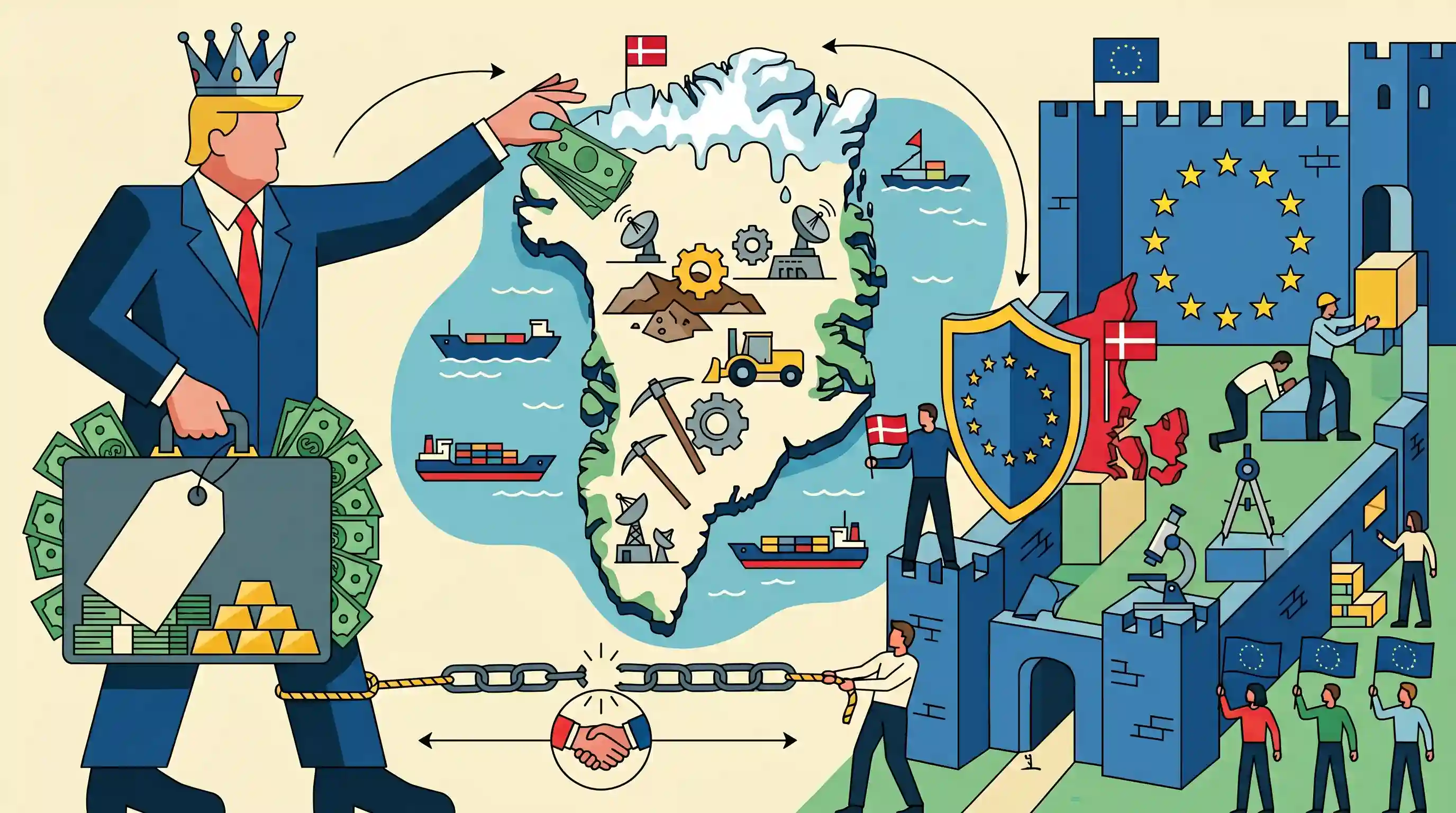
The article analyzes Donald Trump's ambition to acquire Greenland from Denmark, framing it as a critical test for European sovereignty. It highlights the strategic importance of Greenland in the Arctic—a region rich in rare earth minerals and crucial for military positioning as ice caps melt. The episode exposes Europe's vulnerabilities, demonstrating how transactional diplomacy by the US challenges traditional transatlantic alliances. It forces the European Union to reassess its strategic autonomy, recognize the rising sovereign nationalism, and actively defend the rights of its member states against great-power real estate diplomacy.
Key Points
- Strategic Importance of Greenland: Greenland is vital due to its location in the Arctic, vast reserves of rare earth minerals, and strategic value for military bases amidst melting ice caps.
- Challenge to European Sovereignty: Trump's transactional approach of treating an autonomous territory as real estate directly challenges Denmark's sovereignty and tests the EU's political resolve.
- Strained Transatlantic Alliance: The proposal underscores a shift in US-Europe relations from value-based partnerships to transactional diplomacy, prompting Europe to question American reliability.
- Geopolitical Competition in the Arctic: The region is witnessing intensified great-power competition over new shipping routes and resources, escalating tensions between the US, Russia, and China.
- Need for EU Strategic Autonomy: The crisis acts as a wake-up call for the European Union to strengthen its independent geopolitical standing and collective defense mechanisms rather than relying solely on the US security umbrella.
Important Terms
Strategic Autonomy

A state's or union's capacity to pursue independent foreign policy and security objectives without being structurally dependent on or constrained by external powers.
UPSC context
GS Paper 2 (IR); relevant for analyzing India's multi-alignment and Europe's shifting relations with the US and China.
Arctic Council
An intergovernmental forum promoting cooperation among Arctic states on sustainable development and environmental protection, excluding military security matters.
UPSC context
GS Paper 2 (IR); tests knowledge of polar geopolitics and India’s interests as an observer state since 2013.
Rare Earth Elements (REEs)
Seventeen metallic elements critical for high-tech industries, including electronics, green energy technologies, and advanced defense systems, characterized by difficult extraction processes.
UPSC context
GS Paper 1 (Geography) and Paper 3 (Economy); tests resource distribution and global supply chain vulnerabilities.
NATO (North Atlantic Treaty Organization)
A collective defense alliance established in 1949 between North American and European countries to ensure mutual security through political and military cooperation.
UPSC context
GS Paper 2 (IR); critical for understanding global security architecture and contemporary transatlantic diplomatic challenges.
European Union (EU)
A supranational political and economic union of 27 European member states operating through a single market and shared governance institutions.
UPSC context
GS Paper 2 (IR); tests regional integration models and India-EU strategic cooperation in trade and security.
Sovereign Nationalism
A political stance prioritizing national interests and independent decision-making over international alliances, supranational governance, or global institutional norms.
UPSC context
GS Paper 2 (Political Science/IR); relevant for discussing the rise of transactional diplomacy and shifts in the liberal world order.
Prelims Trap
Greenland is an independent sovereign state and a full member of the United Nations.
Greenland is an autonomous territory within the Kingdom of Denmark. Denmark retains constitutional control over its foreign affairs, security, and defense policies.
Static Concepts Connected
What is the mandate and composition of the Arctic Council?
- Mandate: It is an intergovernmental forum promoting sustainable development and environmental protection. Crucially, its mandate explicitly excludes military and security disputes.
- Membership: Comprises eight sovereign states with Arctic territory (Canada, Denmark, Finland, Iceland, Norway, Russia, Sweden, US). India holds Observer status.
Why are Rare Earth Elements (REEs) central to modern geopolitics?
- Strategic Use: They are indispensable components for the clean energy transition (EV batteries, wind turbines) and advanced military hardware (precision-guided munitions, lasers).
- Supply Vulnerability: China currently dominates global processing and refining. Western nations are aggressively seeking alternative reserves, like those under Greenland's ice, to achieve supply chain resilience.
Cross-Topic Patterns
Arctic Sea Routes + Global Trade
Melting sea ice opens the Northern Sea Route, challenging traditional maritime chokepoints like the Suez Canal and fundamentally shifting global trade networks.
Greenland REEs + Minerals Security Partnership
The geopolitical race for Greenland's minerals aligns with the US-led Minerals Security Partnership (which India joined) to de-risk supply chains from China.

Expect a multi-statement question mapping Arctic territories (e.g., Greenland, Svalbard) against their sovereign nations and resources.
Linked PYQs · 4
Linked PYQs · 4
- 2023MainsGS2
‘The expansion and strengthening of NATO and a stronger US-Europe strategic partnership works well for India.’ What is your opinion about this statement ? Give reasons and examples to support your answer.
- 2025MainsGS2
"With the waning of globalization, post-Cold War world is becoming a site of sovereign nationalism.” Elucidate.
- 2018MainsGS1
Why is India taking keen interest in resources of Arctic Region?
- 2011MainsGS2
As regards the increasing rates of melting of Arctic Sea ice, the interests of the Arctic Council nations may not coincide with those of the wider world." Explain.
