US Environmental Policy Rollbacks and Global Climate Governance
Source:Indian Express ↗
Why It Matters
As the US is one of the largest greenhouse gas emitters globally, its domestic environmental policies have profound implications for global climate governance, carbon budgets, and international climate finance. This makes it a crucial case study for GS3 Environment and GS2 International Relations.
Summary
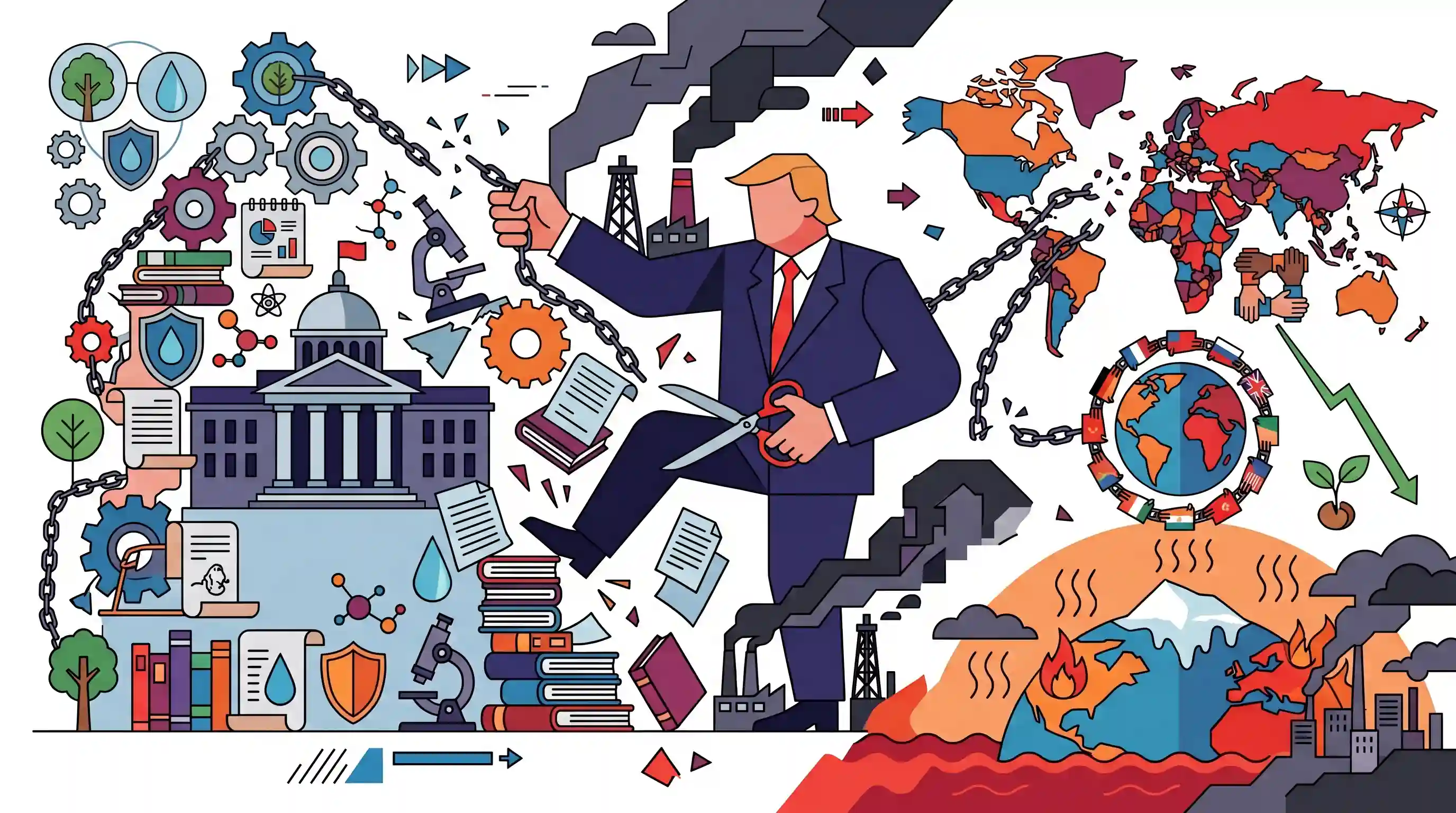
The article discusses the recent moves by the Donald Trump administration to repeal environmental regulations and undermine the Environmental Protection Agency (EPA). By discarding decades of climate science and policy frameworks, the US administration's actions threaten global efforts to combat climate change, posing severe setbacks for international treaties like the Paris Agreement and global emission reduction targets.
Key Points
- The US administration under Donald Trump has initiated significant rollbacks of environmental regulations by altering the mandates of the Environmental Protection Agency (EPA).
- These administrative moves are criticized for dismantling four decades of established climate science and regulatory frameworks designed to curb greenhouse gas emissions.
- This abrupt policy shift severely impacts global climate action, directly undermining the goals of the Paris Agreement and international climate cooperation.
- Domestic policy reversals in the world's largest historical emitter pose severe challenges for global efforts to contain global warming, placing additional burdens on developing nations to meet global climate targets.
Important Terms
Paris Agreement

A 2015 legally binding international treaty aiming to limit global temperature rise to well below 2°C (ideally 1.5°C) above pre-industrial levels through self-determined national targets.
UPSC context
GS Papers II & III; tests understanding of global governance, climate diplomacy, and India’s climate commitments (NDCs).
UNFCCC
The primary 1992 multilateral treaty established at the Rio Earth Summit to coordinate international efforts to stabilize greenhouse gas concentrations and prevent dangerous human interference with the climate.
UPSC context
GS Paper III; the foundational framework for global environmental conventions and the annual Conference of Parties (COP).
Environmental Protection Agency (EPA)
The independent U.S. federal agency responsible for environmental protection and human health; it regulates greenhouse gases based on scientific findings like the Endangerment Finding.
UPSC context
GS Paper II; illustrates how domestic policies of major powers influence international climate equity and global emission targets.
Endangerment Finding
A 2009 scientific determination that greenhouse gases endanger public health and welfare, providing the legal mandate for the U.S. to regulate emissions under the Clean Air Act.
UPSC context
GS Paper III; relevant for analyzing the legal basis of climate regulation and the impact of regulatory rollbacks.
Nationally Determined Contributions (NDCs)
Non-binding national climate plans required under the Paris Agreement, where countries outline their specific commitments to reduce emissions and adapt to climate change.
UPSC context
GS Paper III; tests the 'bottom-up' approach of the Paris Agreement and India’s specific 'Panchamrit' climate goals.
IPCC
The United Nations body for assessing climate science; its periodic reports provide the scientific consensus that informs global policy-making and international climate treaties.
UPSC context
GS Paper III; provides the authoritative scientific evidence essential for evaluating global warming risks and mitigation strategies.
Prelims Trap
"The Paris Agreement legally binds member nations to achieve the specific emission reduction targets set in their NDCs."
NDCs are nationally determined. The treaty legally binds countries to submit, update, and report on NDCs, but does not legally mandate achieving the specific numerical emission targets.
Static Concepts Connected
What is the principle of CBDR-RC under the UNFCCC framework?
- Core Meaning: It acknowledges that all states share an obligation to address environmental destruction, but are not equally responsible for historical emissions.
- Historical Emitters: Developed nations (like the US) have contributed most to historical GHGs, thus must bear a proportionately greater burden for mitigation and financing.
- Equity & Justice: It ensures developing nations are allowed the necessary carbon space to grow economically while transitioning to green energy.
How does the Global Carbon Budget relate to the Paris Agreement's temperature goals?
- Definition: It is the maximum cumulative amount of global human-induced CO2 emissions permitted to limit global warming to a specific threshold, like 1.5°C.
- Budget Depletion: Large historical emitters rolling back regulations accelerate the exhaustion of this budget, shrinking the remaining carbon space for developing countries.
Cross-Topic Patterns
EU CBAM vs. US deregulation
As the US deregulates, the EU's Carbon Border Adjustment Mechanism (CBAM) may heavily penalize carbon-intensive US exports, sparking major WTO disputes and reshaping global green trade flows.
US rollbacks & Global Climate Finance gap
US withdrawal from climate commitments historically stalls multilateral climate finance mechanisms (like the Green Climate Fund), severely straining the adaptation budgets of vulnerable developing nations.

Expect a 2026 multi-statement question linking historical emission responsibilities, global carbon budget depletion, and CBDR-RC principles.
Linked PYQs · 4
Linked PYQs · 4
- 2022MainsGS3
Discuss global warming and mention its effects on the global climate. Explain the control measures to bring down the level of greenhouse gases which cause global warming, in the light of the Kyoto Protocol, 1997.
- 2025MainsGS3
Write a review on India's climate commitments under the Paris Agreement (2015) and mention how these have been further strengthened in COP26 (2021). In this direction, how has the first Nationally Determined Contribution intended by India been updated in 2022?
- 2010PrelimsGS1
The United Nations Framework Convention on Climate Change (UNFCCC) is an international treaty drawn at
- 2025PrelimsGS1
Consider the following statements : Statement I: Article 6 of the Paris Agreement on climate change is frequently discussed in global discussions on sustainable development and climate change. Statement II: Article 6 of the Paris Agreement on climate change sets out the principles of carbon markets. Statement III : Article 6 of the Paris Agreement on climate change intends to promote inter-country non-market strategies to reach their climate targets. Which one of the following is correct in respect of the above statements?
