Strait of Hormuz Cargo Fee Dropped Amid US Iran Military Conflict
Source:Indian Express ↗
Why It Matters
Geopolitical instability in the Strait of Hormuz—the world's most critical oil transit chokepoint—directly affects India's crude oil imports, trade routes, inflation levels, and the safety of its massive diaspora in the Gulf. Analyzing US diplomatic and military strategies in West Asia is vital for understanding India's strategic autonomy and energy diplomacy.
Summary
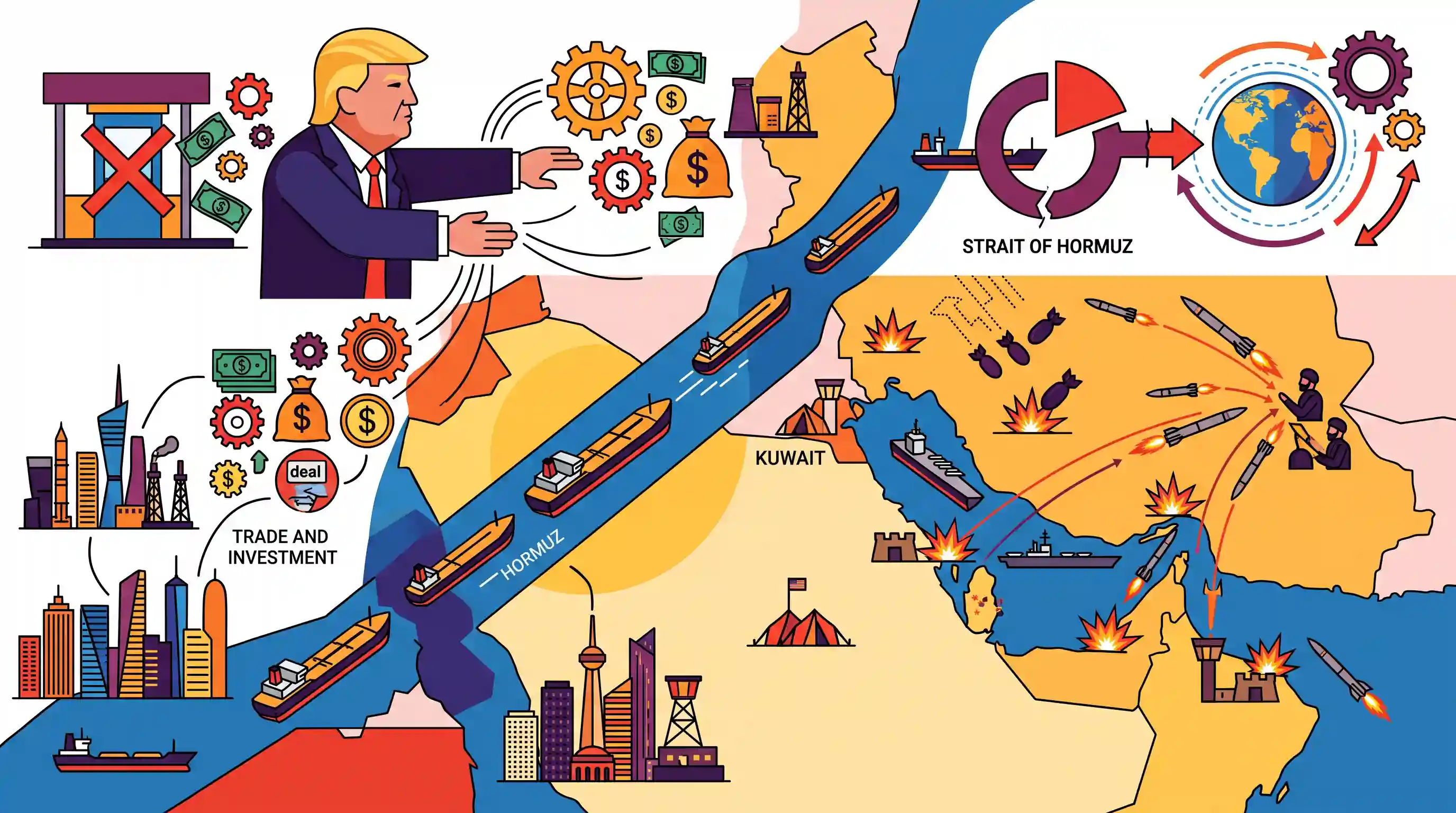
US President Donald Trump has reversed his plan to impose a 20% shipping toll (United States Reimbursement Fee) on Strait of Hormuz cargo, opting instead for bilateral trade and investment deals with Gulf countries. However, the military conflict with Iran continues to intensify. The US is maintaining a naval blockade and executing airstrikes on Iran, which has retaliated with ballistic missile strikes against US military bases in Bahrain, Kuwait, Oman, and Jordan. This persistent conflict threatens to destabilize global energy security, as the Strait of Hormuz serves as a chokepoint for 20% of global oil and gas transit.
Key Points
- US President Donald Trump dropped his decision to levy a 20% United States Reimbursement Fee on cargo shipped through the Strait of Hormuz, replacing it with trade and investment deals with various Gulf States.
- Despite the fee waiver, the US military maintains a strict naval blockade of Iran, though the strategic waterway remains open to other global commercial transit.
- Military escalation continues as the US conducted a third consecutive night of airstrikes against Iran, and Iran retaliated with ballistic missile strikes on US military installations across the Gulf region, including Bahrain, Kuwait, Oman, and Jordan.
- Regional air defenses engaged; Jordan successfully intercepted four Iranian ballistic missiles, while explosions and sirens were reported in Manama, Bahrain.
- Prior to the war, approximately 20% of global oil and gas supply passed through the Strait of Hormuz, meaning the ongoing conflict carries severe risks of global energy supply chain disruption and high inflation.
Important Terms
United States Reimbursement Fee

A proposed 20% transit fee on commercial cargo transiting the Strait of Hormuz, introduced and then reversed by US President Donald Trump in July 2026.
UPSC context
GS Paper 2 (International Relations). Tests knowledge of unilateral trade barriers, global energy transit, and US foreign policy shifts.
Strait of Hormuz
A vital international maritime chokepoint between Iran and Oman, connecting the Persian Gulf to the Gulf of Oman and carrying approximately 20% of global oil transit.
UPSC context
GS Paper 1 (World Geography) & GS Paper 2 (International Relations). Tests strategic maritime geography and India's energy security vulnerabilities.
Freedom of Navigation
A principle of customary international law codified under UNCLOS, ensuring that sovereign vessels enjoy unhindered transit through international waterways and high seas without arbitrary state interference.
UPSC context
GS Paper 2 (International Relations/UNCLOS). Tests understanding of maritime laws, territorial sovereignty, and rules-based international order.
Naval Blockade
A military effort to cut off maritime access to a country's ports, used as a strategic tool in conflicts to disrupt enemy trade and military logistics.
UPSC context
GS Paper 2 (International Relations/Geopolitics) & GS 3 (Security). Tests understanding of warfare strategies, sanctions, and trade disruptions.
US Military
The armed forces of the United States, acting as a critical instrument of US foreign policy, maritime security enforcement, and strategic deterrence worldwide.
UPSC context
GS Paper 2 (Bilateral Relations/Global Security). Tests understanding of superpower geopolitics, military alliances, and regional power dynamics.
White House
The official residence and principal workplace of the President of the United States, representing the executive authority and center of US foreign policy decision-making.
UPSC context
GS Paper 2 (International Relations). Tests understanding of executive power structures and bilateral diplomatic actions in international relations.
Prelims Trap
The Strait of Hormuz is bordered exclusively by Iran and the United Arab Emirates (UAE) at its narrowest point.
Oman borders the southern side of the strait via its Musandam Peninsula exclave, making Oman, not just the UAE and Iran, a key littoral state of the chokepoint.
Static Concepts Connected
What are the primary West Asian maritime chokepoints and their terrestrial bypass alternatives?
- Strait of Hormuz: Connects the Persian Gulf to the Gulf of Oman; bypassed by UAE's Habshan-Fujairah pipeline and Saudi Arabia's East-West Pipeline.
- Bab-el-Mandeb: Connects the Red Sea to the Gulf of Aden; critical for Suez Canal traffic but lacks immediate direct terrestrial bypass pipelines.
- Strategic Vulnerability: Control over 30% of global seaborne petroleum, making their physical security vital for net energy-importing nations like India.
How does India safeguard its energy security against maritime transit shocks?
- Strategic Petroleum Reserves: Maintains underground rock cavern storages in Phase-I (Visakhapatnam, Mangaluru, Padur) holding ~5.33 MMT of crude to cushion supply disruptions.
- Supply Diversification: Reducing dependence on Hormuz (~50% of imports) by actively sourcing crude from Russia, Africa, and North America.
- Equity Oil & G2G: Securing equity oil overseas through ONGC Videsh (OVL) and establishing long-term G2G supply contracts with diverse suppliers.
Cross-Topic Patterns
Maritime Security + SAGAR Initiative
Escalation in West Asian chokepoints tests India's SAGAR framework, forcing the Indian Navy to scale up anti-piracy and merchant vessel escort missions under Operation Sankalp.
West Asian Conflict + Macro-Stability
Hormuz transit disruptions spike Brent crude prices, widening India's Current Account Deficit (CAD) and triggering imported inflation, which complicates RBI's monetary policy maneuvering.

West Asian chokepoints, bypass pipelines (Habshan-Fujairah), and India's SPR phase-II will likely feature in a 2026 multi-statement MCQ.
Linked PYQs · 3
Linked PYQs · 3
- 2025MainsGS2
"Energy security constitutes the dominant kingpin of India's foreign policy, and is linked with India's overarching influence in Middle Eastern countries.” How would you integrate energy security with India's foreign policy trajectories in the coming years?
- 2017MainsGS2
The question of India's Energy Security constitutes the most important part of India's economic progress. Analyze India's energy policy cooperation with West Asian countries.
- 2026PrelimsGS1
Ships from which of the following countries have to cross the Strait of Hormuz to reach out to the Indian Ocean ? 1. Bahrain 2. Syria 3. Qatar 4. Egypt Select the answer using the code given below :
