US National Security Tariffs under Section 232 After Court Ruling
Source:Indian Express ↗
Why It Matters
US trade protectionism drastically alters global trade dynamics, impacting developing countries like India through shifting supply chains, disrupted export markets, and the continuous erosion of multilateral frameworks such as the WTO.
Summary
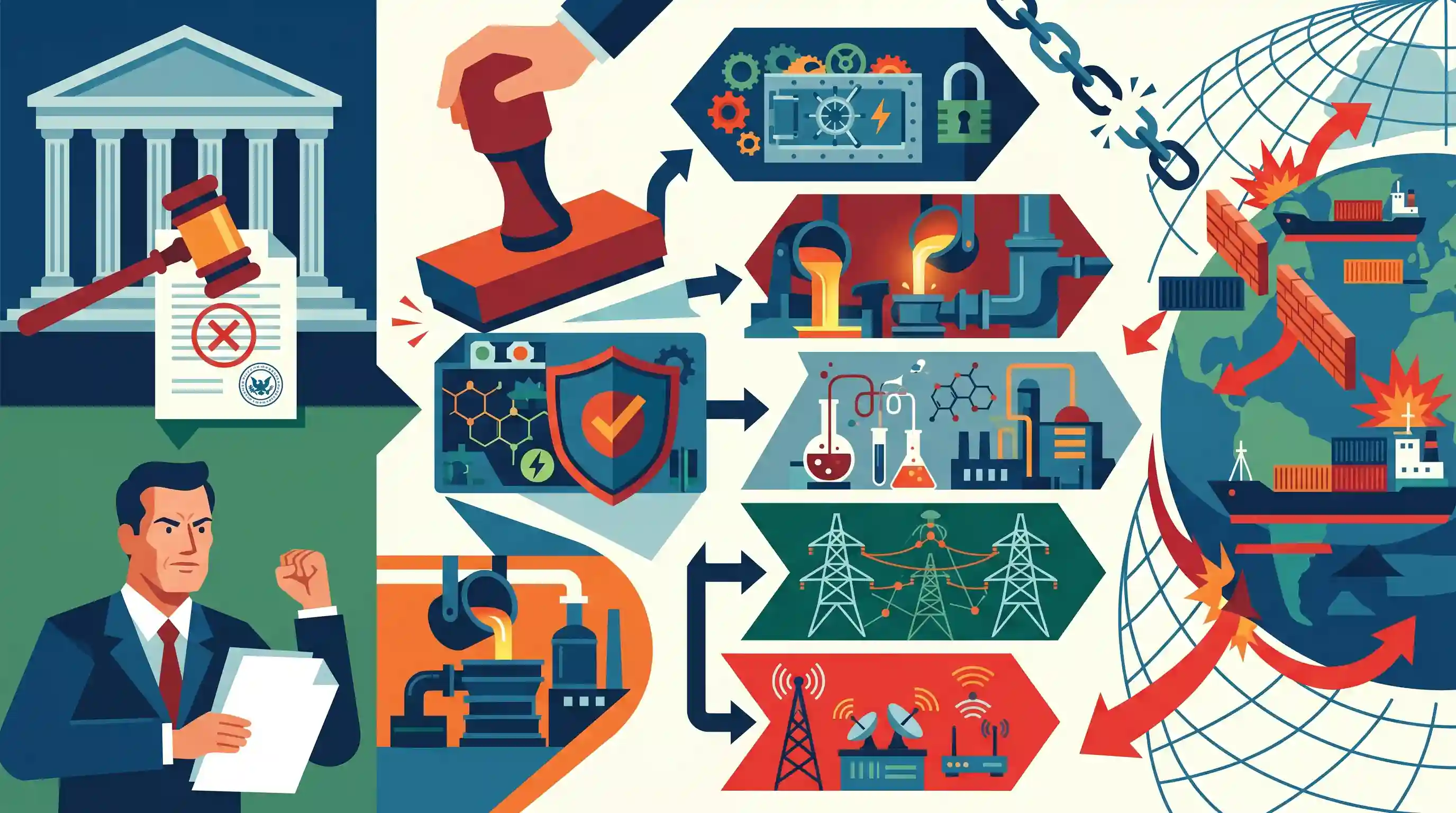
Following a US Supreme Court decision that struck down sweeping tariffs previously imposed by President Donald Trump under the International Emergency Economic Powers Act (IEEPA), his administration is reportedly preparing to impose new tariffs on a half-dozen critical industries. Citing national security concerns, the new levies would rely on Section 232 of the Trade Expansion Act of 1962. These tariffs will target key sectors such as large-scale batteries, cast iron, industrial chemicals, power grids, and telecommunications equipment. This move operates alongside Trump's separate 15% global levy, marking an escalating trend of aggressive trade protectionism under his administration.
Key Points
- US President Donald Trump is considering new national security-based tariffs targeting about six major industries.
- The sectors likely to be affected include power grids, telecommunications equipment, large-scale batteries, industrial chemicals, cast iron, and plastic piping.
- This policy shift comes after the US Supreme Court invalidated many of his previous second-term tariffs pursued under the International Emergency Economic Powers Act (IEEPA).
- The administration plans to utilize Section 232 of the Trade Expansion Act of 1962 to justify the new tariffs.
- These industry-specific measures will be implemented separately from a newly announced 15% temporary global tariff on all US imports.
Important Terms
Section 232 of the Trade Expansion Act of 1962

A 1962 U.S. law authorizing the President to restrict imports through tariffs or quotas if they are found to threaten national security following a Department of Commerce investigation.
UPSC context
GS Paper II & III: Tests understanding of unilateral trade measures and their impact on India's export sectors like steel and aluminum.
International Emergency Economic Powers Act (IEEPA)
A 1977 U.S. federal law granting the President broad power to regulate international economic transactions and freeze assets during a declared national emergency arising from external threats.
UPSC context
GS Paper II: Relates to global economic statecraft, sanctions, and the legal limits of executive power in international relations.
National Security Tariffs
Trade duties imposed under the premise of protecting a nation's vital industries or infrastructure from foreign competition that could compromise defense or economic stability.
UPSC context
GS Paper III: Examines non-tariff barriers and the use of 'national security' as a justification for bypassing WTO trade rules.
Protectionism
Economic policy of shielding domestic industries from foreign competition through import duties, quotas, or subsidies, often leading to increased costs for consumers and trade tensions.
UPSC context
GS Paper III: Vital for discussing global trade slowdowns, 'America First' policies, and their impact on India's growth and employment.
Global Supply Chains
The interconnected network of organizations and processes involved in producing and delivering goods across borders, which can be disrupted by trade barriers or geopolitical shifts.
UPSC context
GS Paper III: Relevant to 'Supply Chain Resilience' and India's potential as an alternative manufacturing hub (China Plus One strategy).
Prelims Trap
Tariffs imposed under national security grounds (Article XXI of GATT) are entirely self-judging and exempt from WTO Dispute Settlement Body review.
WTO panels ruled in recent years that Article XXI is not entirely self-judging. The Dispute Settlement Body has jurisdiction to review if the exception was invoked in good faith during an emergency.
Static Concepts Connected
What are the core WTO tariff principles and the National Security Exception?
- Most-Favored-Nation (MFN): Members must treat all WTO partners equally; countries cannot normally discriminate between their trading partners.
- Bound Tariffs: Countries commit to ceiling rates for tariffs; unilateral and arbitrary global hikes violate these bindings.
- Article XXI (GATT): Allows members to breach WTO obligations if deemed necessary for the protection of their "essential security interests."
How do WTO trade remedies differ from unilateral protectionist tariffs?
- Anti-Dumping Duties: Specifically target imports priced below fair market value, requiring a formal, evidence-based domestic injury investigation.
- Countervailing Duties: Designed to neutralize unfair foreign government subsidies on specific imported goods that harm domestic industries.
- Unilateral Tariffs: Blanket levies applied without WTO-sanctioned injury investigations, violating multilateral trading rules.
Cross-Topic Patterns
Protectionism driving India's PLI scheme
As the US shifts from hyper-globalization to economic security via tariffs, India's PLI scheme acts as a strategic shield, promoting import substitution in critical sectors like telecom and batteries.
Tariff wars and imported inflation
Universal US tariffs disrupt global supply chains and strengthen the dollar, directly exacerbating imported inflation, currency volatility, and current account pressures for emerging markets like India.

Expect a GS2/GS3 question evaluating the 'weaponization of trade' and how routine invocations of national security undermine the WTO framework.
Linked PYQs · 4
Linked PYQs · 4
- 2025MainsGS3
What are the challenges before the Indian economy when the world is moving away from free trade and multilateralism to protectionism and bilateralism? How can these challenges be met?
- 2018MainsGS3
How would the recent phenomena of protectionism and currency manipulations in world trade affect macroeconomic stability of India?
- 2018MainsGS2
What are the key areas of reform if the WTO has to survive in the present context of "Trade War', especially keeping in mind the interest of India?
- 2012MainsGS2
Discuss the likely negative impact of the protectionist measures proposed by the US on India's software industry.
