US Tariffs on China over Military Aid to Iran
Source:Indian Express ↗
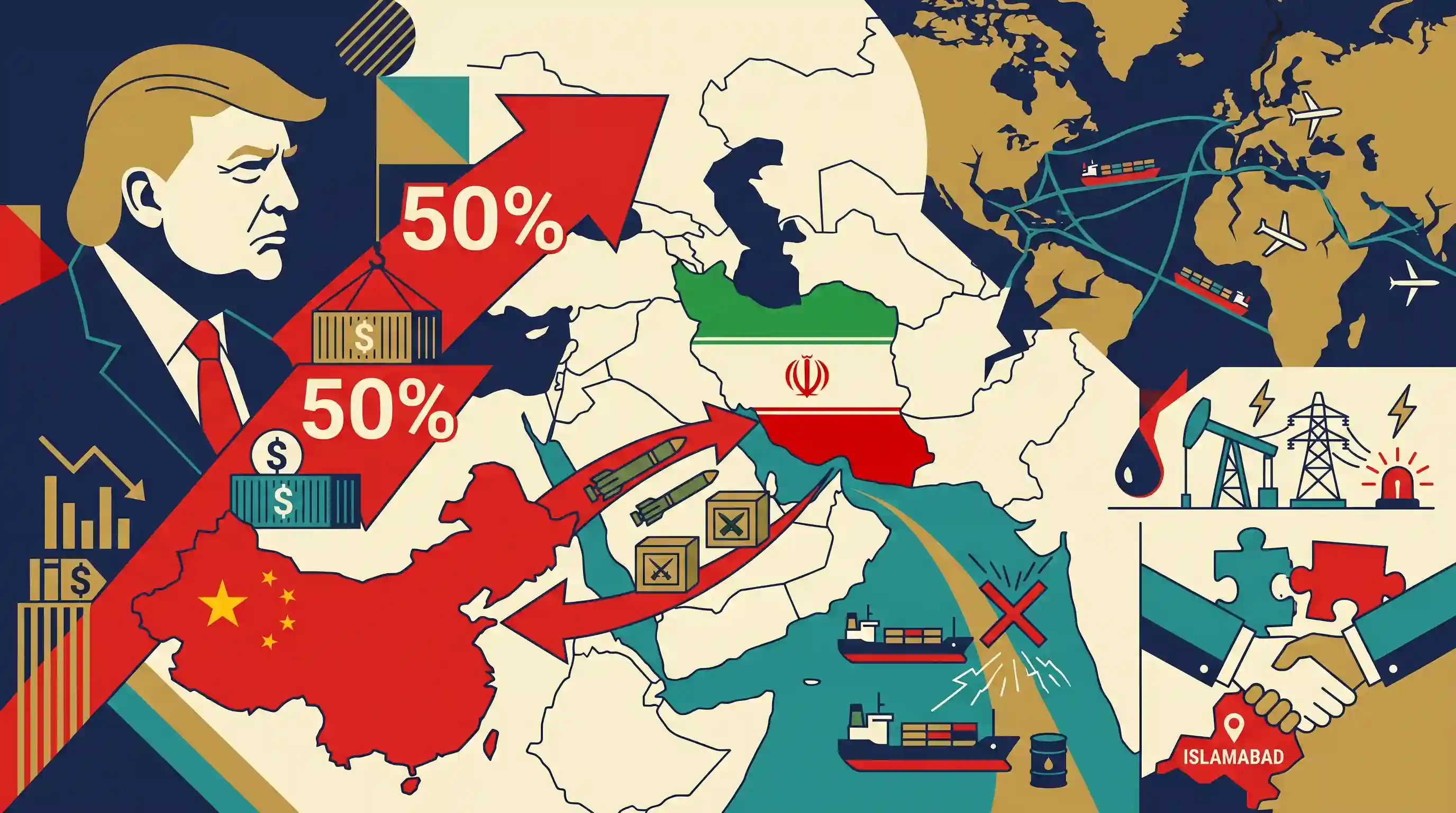
Why It Matters
The interconnectedness of trade and security is vividly illustrated here, as the US leverages economic tools (tariffs) against a global power (China) to achieve security objectives in West Asia (Iran). For India, a blockade of the Strait of Hormuz or wider conflict in the Middle East poses immediate risks to energy security and diaspora safety, while the weaponisation of trade affects global supply chains and WTO norms.
Summary
US President Donald Trump has issued a severe warning to China, threatening a 50% tariff on Chinese imports if Beijing supplies weaponry or military aid to Iran. This threat emerges against a backdrop of escalating tensions in the Middle East, exacerbated by the failure of US-Iran negotiations in Islamabad that imperils an ongoing two-week ceasefire. Trump's aggressive posturing, including claims of being able to 'take out' Iran swiftly and historical references to blockading the Strait of Hormuz, highlights the volatility of the situation. The convergence of US-China trade leverage and West Asian security dynamics presents significant risks for global trade, maritime choke points, and energy security, which are critical to India's foreign policy interests.
Key Points
- US President Donald Trump has threatened to impose a 50% tariff on Chinese goods if Beijing provides weapons or military assistance to Iran.
- Negotiations between the US and Iran held in Islamabad have failed, jeopardising a two-week ceasefire that was set to expire on April 22.
- Trump issued a stark warning that he could 'take out' Iran in 'one day', underscoring the severity of the confrontation.
- The escalating rhetoric follows historical precedents of US pressure, including a previous order by Trump to blockade the Strait of Hormuz.
- Iran's Islamic Revolutionary Guard Corps (IRGC) responded by characterising the US actions and threats as a 'deadly vortex'.
Important Terms
Islamic Revolutionary Guard Corps (IRGC)

An elite branch of Iran’s Armed Forces established after the 1979 Revolution to protect the clerical regime. It operates independently of the regular military, managing regional proxy networks and internal security.
UPSC context
GS Paper 2 (International Relations); tests understanding of West Asian security, state-sponsored actors, and India's regional interests.
World Trade Organization (WTO)
An international body established in 1995 to regulate global trade. It provides a framework for negotiating trade agreements and settling commercial disputes among its 164 member nations.
UPSC context
GS Paper 3 (Economy); critical for issues concerning tariffs, global trade barriers, and India’s stance in multilateral negotiations.
Strait of Hormuz
A strategic waterway connecting the Persian Gulf to the Gulf of Oman. It is the world’s most critical oil transit chokepoint, handling approximately one-fifth of global oil consumption daily.
UPSC context
GS Paper 1 (Geography) & GS 2 (International Relations); vital for mapping and analyzing India’s energy import vulnerabilities.
Maritime Choke Points
Narrow sea passages along major shipping routes—such as straits or canals—where maritime traffic is concentrated, making them strategic for trade but vulnerable to military or economic blockades.
UPSC context
GS Paper 2 (International Relations); essential for maritime security, freedom of navigation, and understanding geo-economic bottlenecks in global trade.
Energy Security
The uninterrupted availability of energy sources at an affordable price. For India, it involves securing reliable supply lines and diversifying sources to reduce high import dependency risks.
UPSC context
GS Paper 3 (Infrastructure/Energy); a recurring topic regarding India’s strategic autonomy and economic resilience against global price shocks.
Prelims Trap
US tariffs and secondary sanctions on countries trading with Iran are backed by UN Security Council resolutions.
These are unilateral economic sanctions (like CAATSA), not multilateral UN mandates. India historically recognizes only UN-mandated sanctions, making US secondary sanctions a diplomatic friction point.
Static Concepts Connected
What are the key maritime chokepoints in the Middle East?
- Strait of Hormuz: Connects the Persian Gulf to the Gulf of Oman; handles approximately 20% of global oil trade and one-fifth of LNG.
- Bab el-Mandeb: Connects the Red Sea to the Gulf of Aden; acts as the critical southern gateway for Suez Canal maritime traffic.
- Suez Canal: Connects the Red Sea to the Mediterranean Sea, offering the shortest maritime route between Europe and the Indo-Pacific.
How do secondary sanctions differ from primary sanctions?
- Primary Sanctions: Restrict citizens, companies, and financial institutions of the sanctioning nation from doing business with the target country.
- Secondary Sanctions: Threaten economic penalties on third-party countries and foreign entities if they continue to trade with the sanctioned target.
- India's Policy: India formally recognizes and enforces only multilateral sanctions mandated by the UN Security Council, rejecting unilateral measures in principle.
Cross-Topic Patterns
Strait blockade + imported inflation
A Hormuz blockade spikes global crude prices, directly expanding India's Current Account Deficit (CAD) and causing imported inflation, heavily complicating the RBI's inflation-targeting mandate.
China-Iran CSP + De-dollarization
China’s 25-year Strategic Partnership with Iran secures discounted oil via yuan settlements, bypassing US dollar hegemony, Western financial sanctions, and integrating Tehran into the BRI.

Map questions linking Middle East straits (Hormuz/Bab el-Mandeb) to bordering nations and global trade disruptions are highly likely in 2026.
Linked PYQs · 4
Linked PYQs · 4
- 2018MainsGS2
What are the key areas of reform if the WTO has to survive in the present context of "Trade War', especially keeping in mind the interest of India?
- 2021MainsGS2
“The USA is facing an existential threat in the form of a China, that is much more challenging than the erstwhile Soviet Union.” Explain.
- 2025MainsGS2
"Energy security constitutes the dominant kingpin of India's foreign policy, and is linked with India's overarching influence in Middle Eastern countries.” How would you integrate energy security with India's foreign policy trajectories in the coming years?
- 2017MainsGS2
The question of India's Energy Security constitutes the most important part of India's economic progress. Analyze India's energy policy cooperation with West Asian countries.
