Strait of Hormuz Blockade Persists Despite US Iran Deescalation
Source:Indian Express ↗
Why It Matters
The Strait of Hormuz is one of the world's most critical maritime chokepoints for oil trade. Escalations between the US and Iran directly jeopardize global energy security. For India, which heavily relies on oil imports from the Persian Gulf, such geopolitical instability can lead to oil price volatility, inflation, and a wider current account deficit, fundamentally impacting its macroeconomic stability and foreign policy positioning in West Asia.
Summary
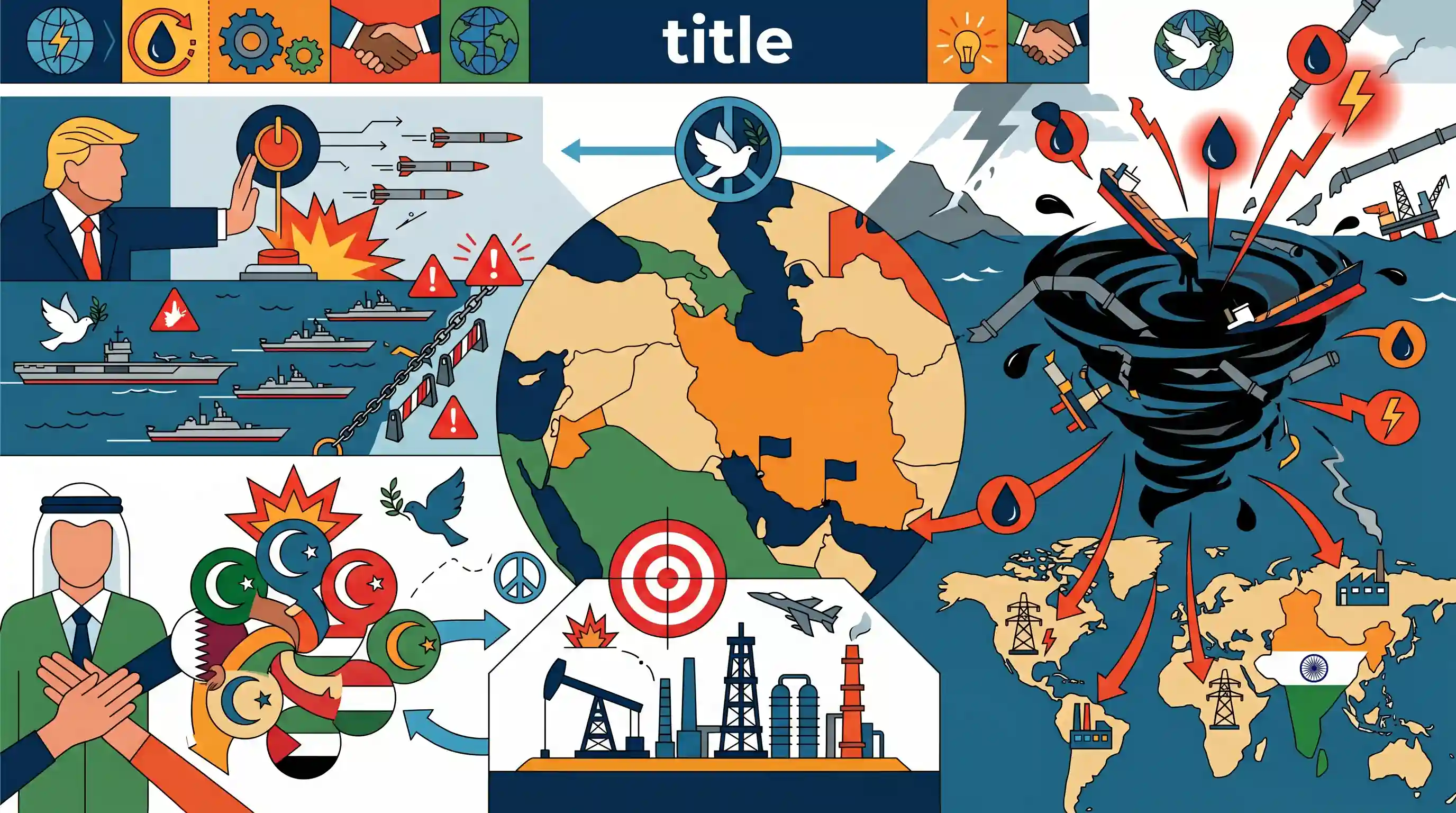
US President Donald Trump called off planned military strikes against Iran, signaling a temporary de-escalation of immediate conflict, but maintained a strict naval blockade of the Strait of Hormuz. The situation follows Qatari mediation, which facilitated a broader, unannounced peace framework encompassing several Middle Eastern states. While military action was averted, tensions remain high as Trump previously warned of targeting Iran's Kharg Island oil export hub. Iran has countered by warning that any conflict would create an 'endless energy quagmire,' emphasizing the acute vulnerability of global energy markets to instability in the Persian Gulf.
Key Points
- US President Donald Trump abruptly canceled planned military strikes on Iran but confirmed that the naval blockade in the Strait of Hormuz remains in full force.
- The de-escalation appears linked to Qatari mediation and a broader, unannounced peace framework involving numerous Middle Eastern states including Israel, Saudi Arabia, and the UAE.
- The US had previously threatened to seize Kharg Island, which is Iran's principal oil export hub, underscoring the energy dimensions of the geopolitical standoff.
- Iranian officials cautioned that any military conflict would ignite an 'endless energy quagmire,' severely disrupting global energy markets and oil supplies.
Important Terms
Strait of Hormuz

A narrow waterway between the Persian Gulf and Gulf of Oman; the world's most critical maritime chokepoint for global oil and gas transit.
UPSC context
GS Paper II/III: Strategic chokepoints and their impact on India's energy security and maritime trade routes.
Kharg Island
Iran's primary maritime crude oil export terminal located in the northern Persian Gulf, handling nearly 90% of the country's oil exports.
UPSC context
GS Paper II/I: Strategic geography and regional conflict sites impacting global energy infrastructure.
Energy Security
The uninterrupted availability of energy sources at an affordable price, crucial for national sovereignty and sustaining economic growth.
UPSC context
GS Paper III: India's import dependency, strategic petroleum reserves, and vulnerability to West Asian instability.
Naval Blockade
An act of war where a naval power prevents vessels from entering or leaving an enemy's coastal areas or ports.
UPSC context
GS Paper II: International humanitarian law, maritime security, and the legal frameworks governing regional conflicts.
West Asia Geopolitics
The political and strategic interactions between Middle Eastern nations and global powers, influenced heavily by oil, religion, and security alliances.
UPSC context
GS Paper II: Effect of policies and politics of developed/developing countries on India's interests.
Qatari Mediation
A diplomatic process where a third party (e.g., Qatar) facilitates negotiations between conflicting states to reach a peaceful resolution.
UPSC context
GS Paper II: International relations and the role of middle powers in diplomatic conflict resolution.
Prelims Trap
"The Strait of Hormuz is bordered by Iran to the north and the United Arab Emirates to the south."
Aspirants often assume the UAE borders the southern part of the Strait of Hormuz. In reality, the southern coast is the Musandam Peninsula, an exclave belonging to Oman.
Static Concepts Connected
Which countries border the Persian Gulf and the Strait of Hormuz?
- Persian Gulf: Iran, Iraq, Kuwait, Saudi Arabia, Bahrain, Qatar, the UAE, and Oman.
- Strait of Hormuz: Bordered directly by only two countries: Iran to the north and Oman (Musandam Peninsula) to the south.
- Kharg Island: Located in the northern Persian Gulf; it is Iran's chief maritime oil export terminal.
How do geopolitical oil shocks impact India's macroeconomic stability?
- Imported Inflation: Rising crude prices increase fuel and transport costs, causing cascading inflation across the economy.
- CAD & Currency: Higher import bills widen the CAD, applying downward pressure on the Rupee against the Dollar.
- Fiscal Deficit: Government may be forced to cut excise duties on fuel or increase subsidies, reducing revenue and widening the deficit.
Cross-Topic Patterns
Qatar's rise as a diplomatic mediator
Qatar frequently bridges gaps between adversarial actors (US-Taliban, Hamas-Israel, US-Iran), acting as a neutral diplomatic ground. This reflects a shift from Saudi-dominated diplomacy to multi-polar mediation in West Asia.
Chokepoints + Strategic Petroleum Reserves
Blockades in Hormuz or Bab-el-Mandeb immediately test India's energy resilience, highlighting the critical role of India's Strategic Petroleum Reserves (SPRs) to buffer against temporary supply shocks.

Expect a 2026 Prelims question pairing Persian Gulf map locations (Hormuz, Kharg Island) with macroeconomic impacts like imported inflation.
Linked PYQs · 4
Linked PYQs · 4
- 2025MainsGS2
"Energy security constitutes the dominant kingpin of India's foreign policy, and is linked with India's overarching influence in Middle Eastern countries.” How would you integrate energy security with India's foreign policy trajectories in the coming years?
- 2017MainsGS2
The question of India's Energy Security constitutes the most important part of India's economic progress. Analyze India's energy policy cooperation with West Asian countries.
- 2024PrelimsGS1
Consider the following statements : Statement-I : Sumed pipeline is a strategic route for Persian Gulf oil and natural gas shipments to Europe. Statement-II : Sumed pipeline connects the Red Sea with the Mediterranean Sea. Which one of the following is correct in respect of the above statements?
- 2025PrelimsGS1
India is one of the founding members of the International North-South Transport Corridor (INSTC), a multimodal transportation corridor, which will connect
