Human Rights Watch Report on US Democratic Backsliding
Source:Indian Express ↗
Why It Matters
The article is highly relevant for GS Paper 2 as it provides real-world context on democratic backsliding and institutional stress in the US. It serves as a vital case study for comparing the constitutional tenets and resilience of large democracies (India and the USA) and analyzing the global role of human rights NGOs in holding governments accountable.
Summary
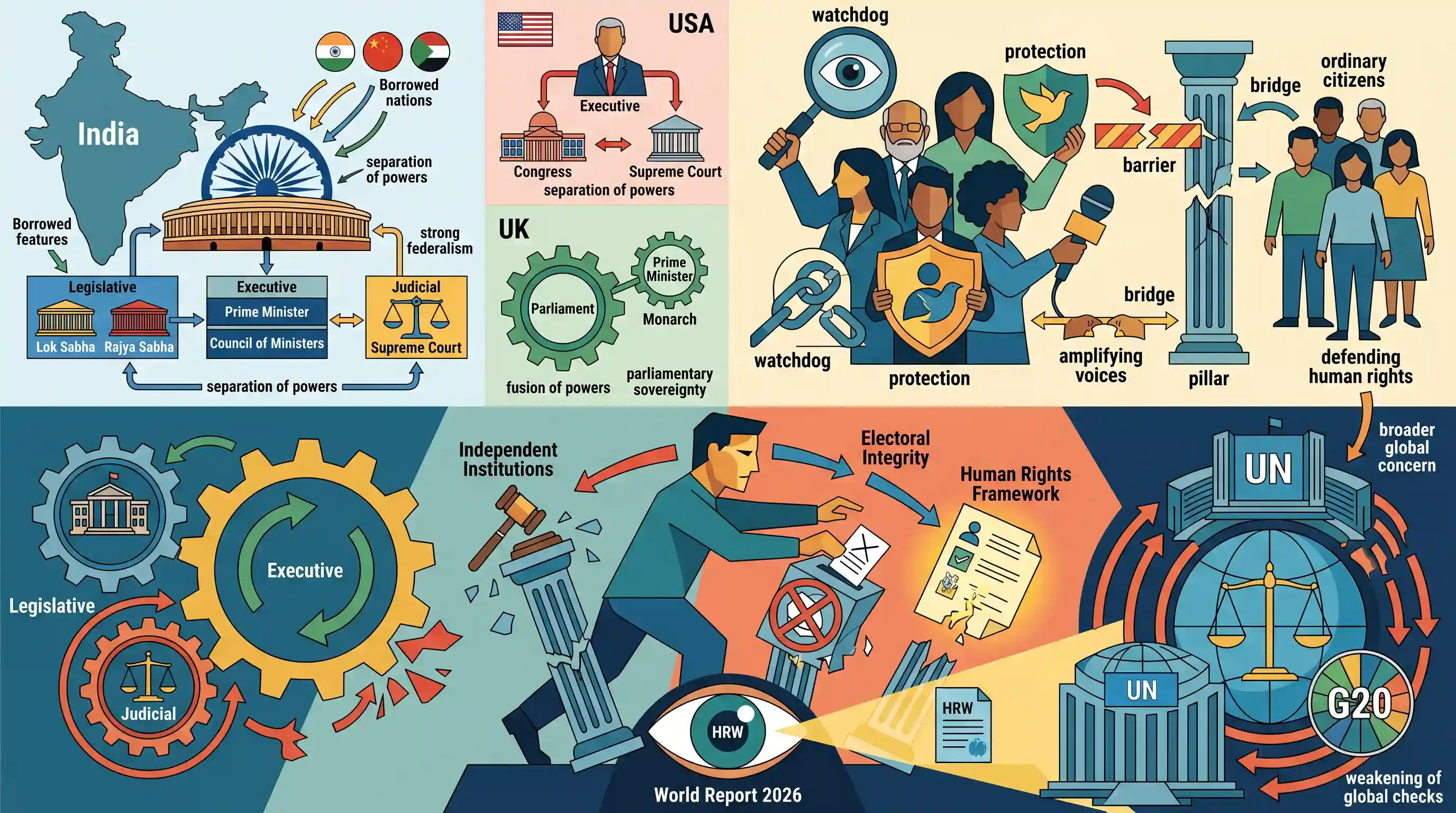
According to the 2026 global report by Human Rights Watch (HRW), Donald Trump has actively undermined key pillars of US democracy. The international non-governmental organization highlights threats to independent institutions, electoral integrity, and human rights frameworks within the United States. This assessment not only underscores domestic vulnerabilities in the US political system but also reflects a broader global concern over democratic backsliding and the weakening of institutional checks and balances.
Key Points
- Human Rights Watch (HRW) released its 2026 global report, warning that Donald Trump has systematically attacked the core pillars of US democracy.
- The report highlights severe threats to democratic institutions, electoral integrity, and human rights norms in the United States.
- The findings underscore a broader global trend of democratic backsliding, emphasizing the critical need for institutional checks and balances to prevent authoritarian overreach.
- The situation raises comparative governance questions regarding the resilience of independent institutions and the separation of powers in major democracies.
Important Terms
Human Rights Watch (HRW)

An international non-governmental organization that conducts research and advocacy on human rights. It monitors global abuses and pressures governments to uphold legal standards.
UPSC context
GS Paper II: Role of NGOs, international institutions, and their impact on global governance and human rights standards.
Democratic Backsliding
The gradual decline in the quality of democratic institutions, norms, and processes, often leading a democracy toward authoritarianism or illiberalism.
UPSC context
GS Paper II: Comparison of constitutional schemes; critical for analyzing threats to democratic stability in India and abroad.
Institutional Checks and Balances
A constitutional principle where the executive, legislature, and judiciary have distinct powers and can limit each other's actions to prevent the concentration of power.
UPSC context
GS Paper II: Separation of powers; fundamental for understanding the accountability of state organs in the Indian and US systems.
Rules-Based International Order
A shared commitment by nations to conduct their activities according to a framework of international law, norms, and established institutions.
UPSC context
GS Paper II: International relations and global groupings; examines India's role in maintaining global stability and legal frameworks.
Civil Society Organizations (CSOs)
Non-state entities—including NGOs, community groups, and labor unions—that operate independently of the government to advocate for public interests and social justice.
UPSC context
GS Paper II: Governance and role of stakeholders in the development process; highlights the watchdog function of non-state actors.
Prelims Trap
"Human Rights Watch (HRW) is an intergovernmental organization under the United Nations."
Aspirants often confuse prominent human rights watchdogs with UN bodies (like the UN Human Rights Council). HRW is an independent international NGO.
Static Concepts Connected
How does the US separation of powers contrast with India's?
- Strict Separation: The US Constitution mandates rigid separation; the President and cabinet are not members of the legislature.
- Functional Overlap: India follows the Westminster model where the executive is drawn from and accountable to the legislature.
- Judicial Review: Both systems allow courts to strike down unconstitutional laws, though India balances this with parliamentary sovereignty.
What is Human Rights Watch (HRW) and its mandate?
- Origins: Founded in 1978 as Helsinki Watch to monitor Soviet compliance with the 1975 Helsinki Accords.
- Nature: An international non-governmental organization (INGO), distinct from UN bodies, funded strictly by private donations.
- Function: Acts as a global watchdog investigating human rights abuses and tracking democratic backsliding worldwide.
Cross-Topic Patterns
Global INGOs + Democratic Watchdogs
Organizations like HRW and Amnesty International frequently appear in GS2 linking the role of civil society with extra-institutional accountability and international human rights norms.
Backsliding vs. Constitutional Morality
The global trend of democratic backsliding forms a useful comparative contrast for India's judicial reliance on 'Constitutional Morality' to constrain executive overreach.

Expect a GS2 Mains question comparing the resilience of institutional checks in the US and India amidst global democratic backsliding.
Linked PYQs · 3
Linked PYQs · 3
- 2018MainsGS2
India and USA are two large democracies. Examine the basic tenets on which the two political systems are based.
- 2019MainsGS2
Do you think that Constitution of India does not accept principle of strict separation of powers rather it is based on the principle of 'checks and balance'? Explain.
- 2021MainsGS2
Can Civil Society and Non-Governmental Organizations present an alternative model of public service delivery to benefit the common citizen? Discuss the challenges of this alternative model.
