US and Australia Sign Rare Earth Minerals Supply Agreement
Source:Indian Express ↗
Why It Matters
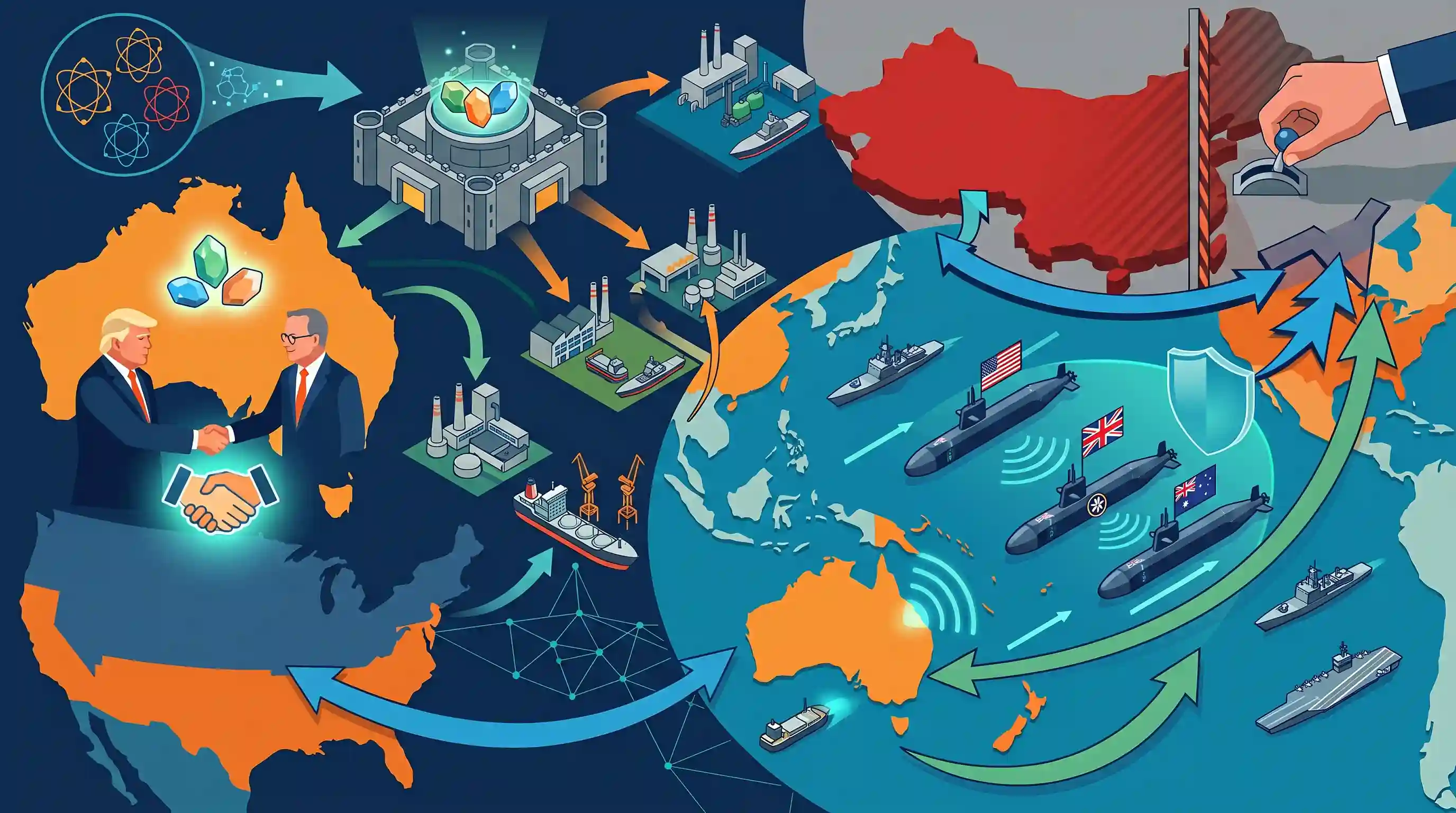
The agreement highlights the ongoing global shift away from dependence on China for critical minerals. For UPSC aspirants, this illustrates the intersection of geopolitics, high-tech supply chains, and security architectures (AUKUS) in the Indo-Pacific, which are highly relevant for IR and Economy topics.
Summary
US President Donald Trump and Australian Prime Minister Anthony Albanese have signed a strategic agreement concerning rare earth minerals. Australia intends to establish a strategic reserve of these critical materials, allowing allies like the United States and the United Kingdom to purchase shares. The primary objective is to build resilient supply chains and reduce dependence on China, which heavily dominates the global rare earths market and has recently tightened export controls. Furthermore, the leaders committed to accelerating the AUKUS defence pact, particularly the development and deployment of nuclear-powered submarines, to strengthen deterrence and stability in the Indo-Pacific region.
Key Points
- The US and Australia signed an agreement to collaborate on rare earth minerals and minor metals.
- Australia plans to create a strategic reserve of these critical minerals and offer shares to allies including the US and UK.
- The agreement is strategically motivated to reduce Western reliance on Chinese supply chains, following China's tightened export controls.
- The leaders also discussed accelerating the AUKUS defence pact, specifically regarding nuclear-powered submarines.
- Australia is seeking to balance its strategic alliance with the US while managing its economic relationship with China.
Important Terms
AUKUS Defence Pact

A trilateral security partnership between Australia, the UK, and the USA aimed at ensuring a free and open Indo-Pacific, primarily through sharing nuclear-powered submarine technology and advanced defense capabilities like AI and quantum computing.
UPSC context
GS Paper II (International Relations). Tests knowledge of regional security groupings and their impact on India’s maritime strategy and Indo-Pacific stability.
Rare Earth Minerals
A group of 17 metallic elements (15 lanthanides plus scandium and yttrium) essential for manufacturing high-tech products, defense systems, permanent magnets for electric vehicles, and renewable energy technologies.
UPSC context
GS Paper III (Economy/Science). Relevant for energy transition, high-tech manufacturing, and addressing China's global dominance in mineral processing.
Critical Minerals
Minerals essential for economic or national security, often with supply chains vulnerable to disruption due to high geographic concentration or processing monopolies, such as lithium, cobalt, and rare earth elements.
UPSC context
GS Paper I (Geography) and GS III (Economy). Important for resource security, green technology manufacturing, and strategic international partnerships.
Indo-Pacific
A geopolitical and maritime region spanning the Indian and Pacific Oceans, increasingly treated as a single strategic space vital for global trade, maritime security, and balancing regional power dynamics.
UPSC context
GS Paper II (International Relations). Core focus of India’s maritime strategy (SAGAR) and its role in a rules-based international order.
Supply Chain Resilience
The capacity of a supply chain to anticipate, adapt to, and recover from disruptions by diversifying sources, stockpiling, and 'friend-shoring' to reduce dependence on single-source suppliers like China.
UPSC context
GS Paper III (Economy). Key for understanding economic security, the Supply Chain Resilience Initiative (SCRI), and global trade risk management.
Prelims Trap
Rare Earth Elements are geologically scarce and exclusively found in China, giving it a natural monopoly.
REEs are globally abundant, including in Australia and India. China's monopoly stems from heavily subsidized, environmentally lax processing and refining capabilities, not geological scarcity.
Static Concepts Connected
What are Rare Earth Elements (REEs) and why are they considered strategic?
- Composition: A group of 17 chemically similar elements, including the 15 lanthanides on the periodic table plus scandium and yttrium.
- The "Rare" Misnomer: They are relatively abundant in the Earth's crust but are rarely found in concentrated, easily mineable ore deposits, making extraction costly.
- Strategic Use: Essential for permanent magnets in wind turbines, electric vehicles, and advanced military hardware like missile guidance systems.
What are the two core pillars of the AUKUS security partnership?
- Pillar 1 (Submarines): Assisting Australia in acquiring conventionally armed, nuclear-powered submarines (SSNs) to project maritime deterrence in the Indo-Pacific.
- Pillar 2 (Advanced Tech): Collaborative development of advanced defense capabilities, including artificial intelligence, quantum technologies, hypersonics, and electronic warfare.
Cross-Topic Patterns
Minerals Security Partnership (MSP) + Friend-shoring
India joined the US-led MSP to secure critical mineral chains. This US-Australia strategic reserve mechanism operates on the exact same 'friend-shoring' principle to bypass China's supply chokeholds.
AUKUS hard power vs Quad soft power
While AUKUS explicitly handles hard security and nuclear submarine technology, the Quad deliberately avoids military pacts, focusing instead on geoeconomics, maritime domain awareness, and supply chain resilience.

Expect a multi-statement question mixing AUKUS Pillar-2 technologies, the Minerals Security Partnership, and China's REE processing monopoly.
Linked PYQs · 5
Linked PYQs · 5
- 2025PrelimsGS1
Consider the following statements : I. India has joined the Minerals Security Partnership as a member. II. India is a resource-rich country in all the 30 critical minerals that it has identified. III. The Parliament in 2023 has amended the Mines and Minerals (Development and Regulation) Act, 1957 empowering the Central Government to exclusively auction mining lease and composite license for certain critical minerals. Which of the statements given above are correct?
- 2012PrelimsGS1
Recently, there has been a concern over the short supply of a group of elements called 'rare earth metals'. Why? 1. China, which is the largest producer of these elements, has imposed some restrictions on their export. 2. Other than China, Australia, Canada and Chile, these elements are not found in any country. 3. Rare earth metals are essential for the manufacture of various kinds of electronic items and there is a growing demand for these elements. Which of the statements given above is/are correct?
- 2021MainsGS2
The newly tri-nation partnership AUKUS is aimed at countering China's ambitions in the Indo-Pacific region. Is it going to supersede the existing partnerships in the region? Discuss the strength and impact of AUKUS in the present scenario.
- 2024MainsGS2
‘The West is fostering India as an alternative to reduce dependence on China's supply chain and as a strategic ally to counter China's political and economic dominance.’ Explain this statement with examples.
- 2025PrelimsGS1
Consider the following statements : Statement I: Some rare earth elements are used in the manufacture of flat television screens and computer monitors. Statement II : Some rare earth elements have phosphorescent properties. Which one of the following is correct in respect of the above statements?
