India UK Experts Formulate Strategies Against Antimicrobial Resistance
Source:The Hindu ↗
Why It Matters
AMR is one of the top 10 global public health threats identified by the WHO. The transition from clinical to community-level surveillance and the adoption of the One Health approach are critical policy shifts to manage the emergence of superbugs. This aligns with UPSC GS3 Science and Technology (biotechnology, health issues) and GS2 (health policy and governance).
Summary
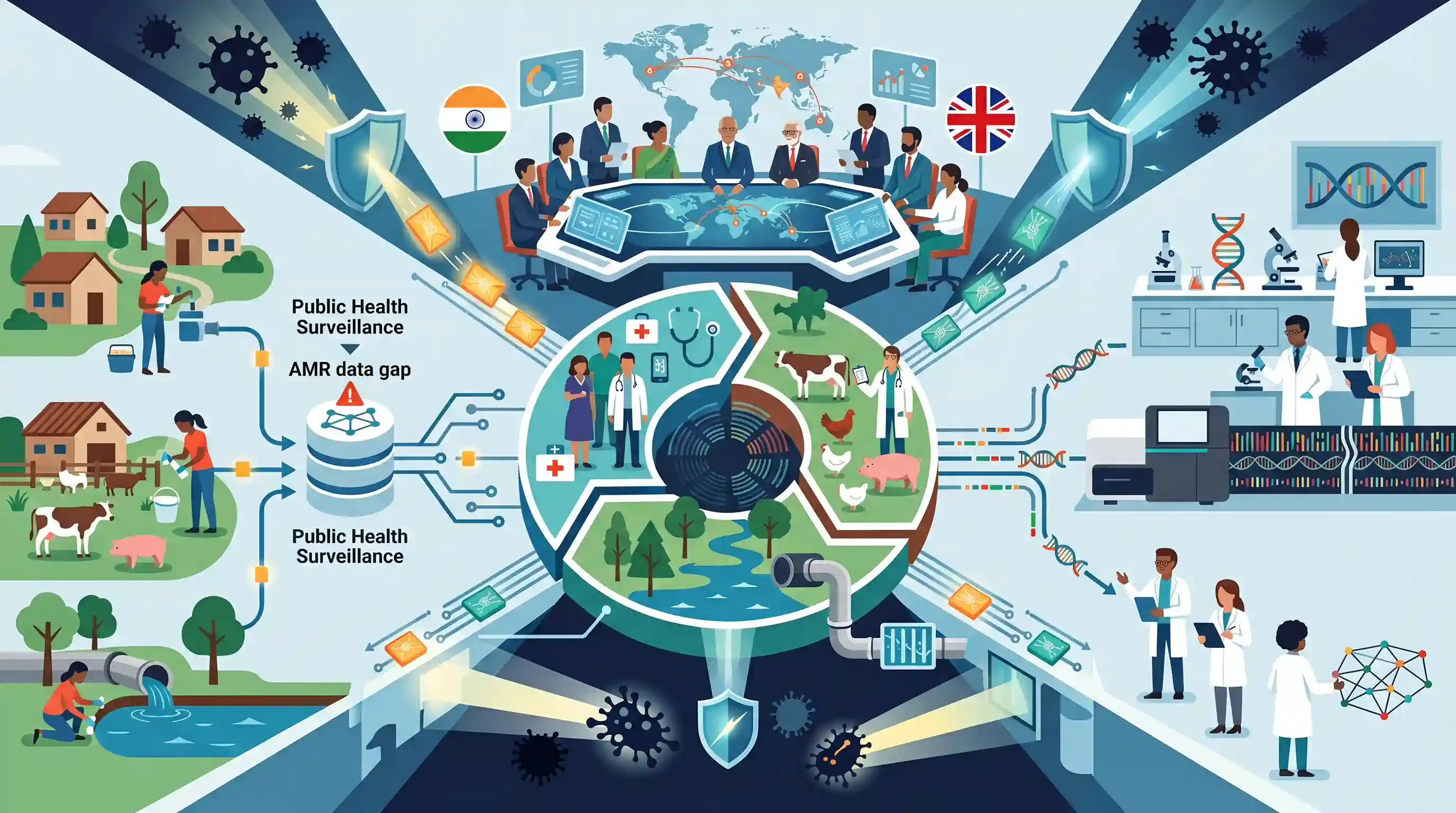
A three-day India-U.K. network meeting on Antimicrobial Resistance (AMR) was held at SRM University-A.P., emphasizing the urgent need to expand community-level surveillance. Domain experts discussed integrating human, animal, and environmental testing (including livestock and wastewater) under the One Health framework. The event highlighted gaps in current AMR data caused by low awareness and inadequate infrastructure, while promoting collaborative, multidisciplinary research involving genomics, social medicine, and animal health to effectively combat drug-resistant superbugs on a global scale.
Key Points
- Domain experts from India and the U.K. convened at SRM University-A.P. to formulate strategies for combating Antimicrobial Resistance (AMR).
- The meeting focused on expanding community-level AMR surveillance by looking beyond clinical settings to integrate animal, livestock, and wastewater sampling.
- Participants emphasized adopting the One Health framework, which interconnects human, animal, and environmental health data to track resistant pathogens effectively.
- Current gaps in community-level AMR data were attributed to limited public awareness and inadequate surveillance infrastructure.
- Multidisciplinary research approaches were highlighted, involving microbiome metagenomics, AMR genomics, phage engineering, and social medicine.
Important Terms
Antimicrobial Resistance (AMR)

A 'silent pandemic' where bacteria, viruses, and parasites evolve to resist medicines, rendering standard treatments ineffective. In India, it is driven by antibiotic misuse in healthcare and livestock.
UPSC context
GS Paper 2 (Health) and Paper 3 (S&T). Tests understanding of public health threats, superbugs, and national action plans.
One Health Approach
An integrated, multisectoral framework recognizing that the health of people, animals, and ecosystems is interdependent. It is crucial for managing zoonotic diseases and environmental drivers of AMR.
UPSC context
GS Paper 2 (Public Health) and Paper 3 (Environment). Vital for topics on pandemic preparedness and biodiversity.
UK Research and Innovation (UKRI)
The UK's national funding agency for science and research. In India, it facilitates multi-million pound bilateral collaborations with DBT and ICMR on health, technology, and sustainability.
UPSC context
GS Paper 2 (International Relations/Bilateral Agreements). Concerns India-UK science and technology cooperation and joint research funding.
CCMB (Centre for Cellular and Molecular Biology)
A premier Indian research laboratory under the CSIR that conducts high-end research in genomics and molecular biology, including tracking infectious diseases and drug-resistant pathogens.
UPSC context
GS Paper 3 (Science & Technology). Relevant for institutional roles in India's biotechnology landscape and genomic surveillance.
Prelims Trap
"Bacteriophages, increasingly used to combat antimicrobial resistance, are a class of beneficial bacteria."
Bacteriophages are viruses, not bacteria. They specifically infect, replicate within, and destroy bacterial cells, making them alternatives to antibiotics.
Static Concepts Connected
What is the 'One Health' approach in public health?
- Interconnected domains: Integrates human, animal, and ecosystem health to understand and prevent zoonotic spillovers.
- Broad surveillance: Uses integrated tools like wastewater-based epidemiology to track pathogens before widespread clinical outbreaks occur.
- Holistic AMR mitigation: Aims to curb antibiotic misuse simultaneously across clinical, veterinary (livestock/poultry), and agricultural sectors.
What are the core features of Metagenomics?
- Culture-independent: Analyzes genetic material recovered directly from environmental samples (like wastewater), bypassing traditional lab culturing.
- Microbial mapping: Profiles complex microbial communities to detect novel pathogens and antimicrobial resistance (AMR) genes rapidly.
Cross-Topic Patterns
Environmental AMR + API Pollution
Discharging untreated active pharmaceutical ingredients (APIs) from manufacturing hubs into water bodies accelerates environmental AMR, merging industrial pollution control with global health security.
Phage Therapy + Multidrug Resistance
As broad-spectrum antibiotics fail against superbugs, utilizing engineered bacteriophages (viruses that infect bacteria) represents a critical shift from chemical to biological medical interventions.

Expect a multi-statement question linking the 'One Health' approach, wastewater surveillance, and bacteriophage applications in 2026.
Linked PYQs · 2
Linked PYQs · 2
- 2014MainsGS3
Can overuse and free availability of antibiotics without Doctor's prescription, be contributors to the emergence of drug-resistant diseases in India? What are the available mechanisms for monitoring and control? Critically discuss the various issues involved.
- 2019PrelimsGS1
Which of the following are the reasons for the occurrence of multi-drug resistance in microbial pathogens in India? 1. Genetic predisposition of some people 2. Taking incorrect doses of antibiotics to cure diseases 3. Using antibiotics in livestock farming 4. Multiple chronic diseases in some people Select the correct answer using the code given below.
