India Foreign Policy Posture on West Asian Energy Security Chokepoints
Source:The Hindu ↗
Why It Matters
It demonstrates how domestic political discourse links with international geopolitical developments, emphasizing the critical importance of the West Asian region and strategic transit routes like the Strait of Hormuz to India's energy security and economic well-being.
Summary
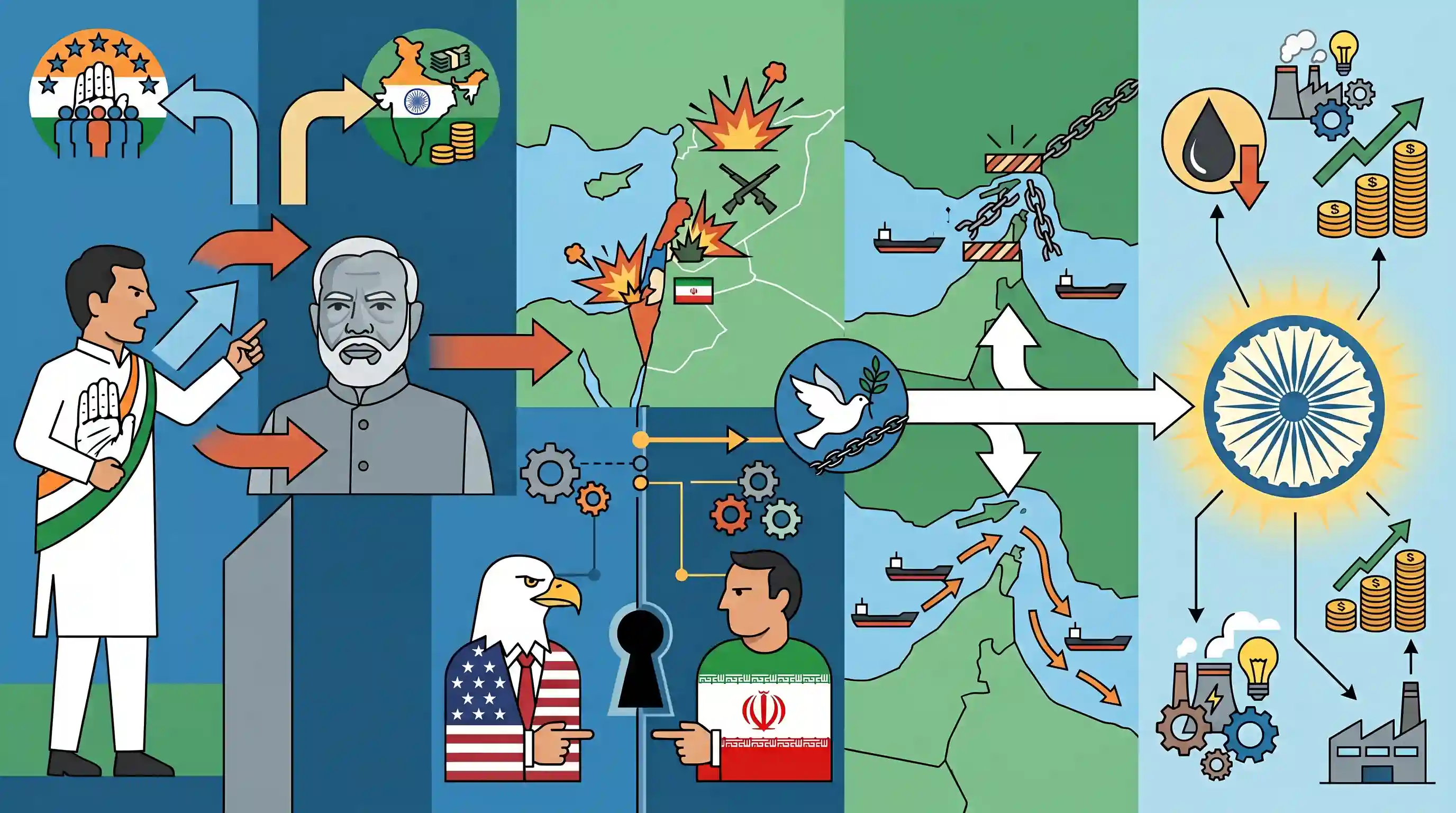
The Congress party has strongly criticized Prime Minister Narendra Modi for his continued silence on Israel's military offensive in Lebanon, alleging that he prioritizes ideological alignment over national interests. The political attack highlights the broader geopolitical implications of the West Asian conflict, noting that back-channel negotiations involving the US and Iran could potentially end the war. A successful resolution is seen as vital for reopening the Strait of Hormuz, which would ensure the free flow of global energy supplies, bring down crude oil prices, and directly benefit India's energy security and economic stability.
Key Points
- The Congress party criticized PM Modi for his silence on Israel's military offensive in Lebanon, questioning his commitment to India's core interests.
- The conflict has significant geopolitical and geoeconomic ramifications, particularly concerning the Strait of Hormuz, a crucial chokepoint for global oil transit.
- Ongoing back-channel negotiations involving the US and Iran aim to halt the conflict, which could stabilize energy markets and reduce crude oil prices.
- India, being highly dependent on imported oil, has a massive stake in the reopening of the Strait of Hormuz and the subsequent reduction in energy costs.
- U.S. President-elect Donald Trump reportedly intervened to persuade Israeli PM Benjamin Netanyahu to cancel a major military raid on Beirut.
Important Terms
Strait of Hormuz

A strategic chokepoint between the Persian Gulf and Gulf of Oman; it carries approximately 20% of global oil and 35% of liquefied natural gas (LNG).
UPSC context
GS Paper 1 (Geography) & GS Paper 2 (IR); tested as a vital maritime chokepoint affecting India's energy imports and economic stability.
Hezbollah
A Lebanese Shia political and militant organization; it is a major regional actor and Iranian proxy involved in the escalating military conflict with Israel.
UPSC context
GS Paper 2 (International Relations); relevant for West Asia geopolitics, non-state actors, and their impact on regional security.
Back-channel Diplomacy
Discreet, unofficial negotiations between adversaries conducted outside formal diplomatic channels to explore resolutions without the pressure of public scrutiny.
UPSC context
GS Paper 2 (IR); concerns conflict resolution mechanisms and India’s strategic use of informal channels with neighboring or hostile states.
Energy Security
The reliable availability of energy sources at affordable prices; for India, this requires securing maritime routes and diversifying oil and gas suppliers.
UPSC context
GS Paper 3 (Economy/Security); critical for understanding India's vulnerability to global supply shocks and the need for Strategic Petroleum Reserves.
Indian National Congress
India’s principal opposition party, which provides parliamentary oversight and public critique of the government’s foreign policy decisions and diplomatic stances.
UPSC context
GS Paper 2 (Polity); tested on the role of the opposition in shaping national discourse and holding the executive accountable.
Prelims Trap
"The Strait of Hormuz is a critical chokepoint connecting the Red Sea to the Arabian Sea."
Aspirants frequently confuse West Asian chokepoints. Hormuz connects the Persian Gulf to the Gulf of Oman, whereas the Red Sea to the Gulf of Aden is connected by the Bab-el-Mandeb Strait.
Static Concepts Connected
Which water bodies do key West Asian strategic straits connect?
- Strait of Hormuz: Connects the Persian Gulf to the Gulf of Oman and the Arabian Sea. It is the world's most critical oil transit chokepoint.
- Bab-el-Mandeb: Connects the Red Sea to the Gulf of Aden and the Arabian Sea, serving as the southern gate to the Suez Canal.
- Suez Canal: An artificial sea-level waterway in Egypt, connecting the Mediterranean Sea to the Red Sea, separating Africa and Asia.
How do global crude oil price shocks impact India's macroeconomic stability?
- Current Account Deficit: Higher crude oil prices inflate India's massive import bill, directly causing the CAD to widen as dollar outflows increase.
- Imported Inflation: Expensive imported fuel increases domestic transportation and logistics costs, cascading into higher retail prices for most commodities.
- Currency Depreciation: A widening CAD increases domestic demand for the US Dollar to pay for imports, putting severe downward pressure on the Indian Rupee.
Cross-Topic Patterns
Energy chokepoints & Imported Inflation
The geopolitical instability in the Strait of Hormuz directly links IR to core macroeconomic concepts like imported inflation, currency depreciation, and the widening of India's Current Account Deficit (CAD).
The De-hyphenation Doctrine
India's standalone, strategic ties with Israel—while maintaining separate relations with Palestine and Iran—reflects the "de-hyphenation" doctrine, transitioning from ideological non-alignment to pragmatic multi-alignment.

Expect a multi-statement prelims question mapping West Asian chokepoints (Hormuz/Bab-el-Mandeb) directly to India's Current Account Deficit.
Linked PYQs · 3
Linked PYQs · 3
- 2025MainsGS2
"Energy security constitutes the dominant kingpin of India's foreign policy, and is linked with India's overarching influence in Middle Eastern countries.” How would you integrate energy security with India's foreign policy trajectories in the coming years?
- 2017MainsGS2
The question of India's Energy Security constitutes the most important part of India's economic progress. Analyze India's energy policy cooperation with West Asian countries.
- 2018MainsGS2
“India’s relations with Israel have, of late, acquired a depth and diversity, which cannot be rolled back.” Discuss.
