Quad and India Strategic Interests in Indo-Pacific
Source:Indian Express ↗
ఇది ఎందుకు ముఖ్యం
The Quad is a cornerstone of India's contemporary foreign policy and Indo-Pacific strategy. Evaluating its efficacy and alignment with India's strategic autonomy is vital for the International Relations syllabus.
సారాంశం
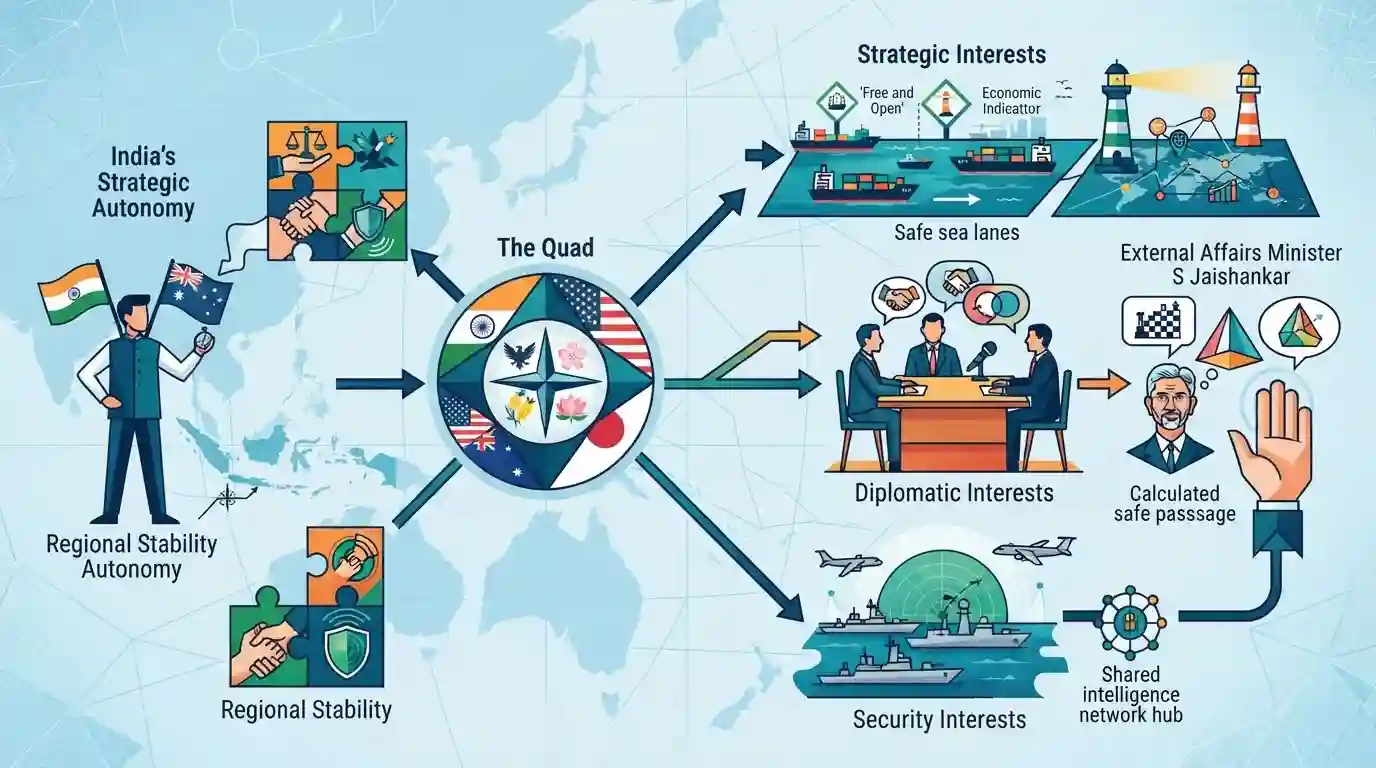
An analysis examining how the Quad (Quadrilateral Security Dialogue) serves India's strategic, diplomatic, and security interests in the Indo-Pacific, highlighting insights from External Affairs Minister S Jaishankar on India's strategic autonomy and regional stability.
ముఖ్య అంశాలు
- The Quad (India, US, Japan, Australia) serves as a critical plurilateral mechanism to advance India's strategic, economic, and security interests in the Indo-Pacific region.
- External Affairs Minister S Jaishankar defended the efficacy of the Quad, emphasizing that it is not a military alliance but a force for regional stability, global public goods, and a rules-based order.
- India's participation balances strategic autonomy with robust minilateral partnerships to counter regional hegemonies and foster resilient supply chains.
ముఖ్యమైన పదాలు
Quad

An informal strategic forum comprising India, the US, Japan, and Australia focused on ensuring a free, open, and inclusive Indo-Pacific region through diplomatic and practical cooperation.
UPSC context
UPSC GS Paper II (International Relations): Important international institutions, agencies and fora—their structure and mandate, and India's regional groupings.
Quadrilateral Security Dialogue
The formal diplomatic framework of the Quad, serving as a platform for multilateral maritime and security dialogue among India, the United States, Japan, and Australia.
UPSC context
UPSC GS Paper II (International Relations): Bilateral, regional and global groupings involving India and/or affecting India's interests.
Ministry of External Affairs
The nodal executive government department in India responsible for conducting foreign relations, formulating external policies, and safeguarding the nation's diplomatic and strategic interests abroad.
UPSC context
UPSC GS Paper II (International Relations / Polity): Structure, organization, and functioning of the Executive and formulation of India's foreign policy.
ప్రిలిమ్స్ ఉచ్చు
Quad is a formal military alliance with a mutual defense pact similar to Article 5 of NATO.
Aspirants often get tripped up by treating the Quad as a formal collective security treaty like NATO, missing its character as a plurilateral diplomatic forum without a mutual defense clause.
అనుసంధానమైన స్థిర భావనలు
What are the core objectives and evolution of the Quadrilateral Security Dialogue (Quad)?
- Evolution: Origin: Evolved from the 2004 Tsunami Core Group; proposed by Japanese PM Shinzo Abe in 2007, revived in 2017.
- Core Objective: Mandate: Plurilateral dialogue mechanism focused on maintaining a free, open, and inclusive Indo-Pacific, distinct from a military alliance.
- Key Pillars: Key Pillars: Maritime Domain Awareness (MDA), critical and emerging technologies, climate change, health security, and resilient supply chains.
అంతర-అంశ నమూనాలు
Minilateralism vs Non-Alignment in Indian Foreign Policy
Minilateral frameworks like Quad and I2U2 reflect India's shift from traditional non-alignment to issue-based alignments while retaining strategic autonomy.
Indo-Pacific Supply Chain Resilience & Critical Minerals
Quad initiatives on critical minerals and semiconductor supply chains directly intersect with Indo-Pacific economic frameworks and trade diversification strategies.

Quad's evolution from naval exercises to non-traditional security (HADR, MDA, critical tech) is a prime candidate for Mains GS-2.
అనుసంధాన PYQలు · 1
అనుసంధాన PYQలు · 1
- 2020MainsGS2
Quadrilateral Security Dialogue (Quad)' is transforming itself into a trade bloc from a military alliance, in present times - Discuss.
