Quad and India Strategic Autonomy in Indo Pacific
Source:Indian Express ↗
Why It Matters
This topic is crucial for understanding India's contemporary foreign policy, minilateralism, and its balancing act in the Indo-Pacific amid shifting geopolitical equations with China and the US.
Summary
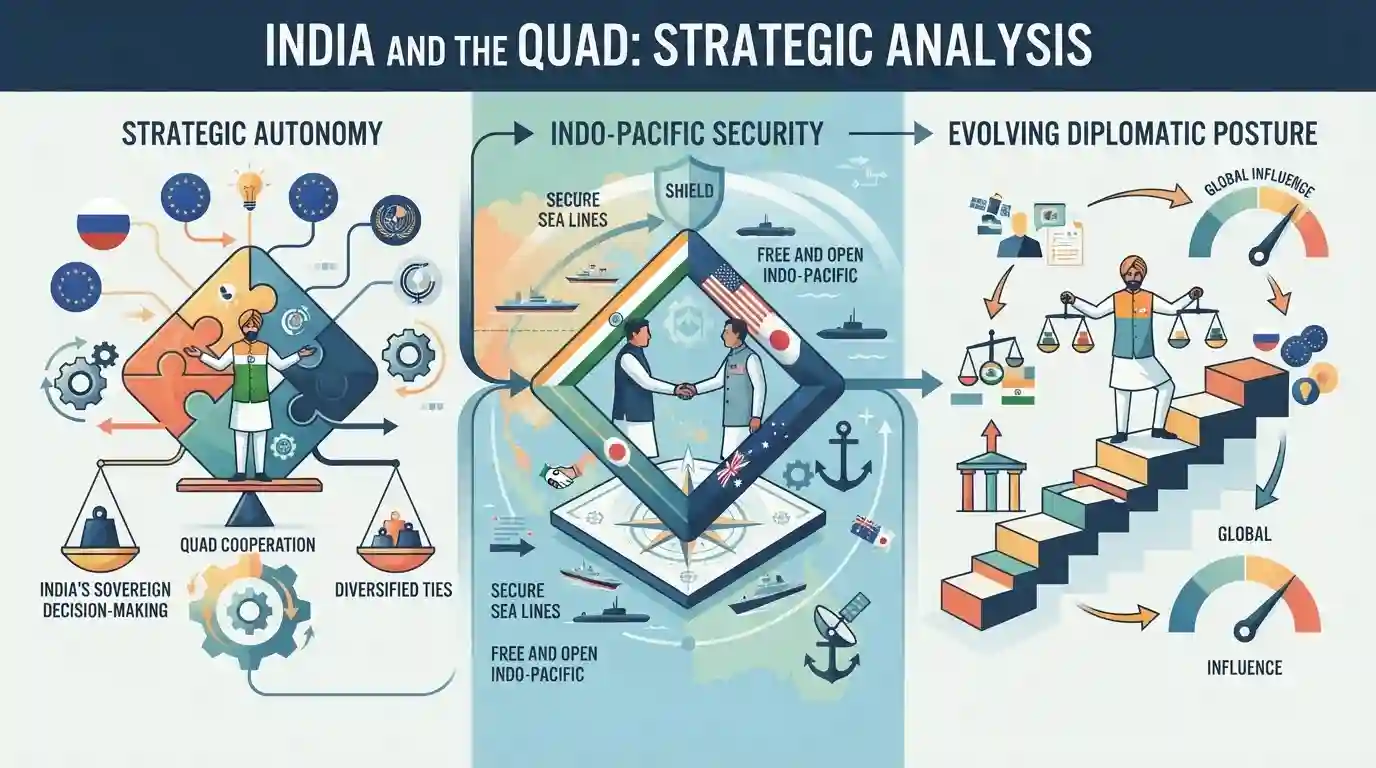
An analysis of whether the Quad (Quadrilateral Security Dialogue) serves India's strategic interests, evaluating its impact on India's strategic autonomy, regional security in the Indo-Pacific, and evolving diplomatic posture.
Key Points
- The Quad (India, US, Japan, Australia) serves India's national interests by reinforcing a multipolar Indo-Pacific, maintaining balance of power, and addressing non-traditional security challenges.
- India's engagement with the Quad does not compromise its core principle of strategic autonomy; rather, it expands its diplomatic leverage and regional partnerships.
- Critics often question whether the Quad acts as a military alliance or a broad-based developmental coalition, but its evolving architecture focuses on maritime security, supply chain resilience, and public goods.
- External Affairs Minister S Jaishankar has emphasized that minilateral groupings like the Quad complement, rather than substitute, India's broader multilateral and bilateral commitments.
Important Terms
Quadrilateral Security Dialogue

An informal strategic forum comprising India, the United States, Japan, and Australia, aimed at maintaining a free, open, and prosperous Indo-Pacific region through collaborative initiatives.
UPSC context
GS Paper II: Important International institutions, agencies and fora - their structure, mandate, and India's role in global groupings.
Strategic Autonomy
India's foundational foreign policy principle of retaining independent decision-making capacity and avoiding formal military alliances while engaging multiple major power blocs.
UPSC context
GS Paper II: Bilateral, regional and global groupings and agreements involving India and/or affecting India's interests.
Ministry of External Affairs
The nodal government ministry responsible for conducting India's external relations, formulating foreign policy, and representing the country in international bodies and negotiations.
UPSC context
GS Paper II: Structure, organization and functioning of the Executive and Ministries/Departments of the Government.
Static Concepts Connected
What are the key pillars and objectives of the Quadrilateral Security Dialogue (Quad)?
- Core Vision: Free, open, and inclusive Indo-Pacific respecting international rules-based order.
- Key Domains: Maritime security, HADR, critical and emerging technologies, climate change, and resilient supply chains.
- Nature of Grouping: Minilateral framework that complements, not substitutes, traditional bilateral or multilateral alliances.
Cross-Topic Patterns
Minilateralism and India's Strategic Autonomy
The evolution of minilaterals like Quad parallels shifts in India's traditional non-alignment toward proactive multi-alignment, balancing strategic autonomy with robust security partnerships.

Quad evolution + strategic autonomy + multi-alignment is a prime candidate for a Mains GS-II analytical question.
Linked PYQs · 2
Linked PYQs · 2
- 2020MainsGS2
Quadrilateral Security Dialogue (Quad)' is transforming itself into a trade bloc from a military alliance, in present times - Discuss.
- 2024MainsGS2
‘The West is fostering India as an alternative to reduce dependence on China's supply chain and as a strategic ally to counter China's political and economic dominance.’ Explain this statement with examples.
