RBI Inflation Targeting Framework Efficacy and Structural Challenges
Source:The Hindu ↗
हे का महत्त्वाचे आहे
Understanding the efficacy and limitations of India's inflation-targeting monetary policy framework is critical for aspirants studying central banking, macroeconomic management, and the perennial challenge of food inflation in India.
सारांश
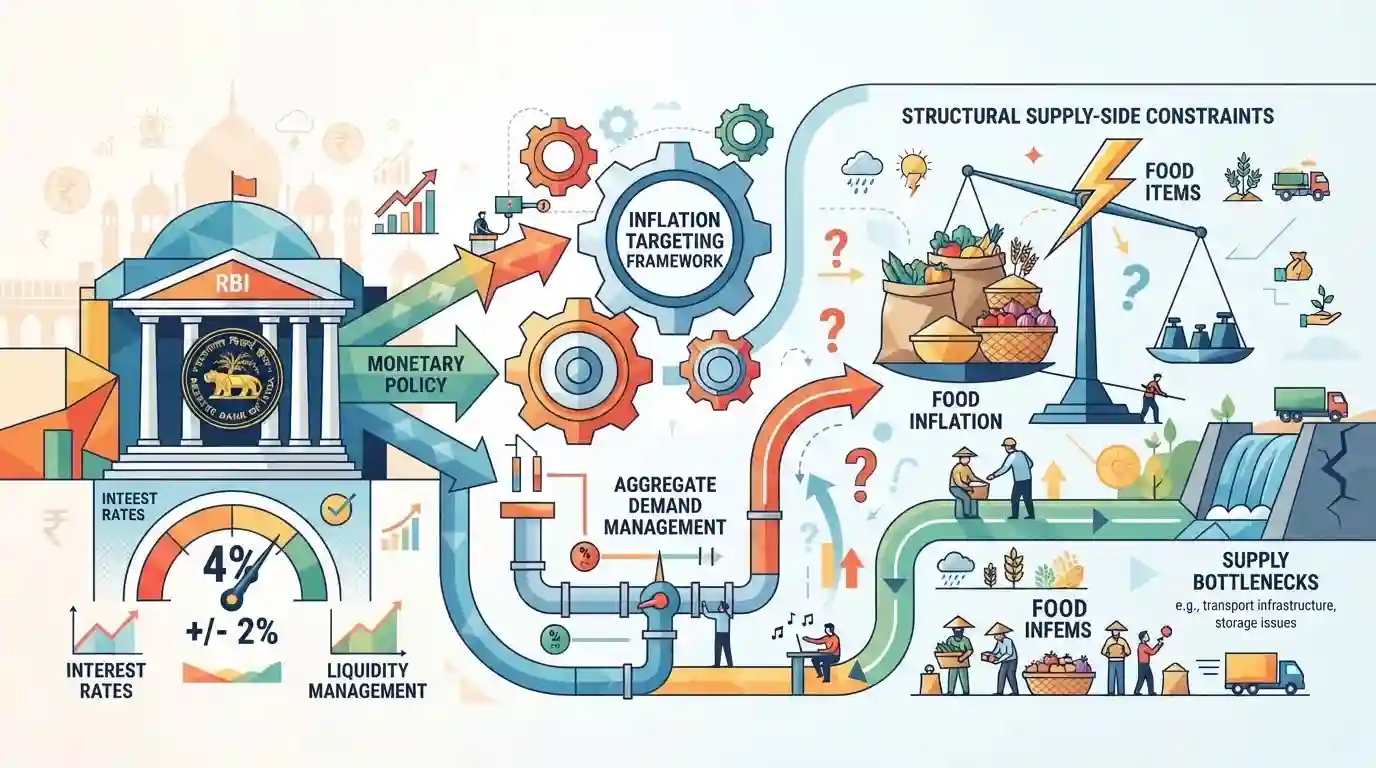
The article explores the effectiveness, mechanics, and debates surrounding inflation targeting in India by the Reserve Bank of India, evaluating how well the framework handles structural supply-side constraints like food inflation.
मुख्य मुद्दे
- Inflation targeting framework in India, anchored by the RBI and the Monetary Policy Committee (MPC), targets consumer price inflation at 4% with a tolerance band of +/- 2%.
- The efficacy of inflation targeting faces challenges in developing economies like India due to supply-side shocks, notably volatile food and fuel prices, which monetary policy instruments cannot directly remedy.
- Critics debate whether strict adherence to headline inflation targeting hinders growth or adequately addresses persistent structural price pressures.
महत्त्वाच्या संज्ञा
Reserve Bank of India

India’s central banking institution, established in 1935, which regulates the issuance of currency, controls the monetary supply, and operates the flexible inflation targeting framework to maintain price stability and economic growth.
UPSC context
UPSC Prelims/Mains (GS Paper 3): Core institution for monetary policy, banking regulation, inflation control, and financial sector governance.
Monetary Policy Committee
A statutory six-member body constituted under the RBI Act, 1934, tasked with determining the policy repo rate required to achieve the mandated inflation target.
UPSC context
UPSC Prelims/Mains (GS Paper 3): Focuses on institutional framework of monetary policy, decision-making transparency, and inflation targeting mechanisms.
संबंधित स्थिर संकल्पना
What are the institutional mechanism and statutory basis of Inflation Targeting in India?
- Statutory Basis: RBI Act Amendment of 2016 gave statutory backing to the flexible inflation targeting framework, setting the primary objective of the RBI as price stability while keeping in mind the objective of growth.
- Target & Band: Headline CPI inflation is targeted at 4% with a tolerance band of +/- 2% (upper tolerance 6%, lower tolerance 2%), assessed over a consecutive three-quarter horizon.
- Composition: The Monetary Policy Committee (MPC) comprises 6 members (3 from RBI including the Governor, and 3 external members appointed by the Central Government) with a casting vote for the Governor in case of a tie.
आंतर-विषय नमुने
Food Inflation vs Monetary Policy Transmission
Food price volatility in CPI directly impacts monetary policy stance, bridging agriculture supply chains with central bank interest rate decisions.
Urjit Patel Committee & Macroeconomic Architecture
The Urjit Patel Committee report transformed India's macroeconomic architecture, shifting focus from multiple indicators to a singular price stability mandate.

Expect a statement-based question combining MPC mandate, CPI weighting structure, and the limits of rate hikes on food inflation.
संबंधित PYQ · 3
संबंधित PYQ · 3
- 2024MainsGS3
What are the causes of persistent high food inflation in India? Comment on the effectiveness of the monetary policy of the RBI to control this type of inflation.
- 2022PrelimsGS1
In India, which one of the following is responsible for maintaining price stability by controlling inflation?
- 2020PrelimsGS1
Consider the following statements: 1. The weightage of food in Consumer Price Index (CPI) is higher than that in Wholesale Price Index (WPI). 2. The WPI does not capture changes in the prices of services, which CPI does. 3. Reserve Bank of India has now adopted WPI as its key measure of inflation and to decide on changing the key policy rates. Which of the statements given above is/are correct?
