Doda Encounter and Security Challenges in Jammu Region
Source:Indian Express ↗
Why It Matters
The shifting epicenter of terrorist activities from the Kashmir valley to the Jammu region exposes evolving tactics by militant groups and underscores potential gaps in counter-terrorism grids. It serves as a critical case study for internal security challenges, border management, and the political dimension of national security in a democratic setup.
Summary
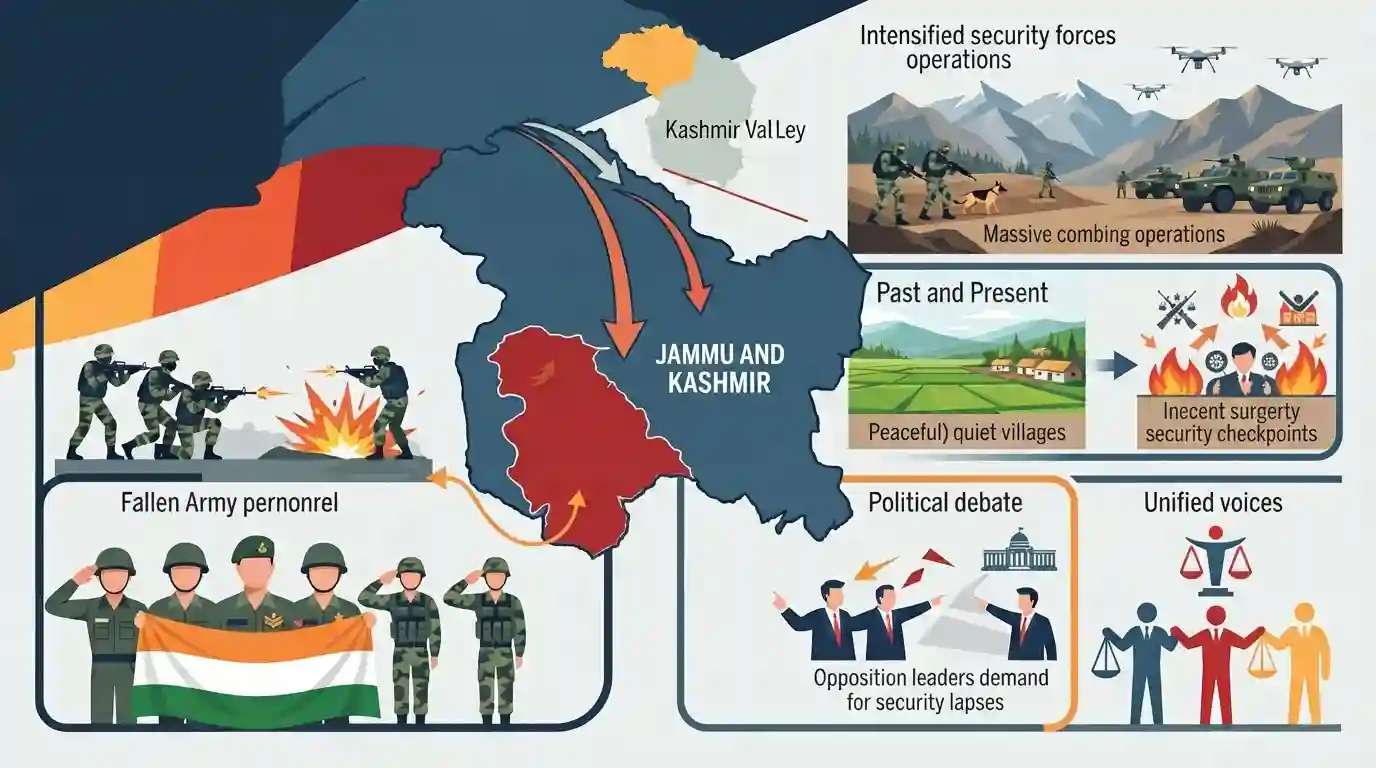
A recent terror encounter in the Doda district of Jammu and Kashmir resulted in the deaths of four Indian Army personnel, including a Major-rank officer. The incident underscores a worrying shift in the locus of terror activities towards the Jammu region, which had experienced relative peace from 2005 to 2021 but has recently seen a surge in attacks. In response to the escalating violence, security forces have intensified massive combing operations. Meanwhile, the attacks have sparked intense political debate, with opposition leaders attributing the security lapses to the central government's policies and demanding strict accountability, even as they emphasized the need for a unified national stance against terrorism.
Key Points
- Four Indian Army personnel, including a Major, were killed in an anti-terror encounter in the Doda district of Jammu and Kashmir.
- This follows a similar ambush in Kathua district, highlighting a recent spike in terror activities in the Jammu division.
- The Jammu region had remained relatively peaceful between 2005 and 2021 but has witnessed 11 attacks in the 78 days leading up to mid-July 2024.
- Security forces and police have launched massive joint combing and search operations in response to the escalating violence.
- Opposition leaders sharply criticized the government's handling of national security, demanding accountability for repeated intelligence and security lapses while pledging collective support against terrorism.
Important Terms
Indian Army

The land-based branch of the Indian Armed Forces responsible for national defense, border security, and conducting counter-insurgency and counter-terrorism operations to maintain territorial integrity.
UPSC context
GS Paper 3 (Internal Security). Tests knowledge of security forces' mandate and their role in border management and counter-terrorism.
Border Area Management
The comprehensive approach to securing national borders, integrating physical guarding, intelligence gathering, infrastructure development, and community engagement to prevent infiltration and cross-border terrorism.
UPSC context
GS Paper 3 (Internal Security). Directly tests strategies for denying local support to militants and securing hostile geographic terrains.
Rashtriya Rifles
A specialized, elite counter-insurgency force of the Indian Army raised in 1990. It is deployed primarily in Jammu and Kashmir to conduct anti-terror operations and maintain internal security.
UPSC context
GS Paper 3 (Internal Security). Relevant for understanding specific forces deployed in J&K for counter-insurgency grids and anti-terror operations.
Jammu and Kashmir Police
The primary law enforcement agency of Jammu and Kashmir. It works closely with central armed forces in joint counter-terrorism operations, providing crucial grassroots human intelligence.
UPSC context
GS Paper 3 (Internal Security). Highlights the importance of local law enforcement, human intelligence (HUMINT), and community policing in counter-insurgency.
Bharatiya Janata Party (BJP)
A major national political party in India. As the ruling party at the center, it oversees the formulation and implementation of national counter-terrorism and internal security policies.
UPSC context
GS Paper 2 (Polity). Relevant to federal dynamics, national security administration, and the executive's role in governance.
Indian National Congress (Congress)
A major national political party in India. As the principal opposition, it plays a key democratic role by scrutinizing central security policies and demanding governmental accountability.
UPSC context
GS Paper 2 (Polity). Highlights the constitutional role of the opposition in a parliamentary democracy regarding national security debates.
Prelims Trap
Districts like Doda, Rajouri, and Poonch are located within the Kashmir Valley.
Aspirants often conflate all conflict zones in J&K with the "Kashmir Valley". Doda, Kathua, Rajouri, and Poonch actually fall in the Jammu division.
Static Concepts Connected
What is the role of Over-Ground Workers (OGWs) in insurgency?
- Logistics: Provide essential supplies, safe houses, transport, and funding to active militants.
- Intelligence: Act as local eyes and ears, tracking and reporting security force movements to insurgents.
- Recruitment: Assist in ideological radicalization, recruitment, and propaganda dissemination without actively participating in armed combat.
What are the key geographical features of the Pir Panjal Range?
- Location: The largest range of the Lesser Himalayas, acting as a natural barrier separating the Jammu region from the Kashmir Valley.
- Key Passes: Features critical connectivity corridors including the Banihal, Pir Panjal, and Rohtang passes.
- Terrain: Characterized by rugged ridges and dense forests, creating natural hideouts that severely complicate search and combing operations.
Cross-Topic Patterns
Terrain dictating Counter-Insurgency
The shift to Pir Panjal highlights how dense forests and high-altitude ridges dictate asymmetric warfare tactics, making geographical mapping (GS1) deeply intertwined with internal security (GS3).
"Winning Hearts and Minds" in Asymmetric Warfare
Tackling Over-Ground Workers links kinetic military operations with socio-economic development, similar to the multi-pronged SAMADHAN strategy utilized in Left Wing Extremism (LWE) areas.

Expect a GS3 Mains question on the strategic shift of terrorism from Kashmir Valley to Jammu, integrating terrain challenges (Pir Panjal).
Linked PYQs · 4
Linked PYQs · 4
- 2023MainsGS3
Winning of 'Hearts and Minds' in terrorism-affected areas is an essential step in restoring the trust of the population. Discuss the measures adopted by the Government in this respect as part of the conflict resolution in Jammu and Kashmir.
- 2025MainsGS3
Terrorism is a global scourge. How has it manifested in India? Elaborate with contemporary examples. What are the counter measures adopted by the State? Explain.
- 2020MainsGS3
Analyze internal security threats and transborder crimes along Myanmar, Bangladesh and Pakistan borders including Line of Control (LoC). Also discuss the role played by various security forces in this regard.
- 2020MainsGS3
For effective border area management, discuss the steps required to be taken to deny local support to militants and also suggest ways to manage favourable perception among locals.
