Documentary Claims British Spy Intercepts Sparked India Canada Row
Source:Indian Express ↗
Why It Matters
The diplomatic row involving Canada, the US, and intelligence from the Five Eyes network highlights crucial issues in India's foreign policy, specifically managing bilateral ties strained by diaspora politics and addressing external support for internal security threats (separatism).
Summary
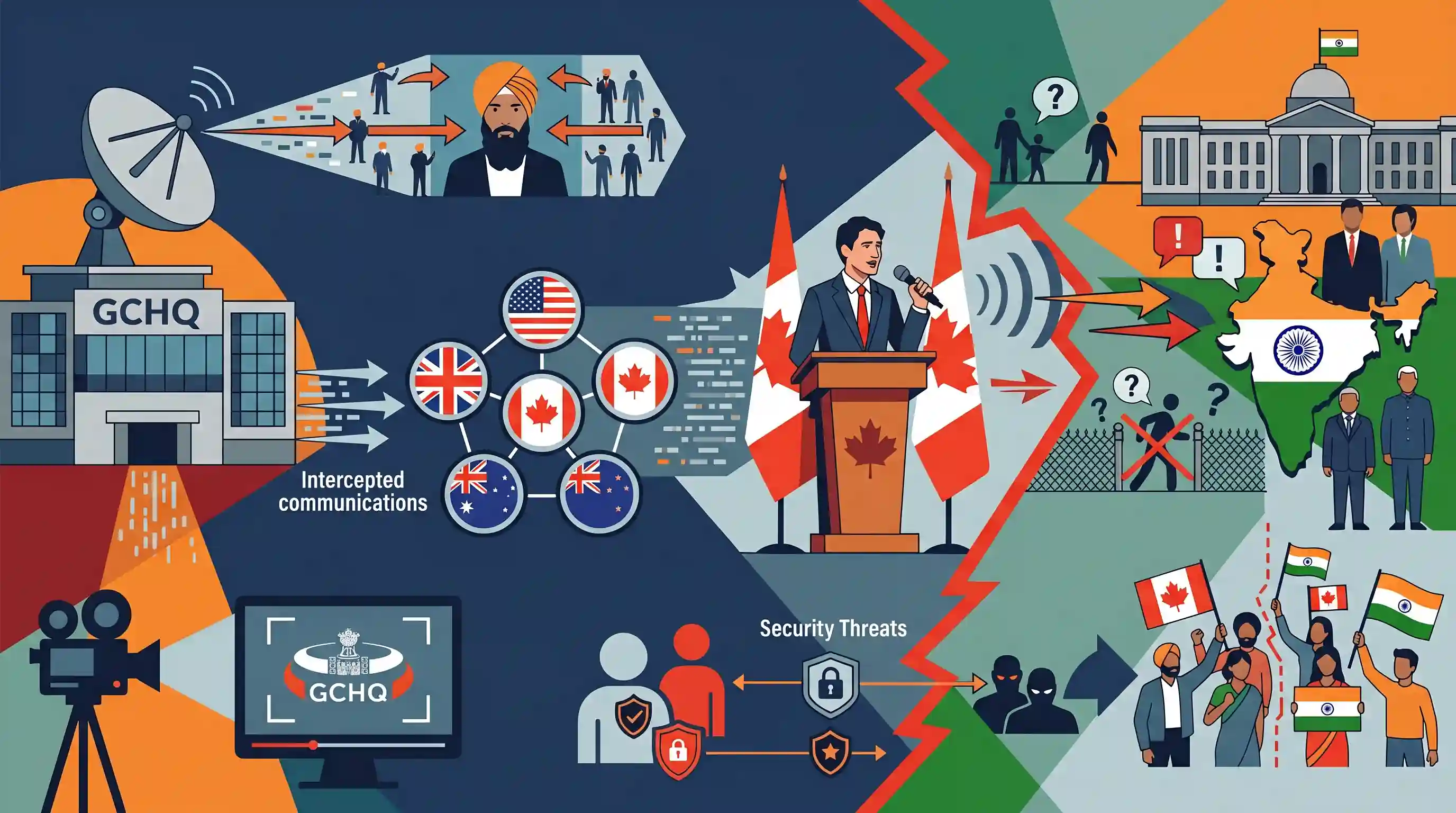
A recent Bloomberg documentary alleges that British spy agency GCHQ intercepted communications discussing the assassinations of pro-Khalistan figures, including Hardeep Singh Nijjar. This intelligence, reportedly shared through the Five Eyes alliance, formed the basis for Canadian Prime Minister Justin Trudeau's public allegations of Indian state involvement in Nijjar's killing. The revelation underscores the significant role of multilateral intelligence-sharing networks in contemporary geopolitics and highlights the ongoing diplomatic tensions between India and Canada regarding extraterritorial extremism and diaspora politics.
Key Points
- A documentary claims that British spy agency GCHQ intercepted communications regarding plots targeting pro-Khalistan figures Hardeep Singh Nijjar, Avtar Singh Khanda, and Gurpatwant Singh Pannun.
- The intercepted intelligence, shared via the Five Eyes network, allegedly formed the basis of Canada's accusation of Indian state involvement in Nijjar's killing.
- India has consistently dismissed the allegations as "absurd" and "motivated," instead accusing Canada of providing a safe haven to pro-Khalistan extremists.
- The intelligence disclosures highlight the complex intersection of global intelligence-sharing networks (Five Eyes), diaspora politics, and bilateral relations between India and Western nations.
Important Terms
Five Eyes (FVEY)

An intelligence-sharing alliance comprising Australia, Canada, New Zealand, the UK, and the US. It originated from the post-WWII UKUSA Agreement to share signals intelligence and security assessments.
UPSC context
GS Paper II: International Relations. Relevant for understanding global security groupings and multilateral intelligence-sharing frameworks.
Government Communications Headquarters (GCHQ)
The UK's signals intelligence and cybersecurity agency. It specializes in intercepting electronic communications and providing technical intelligence to protect national security and support military operations.
UPSC context
GS Paper II/III: International Relations/Security. Tests awareness of major foreign intelligence agencies affecting India’s bilateral diplomacy.
Research and Analysis Wing (R&AW)
India's primary foreign intelligence agency, established in 1968. It is responsible for external intelligence collection, counter-terrorism, and protecting India's national interests through covert and overt operations.
UPSC context
GS Paper III: Security Agencies and their mandate. Fundamental for questions on India's external security apparatus.
Signals Intelligence (SIGINT)
Intelligence gathered by intercepting electronic signals and communications (e.g., phone calls, emails, satellite signals). It is the primary focus of agencies like GCHQ and the Five Eyes alliance.
UPSC context
GS Paper III: Internal Security/Science & Tech. Tests knowledge of modern espionage methods and their geopolitical implications.
MI5 (Security Service)
The UK's domestic counter-intelligence and security agency. Unlike GCHQ’s signals focus or R&AW’s external focus, MI5 handles internal threats like domestic terrorism and espionage within Britain.
UPSC context
GS Paper III: Internal Security. Tests the ability to differentiate between domestic and external intelligence functions in global security.
Extraterritoriality
The principle where a state exercises jurisdiction beyond its borders, or where individuals are exempt from local laws. In this context, it relates to alleged state-sponsored actions on foreign soil.
UPSC context
GS Paper II: International Relations/Polity. Crucial for discussing sovereignty, international law, and diplomatic friction.
Prelims Trap
Five Eyes is an intelligence alliance comprising all G7 nations, with India and Japan serving as observer states.
Five Eyes strictly comprises the US, UK, Canada, Australia, and New Zealand. It is not tied to the G7, and India holds no formal observer status in this intelligence network.
Static Concepts Connected
What is the origin and mandate of the Five Eyes (FVEY) alliance?
- Origin: It stems from the 1946 UKUSA Agreement, originally established post-WWII to share intelligence between the US and UK, later expanding.
- Members: United States, United Kingdom, Canada, Australia, and New Zealand.
- Mandate: The alliance primarily focuses on Signals Intelligence (SIGINT)—intercepting, tracking, and analyzing global electronic communications.
How do violent non-state actors (VNSAs) in the diaspora impact India's internal security?
- Safe Havens: Extremists utilize liberal democratic free-speech laws in Western countries to secure asylum and coordinate separatist activities safely.
- Transnational Funding: Through lobbying, hawala, and targeted extortion networks, they channel funds to domestic extremist cells in India.
- Information Warfare: They leverage propaganda to radicalize youth, revive dormant separatist movements, and internationalize domestic security issues.
Cross-Topic Patterns
Diaspora politics disrupting strategic IR
The Khalistan issue demonstrates how domestic electoral compulsions in host countries can conflict with and override broader bilateral strategic partnerships, such as Indo-Pacific security alignments.
Asymmetric TECHINT and Cyber Sovereignty
GCHQ's interceptions highlight the asymmetric signals intelligence (SIGINT) dominance of Western alliances, exposing vulnerabilities in India's counter-intelligence capabilities and sovereign communications.

Five Eyes membership, signals intelligence mandates, and the Vienna Convention's diplomatic protocols are ripe for a 2026 Prelims trap.
Linked PYQs · 4
Linked PYQs · 4
- 2023MainsGS3
What are the internal security challenges being faced by India? Give out the role of Central Intelligence and Investigative Agencies tasked to counter such threats.
- 2021MainsGS3
Analyse the multidimensional challenges posed by external state and non-state actors, to the internal security of India. Also discuss measures required to be taken to combat these threats.
- 2023MainsGS2
Indian diaspora has scaled new heights in the West. Describe its economic and political benefits for India.
- 2020MainsGS2
Indian diaspora has a decisive role to play in the politics and economy of America and European Countries'. Comment with examples.
