HPV Vaccination Campaigns Address Rising Public Health Cancer Burdens
Source:The Hindu ↗
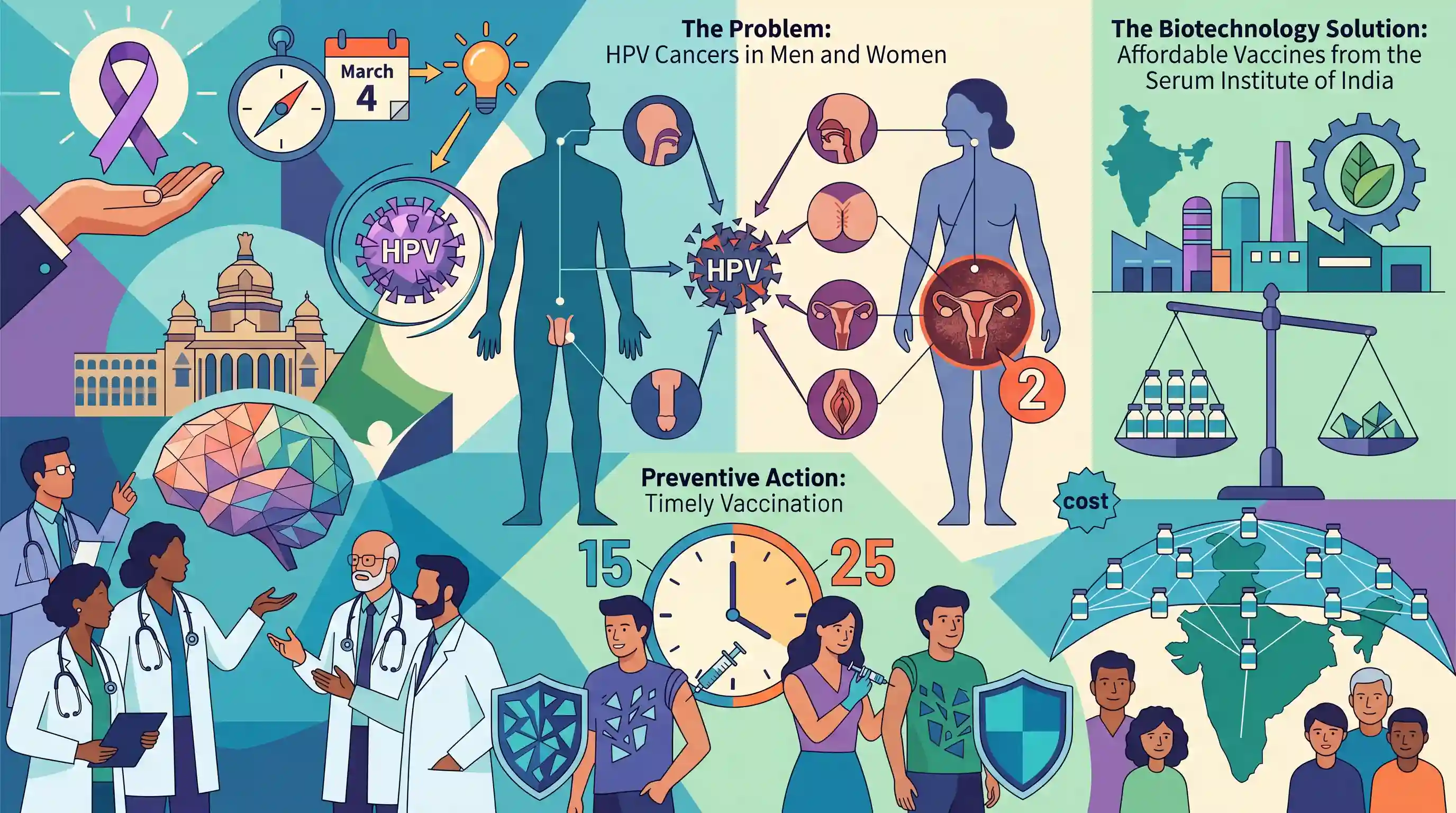
Why It Matters
Cervical cancer poses a massive disease burden in India. Understanding the broader implications of HPV for both genders and the role of indigenous vaccines is essential for addressing UPSC questions on public health policy (GS2) and vaccine technology (GS3).
Summary
Medical experts convened in Bengaluru for the 'Conquer HPV and Cancer Conclave 2025' ahead of International HPV Awareness Day (March 4) to raise awareness about Human Papillomavirus (HPV) and its associated cancers. The conclave highlighted that HPV is a major public health concern affecting both men and women, causing cancers of the cervix, vulva, vagina, anus, penis, and oropharynx. Emphasizing that cervical cancer is the second most common cancer among Indian women, doctors stressed the critical role of timely vaccination—especially given the peak infection window of ages 15 to 25—made more accessible by affordable vaccines from the Serum Institute of India.
Key Points
- HPV affects both men and women, causing not just cervical cancer but also vulvar, vaginal, anal, penile, and oropharyngeal cancers.
- Cervical cancer is the second most common cancer among women in India, with over 1.23 lakh new cases and 77,000 deaths annually.
- Up to 90% of anal cancers and 63% of penile cancers are directly linked to HPV infections.
- The highest risk window for acquiring an HPV infection occurs between the ages of 15 and 25.
- Medical experts urge timely vaccination to prevent HPV, bolstered by the availability of affordable indigenous vaccines from the Serum Institute of India.
Important Terms
Human Papillomavirus (HPV)

A group of 200+ related viruses. Strains like 16 and 18 cause 70-80% of cervical cancers, while types 6 and 11 cause genital warts. It spreads primarily through skin-to-skin sexual contact.
UPSC context
GS II (Public Health); Prelims (Science). Key for understanding India's cancer burden and vaccine-preventable diseases.
Cervical Cancer
Cancer of the cervix, the lower part of the uterus. It is the second most common cancer among Indian women, with high mortality due to late diagnosis. Almost all cases are linked to persistent HPV infection.
UPSC context
GS II (Social Sector-Health); GS I (Women issues). Tests knowledge of gender-specific health challenges in India.
CERVAVAC
India’s first indigenously developed Quadrivalent Human Papillomavirus (qHPV) vaccine, produced by the Serum Institute of India. It targets HPV types 6, 11, 16, and 18, offering an affordable alternative to foreign vaccines.
UPSC context
GS III (Biotechnology/Indigenous Technology). Significant for 'Atmanirbhar Bharat' in healthcare and lowering out-of-pocket expenditure.
Serum Institute of India (SII)
The world's largest vaccine manufacturer by volume, based in Pune. It developed CERVAVAC and leads the 'Conquer HPV and Cancer Conclave 2025' to raise public awareness about preventive vaccination.
UPSC context
GS III (Science & Tech). Notable for its role in India's vaccine diplomacy and public health infrastructure.
Preventive Healthcare
A healthcare model focusing on disease prevention through vaccination, screening, and education rather than just treatment. India's inclusion of HPV vaccination in public programs reflects this strategic shift.
UPSC context
GS II (Governance/Health Policy). Critical for answers on strengthening India's public health systems and reducing long-term costs.
International HPV Awareness Day
Observed on March 4 to raise global awareness about HPV-related cancers and reduce stigma. The 2025 theme, 'One Less Worry,' emphasizes that HPV-related diseases are preventable through existing medical tools.
UPSC context
Prelims (Important Days/Health). Tests awareness of global health mobilizations and their thematic relevance to India.
90-70-90 Target
The WHO Global Strategy target to eliminate cervical cancer by 2030: 90% girls vaccinated by age 15, 70% women screened by age 35/45, and 90% of those diagnosed receiving treatment.
UPSC context
GS II (International Relations/Global Health). Important for evaluating India's alignment with international health standards and SDGs.
Prelims Trap
"HPV infections exclusively affect women and solely result in cervical cancer."
HPV affects both men and women. While it causes ~99% of cervical cancers, it is also a major cause of anal, penile, and oropharyngeal cancers.
Static Concepts Connected
What is a quadrivalent vaccine like CERVAVAC?
- Target scope: A quadrivalent vaccine stimulates an immune response against four different antigens or strains of a virus (in this case, HPV types 16, 18, 6, and 11).
- Indigenous tech: CERVAVAC is India’s first indigenously developed qHPV vaccine, created by the Serum Institute of India and DBT using Virus-Like Particles (VLP) technology.
What is the WHO strategy for cervical cancer elimination?
- 90-70-90 targets: By 2030, 90% of girls vaccinated by age 15; 70% of women screened by age 35 and 45; and 90% of precancer/cancer cases treated.
- Elimination threshold: The ultimate goal is to reduce the incidence of cervical cancer to fewer than 4 cases per 100,000 women globally.
Cross-Topic Patterns
Digital Public Infrastructure (U-WIN)
The rollout of HPV vaccines is linked to the U-WIN platform, showcasing how India repurposes its CoWIN digital public infrastructure for routine immunization tracking.
Indigenization of Biotechnology
The transition from expensive imported vaccines to indigenous CERVAVAC highlights India's push for self-reliance in biomanufacturing, DBT's active role, and affordable healthcare goals.

Expect a multi-statement question on HPV testing its non-cervical impacts on men and the role of VLP technology in the CERVAVAC vaccine.
Linked PYQs · 2
Linked PYQs · 2
- 2022MainsGS3
What is the basic principle behind vaccine development ? How do vaccines work? What approaches were adopted by the Indian vaccine manufacturers to produce COVID-19 vaccines ?
- 2024MainsGS2
In a crucial domain like the public healthcare system the Indian State should play a vital role to contain the adverse impact of marketisation of the system. Suggest some measures through which the State can enhance the reach of public healthcare at the grassroots level.
