Doctor Population Ratio and Medical Education Expansion in India
Source:The Hindu ↗
Why It Matters
The data provides critical facts for GS2 Mains answers on healthcare infrastructure, while policies like 'You Quote We Pay' under NHM serve as excellent examples of addressing the rural-urban divide in medical staffing. The integration of AYUSH practitioners into mainstream doctor-population metrics is also a key policy nuance.
Summary
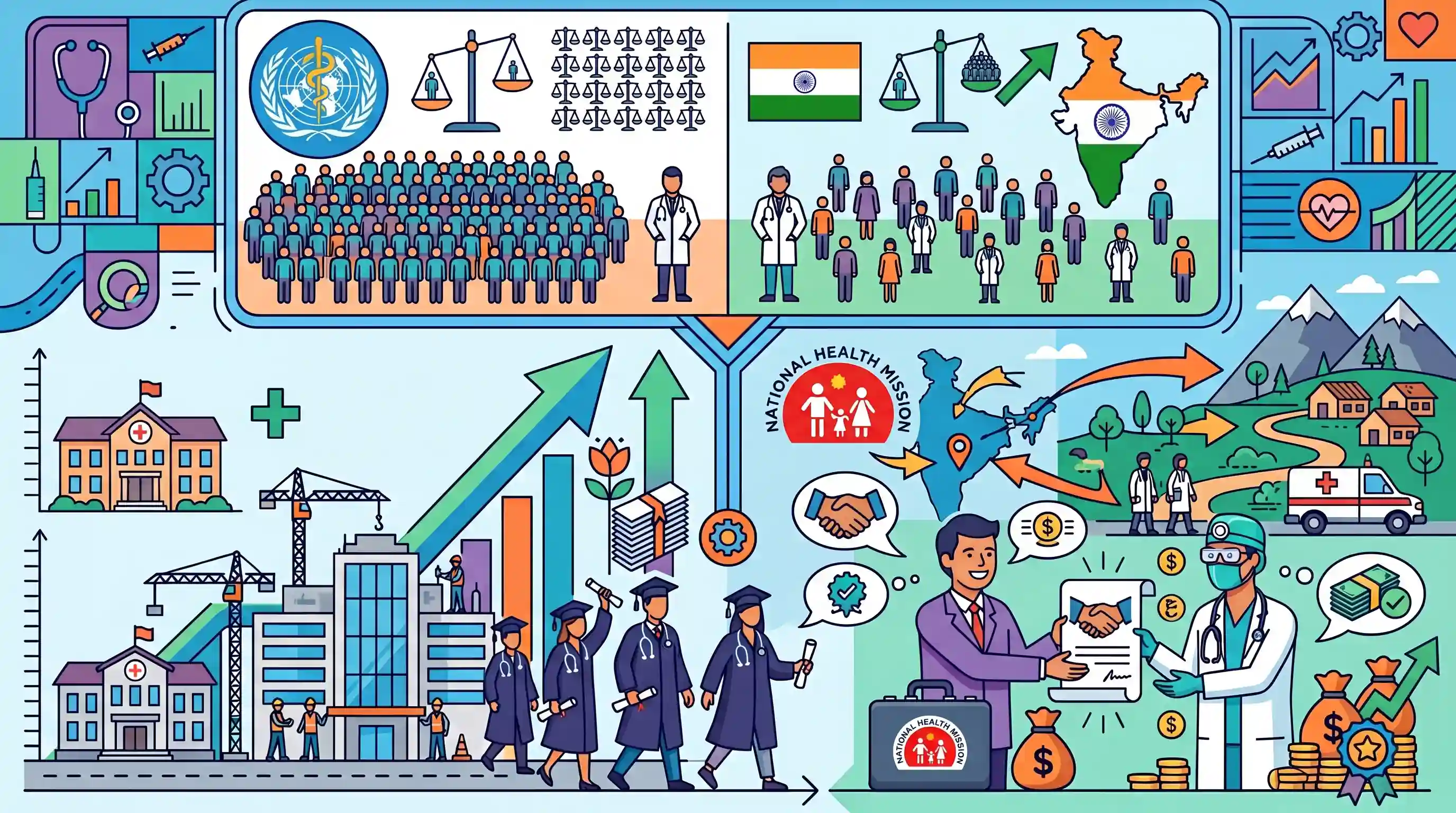
The Union Health Ministry informed Parliament that India's doctor-population ratio is 1:811, comfortably exceeding the WHO norm of 1:1,000. This estimate assumes an 80% availability of registered allopathic and AYUSH practitioners. The government attributed this to a massive expansion of medical education since 2014, including a 111% increase in medical colleges. Furthermore, to address regional disparities, the National Health Mission enables states to offer negotiable salaries ('You Quote We Pay') and special allowances to attract specialist doctors to remote and rural areas.
Key Points
- India's doctor-population ratio stands at 1:811, surpassing the WHO prescribed standard of 1:1,000.
- The ratio calculation factors in an 80% availability of both 13,88,185 registered allopathic doctors and 7,51,768 registered AYUSH practitioners.
- Since 2014, the number of medical colleges in India has increased by 111% (from 387 to 818), driving a 115% increase in UG seats and 127% in PG seats.
- Under the National Health Mission (NHM), states are utilizing the 'You Quote We Pay' model and offering hard-area allowances to attract specialists to rural and remote healthcare centers.
Important Terms
National Health Mission (NHM)

India’s primary health initiative (launched 2013) subsuming rural and urban missions to provide accessible, affordable, and quality healthcare. It supports health infrastructure and human resource augmentation across states.
UPSC context
GS Paper 2: Social Justice; Issues relating to development and management of Social Sector/Services relating to Health.
Doctor-population ratio
A global health metric comparing medical practitioners to inhabitants. While India uses the 1:1,000 WHO norm as a benchmark, the current 1:811 ratio includes both Allopathic and AYUSH doctors.
UPSC context
GS Paper 2: Health infrastructure; targets under Sustainable Development Goal 3 (Good Health and Well-being).
AYUSH
An acronym for Ayurveda, Yoga & Naturopathy, Unani, Siddha, and Homeopathy. These traditional systems are integrated into India’s mainstream healthcare to bridge the gap in medical professional availability.
UPSC context
GS Paper 2: Health; indigenous medicine’s role in achieving Universal Health Coverage.
You Quote We Pay scheme
A flexible recruitment strategy under the National Health Mission allowing states to offer negotiable, market-linked salaries to attract specialist doctors to underserved rural or remote areas.
UPSC context
GS Paper 2: Governance; innovative government interventions to address regional disparities in health services.
Ministry of Health and Family Welfare (MoHFW)
The principal body responsible for formulating and implementing national health policies. It provides financial and technical support to states through Centrally Sponsored Schemes like the NHM.
UPSC context
GS Paper 2: Statutory, regulatory and various quasi-judicial bodies; executive accountability to Parliament.
Prelims Trap
"India's official doctor-population ratio calculation includes only registered allopathic (MBBS) medical practitioners."
The official 1:811 ratio deliberately includes registered AYUSH practitioners alongside allopathic doctors, calculating an 80% active availability for both groups combined.
Static Concepts Connected
What are the structural and financing pillars of the National Health Mission (NHM)?
- Funding Model: It is a Centrally Sponsored Scheme (CSS) typically funded 60:40 between the Centre and States, and 90:10 for North-Eastern and Himalayan states.
- Core Sub-missions: It integrates the National Rural Health Mission (NRHM) and National Urban Health Mission (NUHM) to ensure universal, equitable, and affordable healthcare access.
- Decentralized HR Incentives: States have flexibility to deploy targeted financial incentives, like hard-area allowances, to attract healthcare specialists to vulnerable tribal and remote terrains.
What is the AYUSH system and how is it integrated into public policy?
- Recognized Systems: It stands for Ayurveda, Yoga & Naturopathy, Unani, Siddha, Sowa-Rigpa, and Homoeopathy.
- Policy Integration: The National Health Policy 2017 actively promotes the "pluralistic healthcare" model, mainstreaming AYUSH practitioners into primary healthcare networks to bridge human resource gaps.
Cross-Topic Patterns
Rural-Urban Divide in Public Health
Despite exceeding WHO norms nationally, doctor deployment remains highly skewed towards urban centers, necessitating NHM's flexible 'You Quote We Pay' model to address rural healthcare deficits.
Mainstreaming of Traditional Medicine
Including AYUSH in official WHO-benchmark calculations reflects India's broader diplomatic and domestic push to formalize and integrate traditional medicine systems into national healthcare delivery.

Expect a 2026 multi-statement question testing if the official doctor-population ratio includes AYUSH practitioners or just allopathy.
Linked PYQs · 4
Linked PYQs · 4
- 2024MainsGS2
In a crucial domain like the public healthcare system the Indian State should play a vital role to contain the adverse impact of marketisation of the system. Suggest some measures through which the State can enhance the reach of public healthcare at the grassroots level.
- 2021MainsGS2
“Besides being a moral imperative of a Welfare State, primary health structure is a necessary precondition for sustainable development.” Analyze.
- 2020MainsGS2
In order to enhance the prospects of social development, sound and adequate health care policies are needed particularly in the fields of geriatric and maternal health care. Discuss.
- 2012PrelimsGS1
With reference to National Rural Health Mission, which of the following are the jobs of 'ASHA'; a trained community health worker? 1. Accompanying women to the health facility for antenatal care checkup 2. Using pregnancy test kits for early detection of pregnancy 3. Providing information on nutrition and immunization 4. Conducting the delivery of baby Select the correct answer using the codes given below:
