International Law Relevance and Limitations in Multipolar World
Source:The Hindu ↗
কেন এটি গুরুত্বপূর্ণ
Understanding the relevance and limitations of international law is critical for the UPSC Mains GS2 paper, particularly in evaluating global institutions, the gridlock at the UN Security Council, and the tools available to India and the Global South in navigating a multipolar world.
সারসংক্ষেপ
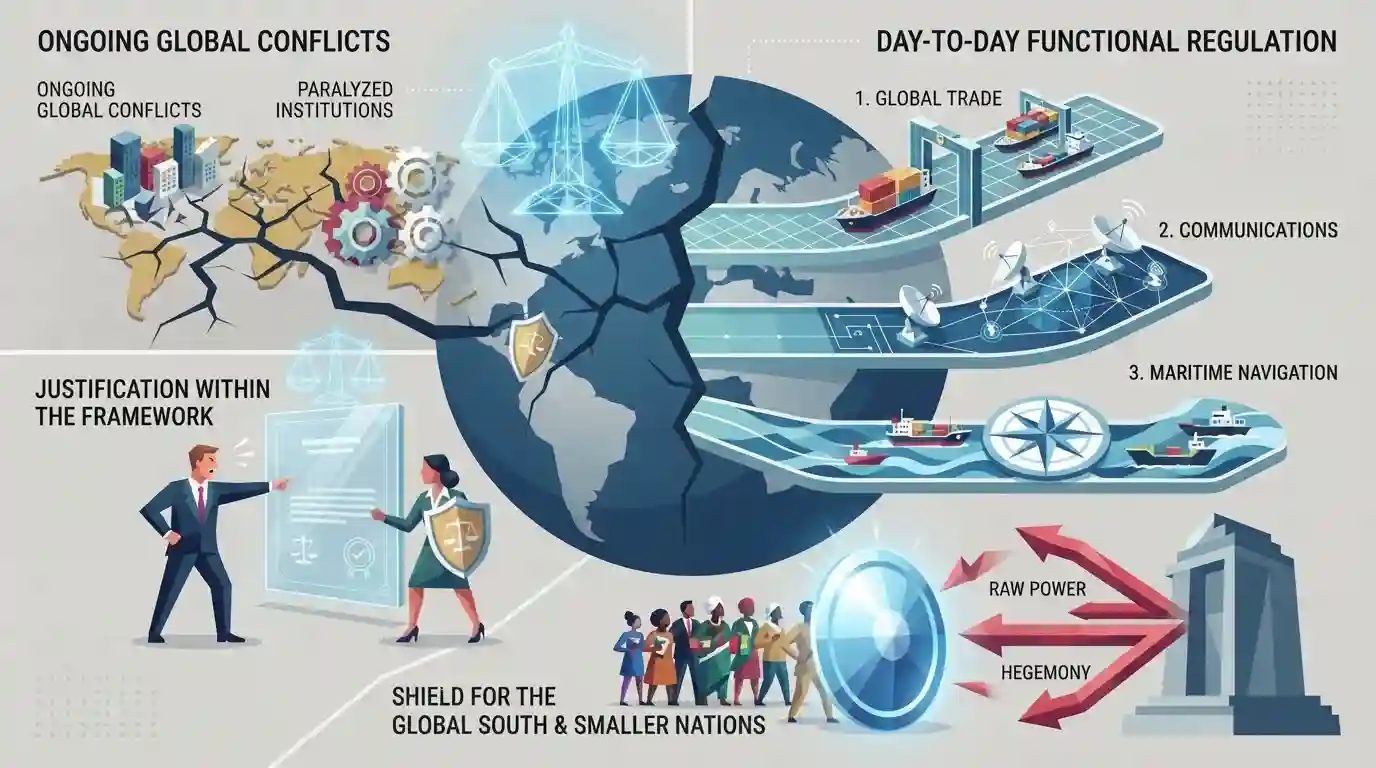
The article argues against the premature dismissal of international law as irrelevant or dead in the face of ongoing global conflicts and the paralysis of institutions like the UN Security Council. It contends that while international law lacks a centralized enforcement mechanism like domestic law, it still exerts substantial normative influence on state behavior. Even when states violate international law, they feel compelled to justify their actions within its framework. Furthermore, the article highlights that beyond high-level security disputes, international law successfully regulates essential, day-to-day functional areas such as global trade, communications, and maritime navigation. Ultimately, it remains an indispensable shield for the Global South and smaller nations to demand accountability in a world otherwise governed by raw power.
মূল বিষয়
- The article refutes the cynical view that international law is obsolete simply because it lacks centralized, coercive enforcement comparable to domestic law.
- Recent geopolitical crises (e.g., the Russia-Ukraine war, the Gaza conflict) have exposed the limitations of bodies like the UN Security Council, leading to skepticism about the efficacy of international rules.
- Despite violations, the normative power of international law is evident because even violating states attempt to justify their actions using its framework (such as invoking 'self-defence' or 'humanitarian intervention').
- Beyond high-stakes security politics, international law successfully governs daily functional areas of global interaction, such as civil aviation, telecommunications, maritime trade, and global health.
- International law remains crucial for smaller nations, non-state actors, and the Global South as a diplomatic tool to constrain major powers and advocate for a rules-based global order.
গুরুত্বপূর্ণ শব্দ
UN Charter

The foundational treaty of the United Nations, signed in 1945, which establishes the structure, powers, and principles of global governance and the rules-based international order.
UPSC context
GS Paper II: International Relations. Crucial for understanding the structural basis of multilateralism, sovereignty, and reforms in global institutions.
Article 51 of the UN Charter
A key provision recognizing the inherent right of individual or collective self-defence for member states if an armed attack occurs, prior to Security Council intervention.
UPSC context
GS Paper II: International Relations. Tests concepts of national sovereignty, use of force, self-defence justifications, and unilateral actions.
UN Security Council (UNSC)
One of the six principal UN organs, responsible for maintaining international peace and security, containing five permanent veto-wielding members and ten elected non-permanent members.
UPSC context
GS Paper II: Multilateral Forums. Highly relevant for questions on geopolitical paralysis, veto reform, and India’s bid for permanent membership.
International Court of Justice (ICJ)
The principal judicial organ of the United Nations, based in The Hague, that adjudicates legal disputes between sovereign states and issues advisory opinions.
UPSC context
GS Paper II: Important International Institutions. Evaluates state accountability under international law, advisory jurisdictions, and comparison with individual-prosecuting tribunals.
International Criminal Court (ICC)
An independent, treaty-based international tribunal established under the Rome Statute to investigate and prosecute individuals accused of genocide, war crimes, and crimes against humanity.
UPSC context
GS Paper II: International Relations. Important for debates on sovereignty, human rights enforcement, and India's decision not to sign the Rome Statute.
World Trade Organization (WTO)
An international body regulating trade in goods, services, and intellectual property, facilitating multilateral trade agreements, and providing a binding dispute settlement mechanism.
UPSC context
GS Paper II & III: Global Agreements. Essential for understanding dispute settlement paralysis, rising protectionism, and interests of the Global South.
প্রিলিমস ফাঁদ
"Judgments of the International Court of Justice (ICJ) are automatically enforced by a centralized UN coercive mechanism."
ICJ rulings are binding on parties but lack an independent enforcement arm. Enforcement relies entirely on the UN Security Council, which is frequently paralyzed by P5 vetoes.
সংযুক্ত স্থির ধারণা
What are the UN Charter provisions on the use of force by states?
- Article 2(4): Prohibits the threat or use of force against the territorial integrity or political independence of any member state.
- Article 51: Recognizes the inherent right of individual or collective self-defence if an armed attack occurs against a member state.
- Chapter VII: Allows the UN Security Council to authorize the use of force to maintain or restore international peace and security.
What are the key jurisdictional differences between the ICJ and the ICC?
- Subject Matter: The ICJ settles legal disputes between member states, whereas the ICC prosecutes individuals for international crimes like genocide and war crimes.
- UN Affiliation: The ICJ is the principal judicial organ of the UN. The ICC is an independent entity established by the Rome Statute.
আন্তঃবিষয় প্যাটার্ন
Global South & Reformed Multilateralism
India champions a rules-based order to shield developing nations from raw power dynamics, directly tying the normative framework of international law to its core demand for UN Security Council expansion.
Functional treaties vs. Security gridlock
While UNSC security politics are paralyzed by vetoes, functional global commons governance (like UNCLOS for maritime and the Chicago Convention for aviation) quietly succeeds, highlighting a decoupled global order.

Expect a 2026 GS-2 Mains question contrasting the veto-induced paralysis of the UNSC with the functional success of treaties like UNCLOS.
সংযুক্ত PYQ · 2
সংযুক্ত PYQ · 2
- 2025MainsGS2
"The reform process in the United Nations remains unresolved, because of the delicate imbalance of East and West and entanglement of the USA vs. Russo-Chinese alliance.” Examine and critically evaluate the East-West policy confrontations in this regard.
- 2014MainsGS2
WTO is an important international institution where decisions taken affect countries in a profound manner. What is the mandate of WTO and how binding are their decisions ? Critically analyse India's stand on the latest round of talks on Food security.
