Tamil Nadu governance friction over university appointments
Source:The Hindu ↗
Why It Matters
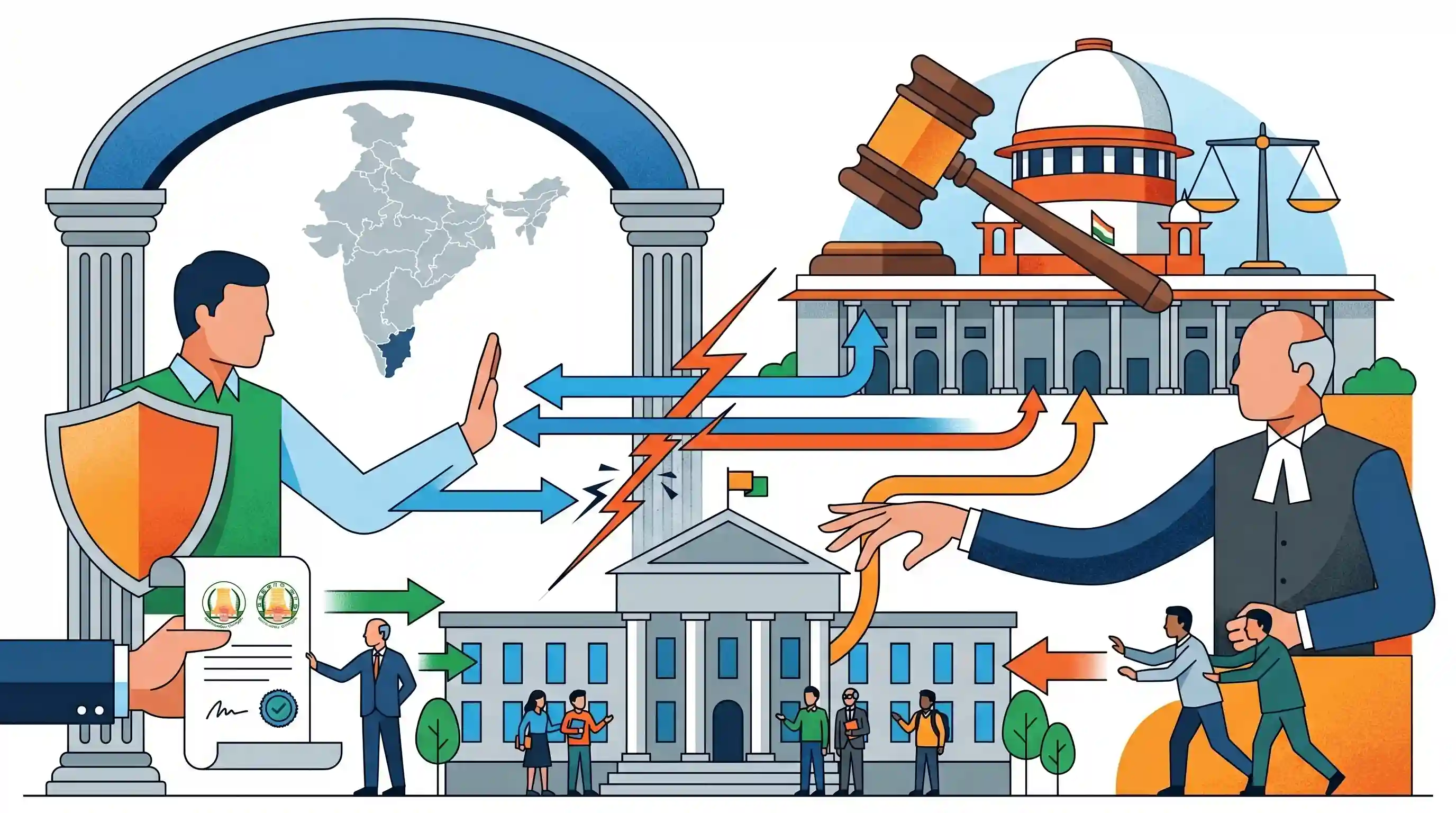
This article illustrates the recurring constitutional and administrative friction between elected State Governments and Governors (appointed by the Centre) regarding the administration of state universities. It is highly relevant for understanding practical challenges in Centre-State relations, federalism, and the discretionary powers of the Governor.
Summary
The Tamil Nadu Higher Education Minister emphasized that while the state government does not seek a confrontation with the Governor, it will not compromise on its rights regarding the appointment of Vice-Chancellors to state universities. The dispute, which highlights ongoing tensions over federalism and the role of the Governor as university Chancellor, is currently pending before the Supreme Court. The state government views the Governor's actions, and the UGC's involvement, as an overreach into state autonomy.
Key Points
- Tamil Nadu Higher Education Minister P. Viswanathan stated that the state government wishes to avoid confrontation with the Governor but cannot compromise on its rights.
- The conflict centers around the authority to appoint Vice-Chancellors (VCs) to state-run universities, a power traditionally held by the Governor acting as the Chancellor.
- The state government accuses the Governor and the Centre (via the UGC) of attempting to usurp state powers and infringe upon state autonomy in higher education.
- The matter regarding the appointment of Vice-Chancellors is currently pending resolution before the Supreme Court.
- The Tamil Nadu Assembly recently convened a special session to address this issue and protect the rights of the state government.
Important Terms
Governor (as Chancellor)

Statutory role held by State Governors, making them ex-officio heads of state universities. Unlike constitutional duties, this role often allows independent action without the state cabinet's aid and advice.
UPSC context
GS Paper II: Role of Governor and Centre-State relations. Tests understanding of constitutional vs. statutory powers and federal friction.
University Grants Commission (UGC)
Statutory body under the UGC Act, 1956, mandated to coordinate and maintain standards in higher education. Its regulations on appointments are binding and override conflicting state laws.
UPSC context
GS Paper II & III: Statutory bodies and Education. Tests knowledge of regulatory frameworks in the social sector.
Vice-Chancellor (VC)
The academic and administrative head of a university. Their appointment is a key flashpoint in federal disputes between State governments (who fund universities) and Governors (who traditionally appoint them).
UPSC context
GS Paper II: Governance. Relevant to discussions on institutional autonomy and executive vs. academic control.
Entry 66 (Union List)
A provision in the Seventh Schedule's Union List granting Parliament exclusive power over "co-ordination and determination of standards" in higher education, often used to assert Central supremacy.
UPSC context
GS Paper II: Distribution of legislative powers. Critical for explaining how the Union regulates sectors technically under Concurrent/State lists.
Federalism
The distribution of power between the Centre and States. In education, conflicts arise when the Centre's standard-setting power (Entry 66) clashes with the State's university management rights.
UPSC context
GS Paper II: Basic Structure and federal challenges. Tests the ability to analyze jurisdictional disputes in cooperative vs. competitive federalism.
Article 163
Constitutional provision requiring the Governor to act on the "aid and advice" of the Council of Ministers, except where the Constitution mandates discretionary action.
UPSC context
GS Paper II: State Executive. Fundamental for exam questions regarding the limits of the Governor's discretionary authority.
Prelims Trap
"When acting as Chancellor, the Governor is bound by the aid and advice of the Council of Ministers."
As Chancellor, the Governor holds a statutory office created by State University Acts, allowing them to act independently and outside the constitutional mandate of Article 163.
Static Concepts Connected
How does the Governor's role as Chancellor differ from their constitutional duties?
- Statutory Origin: The position is created by individual State University Acts, not by Part VI of the Constitution.
- Independent Capacity: The Governor acts in an independent statutory capacity, distinct from their role as the constitutional head of the state.
- No Ministerial Advice: In this role, the Governor is not bound to act on the aid and advice of the State Council of Ministers.
How is legislative power over higher education divided between the Centre and States?
- Concurrent Subject: Since the 42nd Amendment, 'Education' falls under Entry 25 of the Concurrent List, allowing both entities to legislate.
- Union List Override: Entry 66 of the Union List (coordination and determination of standards via UGC) provides the Centre overriding authority.
- Judicial Precedent: Supreme Court rulings establish that UGC regulations have statutory force and will override inconsistent State University Acts.
Cross-Topic Patterns
Chancellor removal bills and Article 200
States attempting to pass bills removing the Governor as Chancellor face legislative roadblocks when the Governor exercises discretion under Article 200 to reserve the bill for the President.
UGC regulations vs. State Autonomy
This dispute mirrors conflicts over NEET, showcasing the recurring federalism friction where Central mandates (like UGC rules under Union List Entry 66) override State policies on Concurrent List subjects (Education).

Expect a 2026 Prelims question testing the exact legal distinction between the Governor's constitutional duties and statutory Chancellor role.
Linked PYQs · 2
Linked PYQs · 2
- 2024MainsGS2
What changes has the Union Government recently introduced in the domain of Centre-State relations ? Suggest measures to be adopted to build the trust between the Centre and the States and for strengthening federalism.
- 2022MainsGS2
Discuss the essential conditions for exercise of the legislative powers by the Governor. Discuss the legality of re-promulgation of ordinances by the Governor without placing them before the Legislature.
