India Foreign Policy Strategy Amid US China Rivalry
Source:The Hindu ↗
Why It Matters
This article dissects the core dilemma of contemporary Indian foreign policy: balancing the immediate security threat from China without compromising strategic autonomy by forming an unequal alliance with the West. It is highly relevant for GS2 mains questions on the Indo-Pacific, India-US relations, India-China border disputes, and the shift from non-alignment to multi-alignment.
Summary
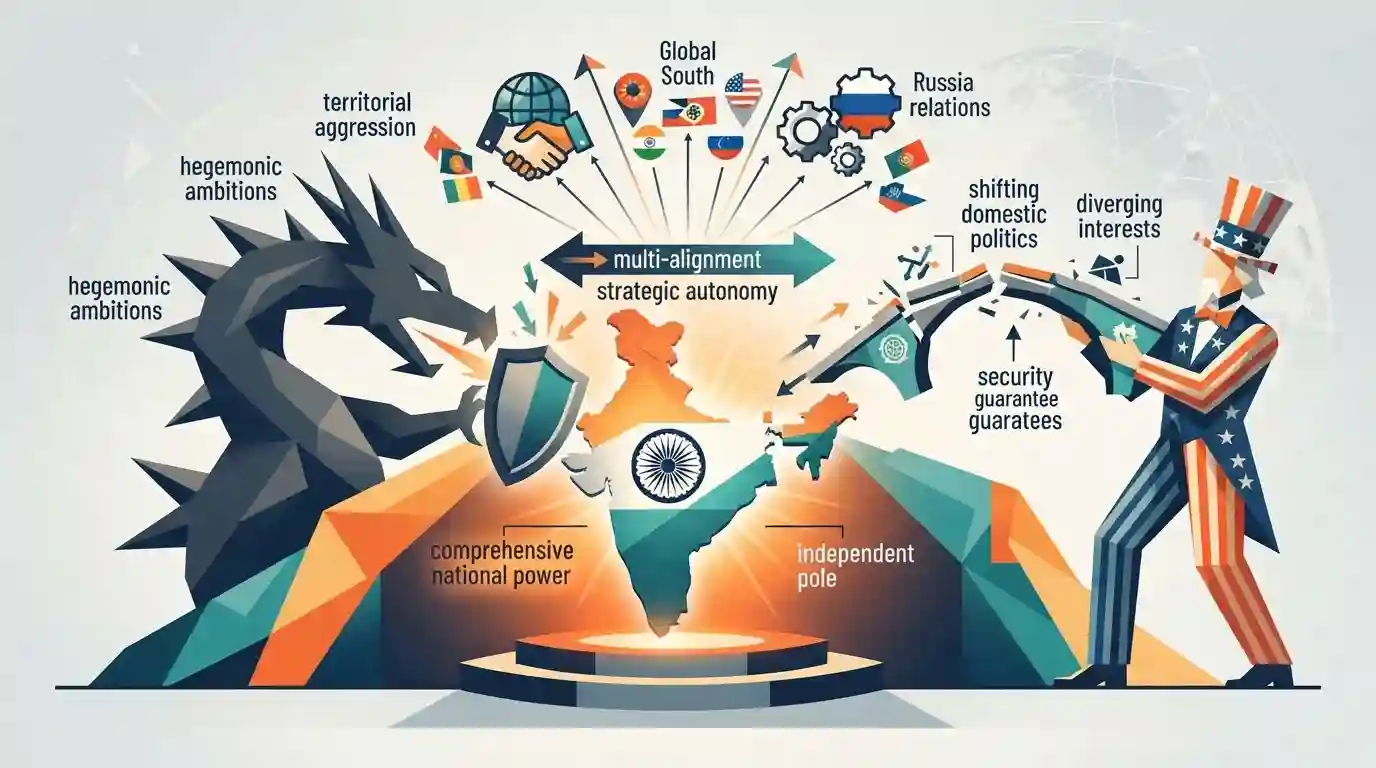
The article evaluates India's foreign policy challenges amidst the escalating geopolitical rivalry between the United States and China. It advocates for a dual approach: resolutely opposing Chinese territorial aggression and hegemonic ambitions in Asia, while strictly maintaining strategic autonomy by not becoming overly dependent on the U.S. Security guarantees from Washington are viewed as potentially unreliable due to shifting American domestic politics and diverging interests in other global arenas (such as Russia and the Global South). Consequently, the piece underscores that India's long-term security and global standing depend on practicing multi-alignment, maintaining its independent foreign policy, and accelerating the development of its own comprehensive national power to act as an independent pole in a multipolar world order.
Key Points
- India must firmly resist Chinese attempts to alter the status quo along the Line of Actual Control (LAC) and reject Beijing's push for a unipolar Asia.
- While strengthening strategic and defense ties with the U.S. is necessary to balance China, India must avoid becoming a junior partner or formal treaty ally, given the unpredictability of U.S. domestic politics and its transactional foreign policy.
- Strategic autonomy should remain the cornerstone of India's grand strategy, requiring multi-alignment through platforms like the Quad, BRICS, and engagement with the Global South.
- Building comprehensive national power—through self-reliance in defense manufacturing and economic resilience—is the only sustainable way to deter Chinese aggression without leaning excessively on American security guarantees.
Important Terms
Quad

An informal strategic forum of India, the United States, Japan, and Australia, dedicated to supporting a free, open, and rules-based Indo-Pacific region through maritime, technological, and economic cooperation.
UPSC context
GS Paper II (International Relations). Tests knowledge of Indo-Pacific strategy, maritime security, and India's balancing act between global powers.
Non-Aligned Movement (NAM)
An international forum of over 120 developing nations established in 1961 to maintain independent foreign policies and avoid formal alignment with or against major global power blocs.
UPSC context
GS Paper II (International Relations). Tests understanding of India's historical foreign policy foundations, strategic autonomy, and Global South leadership.
BRICS
An intergovernmental organization of major emerging economies, originally consisting of Brazil, Russia, India, China, and South Africa, designed to foster economic cooperation, financial autonomy, and global governance reform.
UPSC context
GS Paper II (International Relations). Tests dynamics of multi-alignment, South-South cooperation, and reform of international financial institutions.
Shanghai Cooperation Organisation (SCO)
A Eurasian political, economic, and security alliance of ten member states, including India and China, focused on regional stability, counter-terrorism, and combating the "three evils" of terrorism, separatism, and extremism.
UPSC context
GS Paper II (International Relations). Tests regional security dynamics, Central Asian connectivity, and bilateral balancing within multilateral forums.
Prelims Trap
The Vibrant Villages Programme is uniformly structured as a Centrally Sponsored Scheme across both its first and second phases.
VVP-I is a Centrally Sponsored Scheme, whereas VVP-II transitions into a 100% Centrally Funded Central Sector Scheme, making uniform categorization incorrect.
Static Concepts Connected
What are the four foundational defense agreements signed between India and the United States?
- GSOMIA (2002): Facilitates the secure sharing of classified military intelligence and safeguards sensitive data exchanged between the two nations.
- LEMOA (2016): Allows reciprocal access to military bases for refueling and replenishment during joint exercises, port calls, or humanitarian operations.
- COMCASA (2018): Enables real-time, encrypted communication transfers between compatible US and Indian military hardware during joint deployments.
- BECA (2020): Permits the exchange of highly accurate satellite imagery, maps, and navigational data for precise targeting of strategic assets.
How does contemporary Multi-Alignment differ from Cold War-era Non-Alignment?
- Non-Alignment (NAM): Focused on maintaining ideological distance from opposing superpower blocs to avoid post-colonial military entanglements.
- Multi-Alignment: Drives parallel involvement in competing forums like the Quad and BRICS, choosing partners based strictly on issue-specific national interests.
Cross-Topic Patterns
Border infrastructure + internal security
Schemes like Vibrant Villages counter China's civilian-military fusion strategy, transforming remote border zones from vulnerable security vacuums into populated, resilient strategic buffers.
Defense indigenization + industrial growth
Positive Indigenisation Lists under DAP 2020 act as import-substitution tools that simultaneously boost domestic manufacturing and insulate defence supply chains from global geopolitical shocks.

Mains 2026 will likely test the viability of India's strategic autonomy amid US-China bipolarity and defense import-substitution.
Linked PYQs · 4
Linked PYQs · 4
- 2024MainsGS2
‘The West is fostering India as an alternative to reduce dependence on China's supply chain and as a strategic ally to counter China's political and economic dominance.’ Explain this statement with examples.
- 2019MainsGS2
‘What introduces friction into the ties between India and the United States is that Washington is still unable to find for India a position in its global strategy, which would satisfy India's national self-esteem and ambitions.’ Explain with suitable examples.
- 2014MainsGS2
With respect to the South China sea, maritime territorial disputes and rising tension affirm the need for safeguarding maritime security to ensure freedom of navigation and over flight throughout the region. In this context, discuss the bilateral issues between India and China.
- 2025MainsGS2
"With the waning of globalization, post-Cold War world is becoming a site of sovereign nationalism.” Elucidate.
