Administrative Challenges in Special Electoral Roll Revisions
Source:The Hindu ↗
Why It Matters
This issue directly ties to GS2 Polity and Governance topics concerning the mandate and functioning of the ECI, electoral reforms, and the Representation of the People Act. It highlights the administrative challenges and rights-based issues surrounding universal adult suffrage and voter disenfranchisement, which are frequent subjects of UPSC inquiries.
Summary
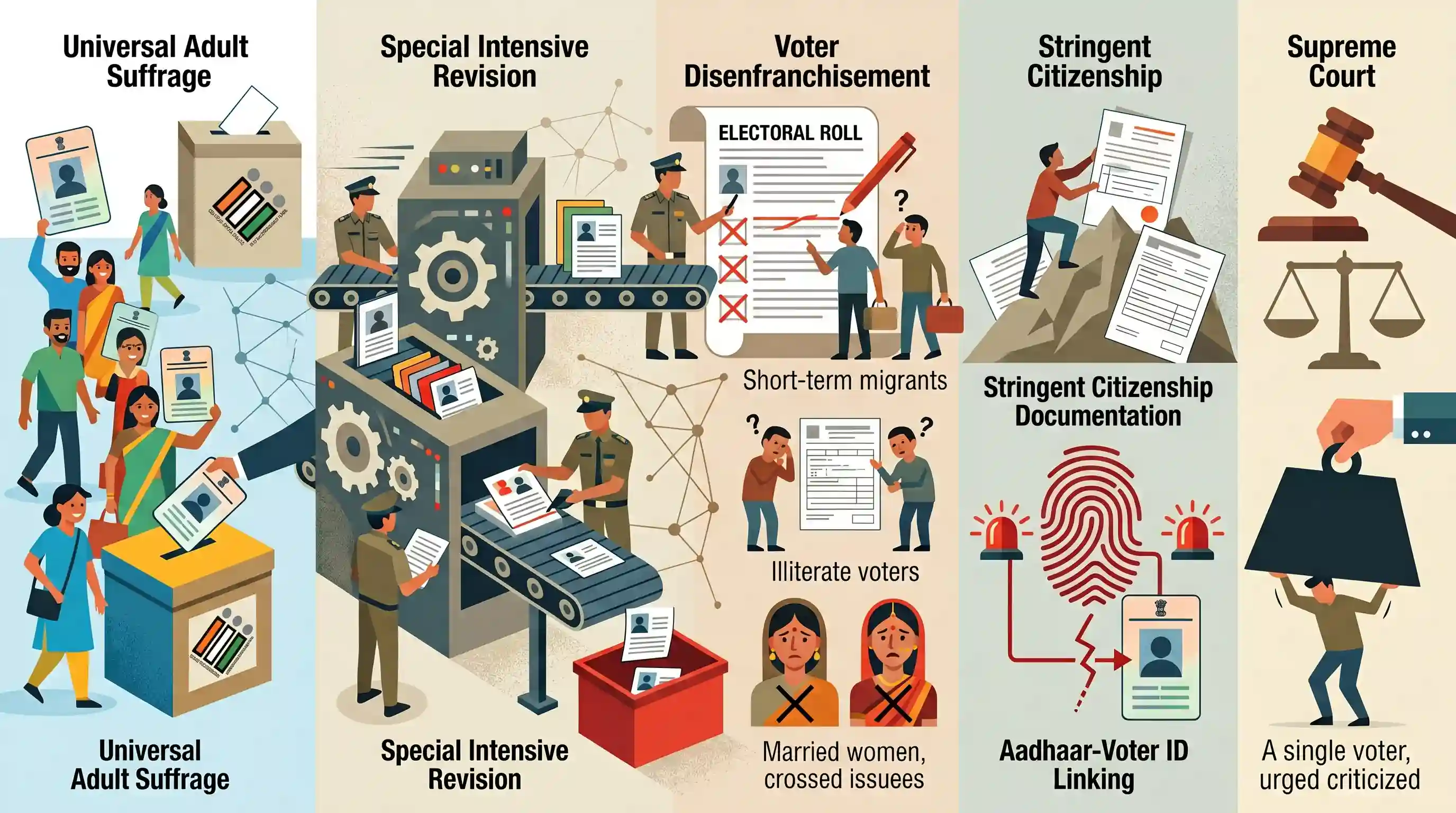
The article criticizes the Election Commission of India's (ECI) rushed execution of the Special Intensive Revision (SIR) of electoral rolls, which has led to mass voter deletions and exclusions across states like Tamil Nadu, West Bengal, and Bihar. Vulnerable populations—including short-term migrants, illiterate voters, and married women—are disproportionately affected, risking large-scale disenfranchisement. Administrative challenges, such as stringent requirements for citizenship documentation and issues stemming from Aadhaar-voter ID linking, compound the problem. The Supreme Court has urged the ECI to take a sympathetic approach, emphasizing that placing the onus of verifying enrollment onto the voters is a systemic flaw that undermines universal adult suffrage.
Key Points
- The Election Commission of India's (ECI) rushed Special Intensive Revision (SIR) is causing large-scale voter disenfranchisement in states like Tamil Nadu, West Bengal, and Bihar.
- Vulnerable demographics, such as short-term migrants, illiterate individuals, and newly married women, face systemic exclusion from electoral rolls due to procedural hurdles.
- Strict citizenship documentation rules (e.g., proving parents' birth details for those born after 1987) create severe bottlenecks for voter registration.
- Despite the authorization of Aadhaar as an identity document for verification in Bihar, mass deletions persisted, highlighting ongoing administrative flaws.
- The systemic burden of confirming electoral presence has been unfairly shifted to eligible voters, prompting Supreme Court intervention to urge a more sympathetic ECI approach.
Important Terms
Special Intensive Revision (SIR)

A proactive, house-to-house enumeration process by the ECI to create a fresh electoral roll. Unlike routine summary revisions, SIR involves physical verification by officials to remove 'ghost voters' and include new electors.
UPSC context
GS Paper II (Elections); tests understanding of electoral reforms and the administrative challenges in balancing roll accuracy with voter inclusion.
Election Commission of India (ECI)
A permanent constitutional body (Article 324) responsible for directing and controlling the entire electoral process in India, including the preparation of electoral rolls and conducting elections to Parliament and State Legislatures.
UPSC context
GS Paper II (Constitutional Bodies); central to topics on electoral integrity, institutional independence, and the conduct of free and fair elections.
Representation of the People Act, 1950
Key legislation providing the legal framework for seat allocation, delimitation of constituencies, and voter qualifications. It specifically governs the preparation and revision of electoral rolls before the actual conduct of elections.
UPSC context
GS Paper II (Polity); foundational for questions on the statutory basis of voter registration and the division of electoral powers.
Universal Adult Suffrage
A constitutional right (Article 326) granting every citizen aged 18 and above the right to vote without discrimination based on religion, race, caste, or sex, unless legally disqualified.
UPSC context
GS Paper II (Polity); fundamental democratic principle; relevant for discussions on disenfranchisement, inclusion, and the 'one person, one vote' doctrine.
Election Laws (Amendment) Act, 2021
Legislation that amended RPA 1950 to permit linking Aadhaar with voter IDs for authentication. It aims to eliminate duplicate entries while raising concerns regarding privacy and potential mass voter deletions.
UPSC context
GS Paper II (Governance); tests awareness of recent reforms, the Puttaswamy privacy judgment, and the impact of technology on electoral rights.
Puttaswamy Judgment
A Supreme Court judgment (2017) declaring the Right to Privacy a fundamental right. It set the 'proportionality test' for state interventions, frequently cited in debates over mandatory Aadhaar-Voter ID linking.
UPSC context
GS Paper II (Fundamental Rights); essential for analyzing the constitutionality of data-sharing and digital surveillance in electoral processes.
Prelims Trap
The Election Commission mandates linking Aadhaar with Voter IDs to purge duplicate voters during intensive revisions.
The Election Laws (Amendment) Act, 2021 allows voluntary—not mandatory—linking of electoral rolls with Aadhaar. ECI cannot force linkage or delete names for non-submission.
Static Concepts Connected
What governs the preparation and revision of electoral rolls in India?
- RPA 1950: The Representation of the People Act (RPA), 1950 deals with the allocation of seats, delimitation of constituencies, and the preparation/revision of electoral rolls.
- Disqualifications: Section 16 of RPA 1950 outlines disqualifications for registration, explicitly excluding non-citizens and those declared of unsound mind by a competent court.
- Right to Hearing: Under Section 22, the Electoral Registration Officer (ERO) must provide the affected individual a reasonable prior opportunity of being heard before deleting their name.
How is the Right to Vote classified under Indian law?
- Constitutional Right: Article 326 guarantees universal adult suffrage for citizens aged 18 and above. It is definitively a Constitutional Right, not a Fundamental Right.
- Statutory Mechanics: The actual exercise and procedural mechanics of this right are statutory, governed by the Representation of the People Acts of 1950 and 1951.
Cross-Topic Patterns
Migration + Electoral Disenfranchisement
The systemic exclusion of short-term migrants from electoral rolls connects directly to the ECI's recently debated proposal for Remote Electronic Voting Machines (RVMs) for domestic migrants.
Aadhaar linking + Privacy Debate
Voluntary Aadhaar-Voter ID linking under the Election Laws (Amendment) Act, 2021 frequently intersects with the Puttaswamy proportionality test on state data collection and the right to privacy.

Expect a 2026 multi-statement question mixing RPA 1950 provisions on electoral roll deletions, Aadhaar linkage legality, and ERO powers.
Linked PYQs · 5
Linked PYQs · 5
- 2017MainsGS2
To enhance the quality of democracy in India the Election Commission of India has proposed electoral reforms in 2016. What are the suggested reforms and how far are they significant to make democracy successful?
- 2024MainsGS2
Examine the need for electoral reforms as suggested by various committees with particular reference to "one nation one election" principle.
- 2022MainsGS2
Discuss the role of the Election Commission of India in the light of the evolution of the Model Code of Conduct.
- 2024MainsGS2
Right to privacy is intrinsic to life and personal liberty and is inherently protected under Article 21 of the constitution. Explain. In this reference discuss the law relating to D.N.A. testing of child in the womb to establish its paternity.
- 2017PrelimsGS1
Right to vote and to be elected in India is a
