Karnataka SC Federation Opposes Extension for Sub Categorisation Panel
Source:The Hindu ↗
Why It Matters
The debate around the sub-categorisation of Scheduled Castes (internal reservation) is a critical issue in Indian polity and social justice, testing the limits of affirmative action and constitutional mechanisms. It is relevant for GS Paper 2 (Welfare schemes for vulnerable sections, mechanisms, laws, institutions and bodies constituted for the protection and betterment of these vulnerable sections).
Summary
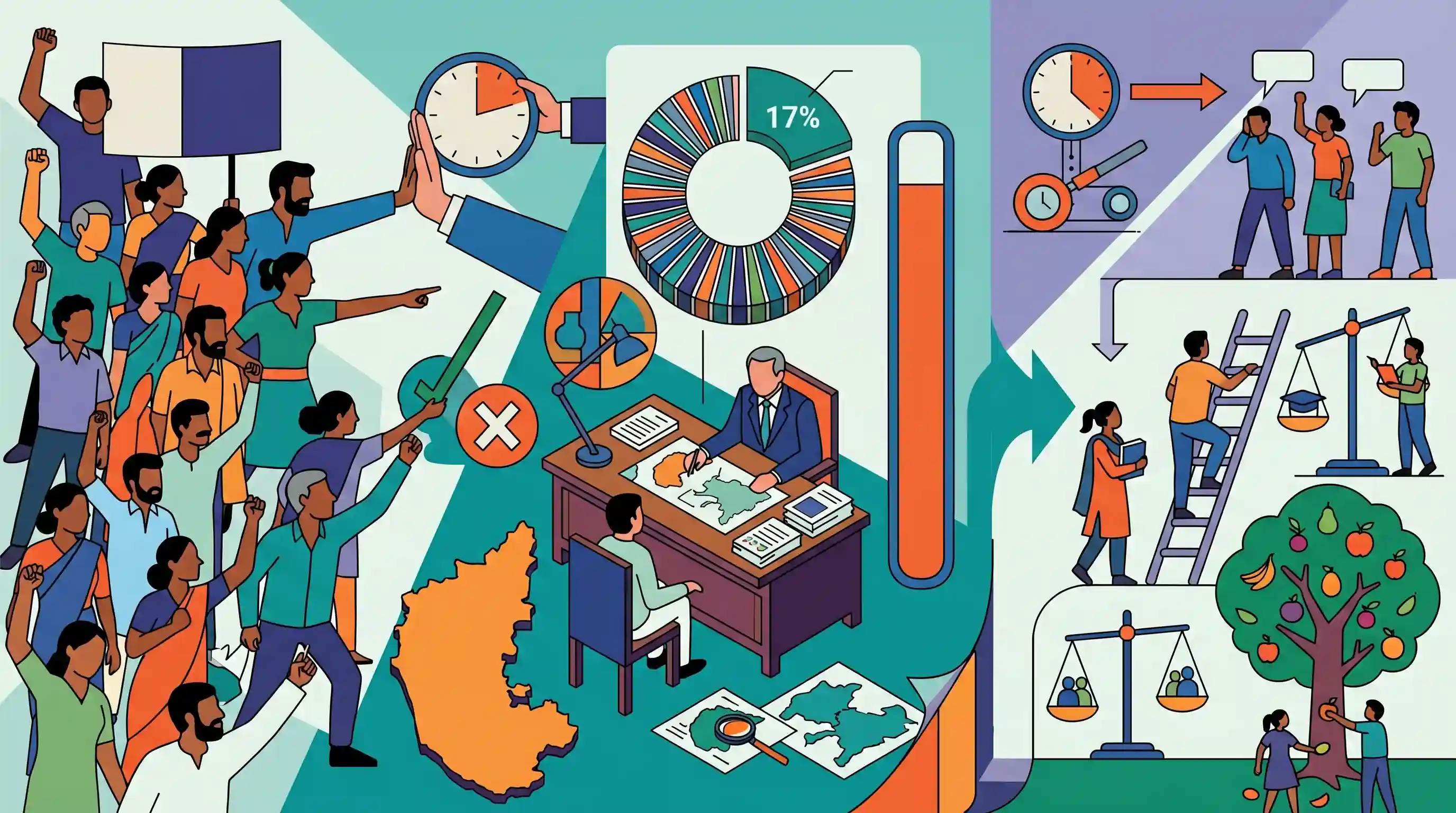
The Samajika Nyayakkagi Parishishta Jatigala Okkoota, a federation of Scheduled Caste communities in Karnataka, has demanded that the state government not grant further extensions to the H.N. Nagamohan Das commission. Tasked with recommending internal reservations across 101 SC communities within the 17% overarching SC quota, the commission has already finished 91-92% of its survey. Activists argue that another time extension would unnecessarily delay the formulation and implementation of policies aimed at equitable sub-categorisation and social justice.
Key Points
- The Samajika Nyayakkagi Parishishta Jatigala Okkoota (federation of SC communities) has urged the Karnataka government to deny further extensions to the H.N. Nagamohan Das commission.
- The commission is tasked with surveying 101 Scheduled Caste communities to recommend internal reservation structures within Karnataka's 17% SC quota.
- About 91-92% of the survey is complete, and advocates argue that further extensions will unduly delay the implementation of sub-categorisation recommendations.
- The development underlines the broader national push for the sub-categorisation of Scheduled Castes to ensure equitable distribution of affirmative action benefits among the most marginalized sub-castes.
Important Terms
H.N. Nagamohan Das Commission

A Karnataka state-appointed commission chaired by retired Justice H.N. Nagamohan Das. It recommended increasing SC/ST quotas (to 17% and 7%) and conducted surveys to enable scientific sub-categorization within the SC community.
UPSC context
GS II (Social Justice/Vulnerable Sections). Relevant for studying state-level affirmative action and the role of commissions in policy-making.
Internal Reservation (Sub-categorization)
The practice of dividing a larger reserved category (e.g., Scheduled Castes) into sub-groups to ensure benefits reach the most marginalized or underrepresented communities within that category.
UPSC context
GS II (Social Justice). Central to the debate on equitable reservation and the evolution of Article 14 jurisprudence.
Samajika Nyayakkagi Parishishta Jatigala Okkoota
A federation representing Scheduled Caste communities in Karnataka. It functions as a pressure group advocating for the timely implementation of sub-quotas and equitable social justice for Dalit sub-groups.
UPSC context
GS II (Pressure Groups). Example of a civil society organization influencing state reservation policies.
State of Punjab v. Davinder Singh (2024)
A landmark 2024 Supreme Court judgment (7-judge bench) that permitted states to sub-classify Scheduled Castes and Scheduled Tribes for reservations, overturning the 2004 E.V. Chinnaiah precedent.
UPSC context
GS II (Judiciary). A critical case for understanding the legality of sub-quotas and the "creamy layer" concept.
Article 341
A constitutional provision empowering the President to notify specific groups as Scheduled Castes. Current legal interpretations allow states to sub-classify this list without altering its overall membership.
UPSC context
GS II (Constitution). Foundational for understanding the Union-State power balance regarding the identification of reserved categories.
A.J. Sadashiva Commission
A 2005 Karnataka commission that recommended dividing the SC quota into four sub-groups. Its findings remained unimplemented for years, serving as the precursor to the Nagamohan Das survey.
UPSC context
GS II. Provides historical context to the long-standing political and legal struggle for sub-reservation in Karnataka.
Prelims Trap
State legislatures can now amend the Presidential list of Scheduled Castes to create sub-categories.
While states can sub-classify the existing list for internal quotas (per the 2024 SC ruling), only Parliament can add or remove castes from the Presidential list under Article 341.
Static Concepts Connected
How is the constitutional authority over the Scheduled Caste list divided?
- Presidential Notification: Under Article 341(1), the President of India first notifies the initial list of Scheduled Castes for any State or Union Territory.
- Parliamentary Power: Under Article 341(2), only Parliament has the authority to include or exclude any caste from this Presidential list via legislation.
- State Sub-classification: States cannot alter the list itself, but can sub-classify the notified castes to allocate targeted internal quotas using Articles 15(4) and 16(4).
What conditions did the Supreme Court set for SC sub-categorisation in 2024?
- Empirical Data: States must collect quantifiable, empirical data proving the inadequate representation and backwardness of specific sub-castes.
- No Total Exclusion: A state cannot reserve 100% of the SC quota for a specific sub-group to the complete exclusion of other SC communities.
- Substantive Equality: The core rationale must be to address intra-group heterogeneity so that advanced sub-castes do not corner all reservation benefits.
Cross-Topic Patterns
SC Sub-categorisation & OBC Rohini Commission
The state-level push for SC internal quotas (like the Nagamohan Das Commission) mirrors the Union government's Justice G. Rohini Commission, which aimed for the equitable sub-categorisation of OBCs nationally.
Substantive Equality vs Formal Equality
Internal reservations highlight the constitutional evolution of Article 14, where 'intelligible differentia' is used to achieve substantive equality by treating unequal sub-groups differently within the broader SC umbrella.

Expect a Prelims trap confusing Parliament's absolute power under Article 341 with the States' newly affirmed power to sub-classify SCs.
Linked PYQs · 2
Linked PYQs · 2
- 2018MainsGS2
Whether National Commission for Scheduled Castes (NCSC) can enforce the implementation of constitutional reservation for the Scheduled Castes in the religious minority institutions? Examine.
- 2023MainsGS2
“Development and welfare schemes for the vulnerable, by its nature, are discriminatory in approach.” Do you agree? Give reasons for your answer.
