MRNA Tumor Vaccines Advance Precision Oncology and Cancer Care
Source:The Hindu ↗
ఇది ఎందుకు ముఖ్యం
Therapeutic cancer vaccines represent a critical paradigm shift in precision medicine, marrying advanced genomic sequencing, nanotechnology (lipid nanoparticles), and immunology. This is directly relevant to GS Paper 3 (Science and Technology and Biotechnology) and GS Paper 2 (Health sector and public infrastructure), offering prime analytical material on how emerging technologies can revolutionize non-communicable disease treatment.
సారాంశం
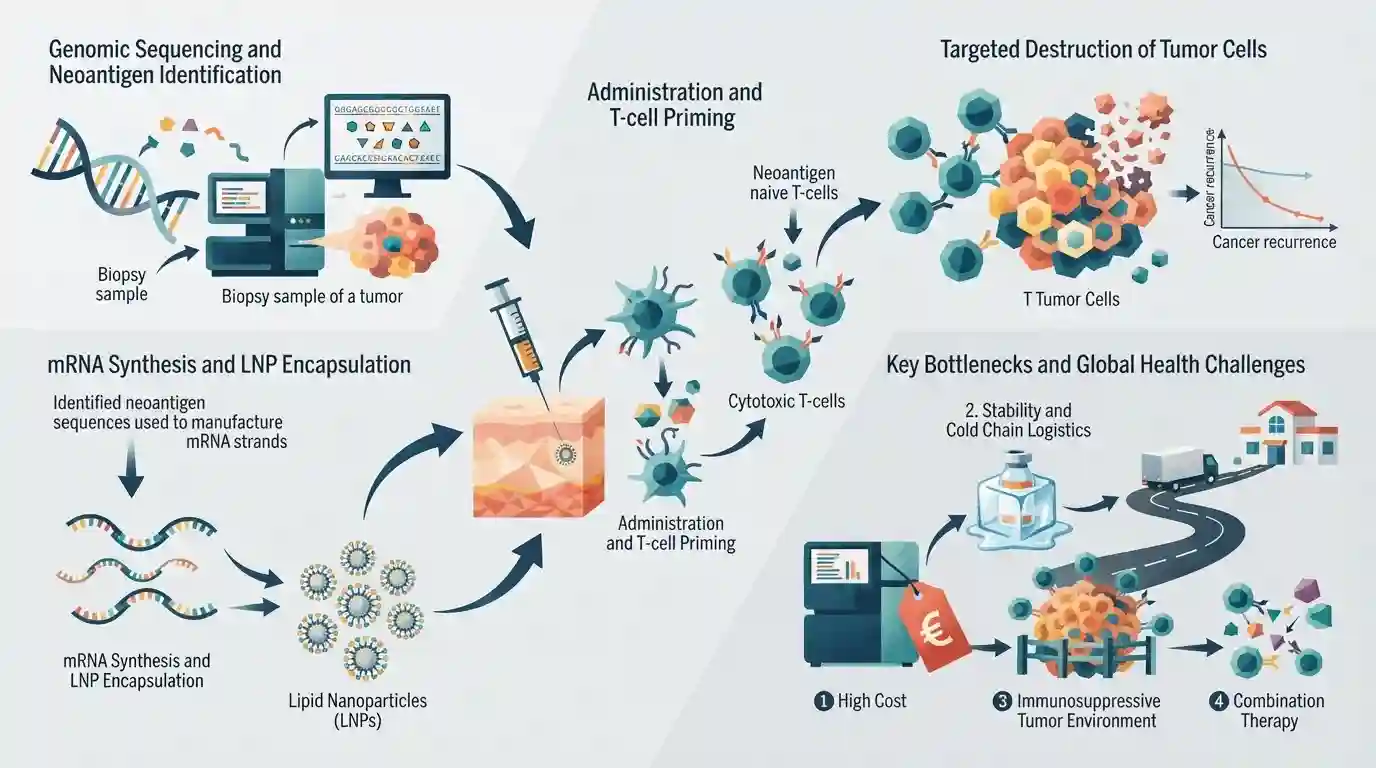
The article explores the revolutionary potential of therapeutic messenger RNA (mRNA) tumor vaccines in precision oncology. Unlike traditional vaccines that prevent infections, these personalized vaccines are therapeutic and designed to treat existing cancers. By genetically sequencing a patient's tumor, scientists identify unique mutations (neoantigens), manufacture synthetic mRNA coding for these targets, and encapsulate them in lipid nanoparticles (LNPs) for delivery. Once administered, they prime the patient's own cytotoxic T-cells to specifically target and destroy cancer cells, significantly lowering recurrence rates. While clinical trials pairing mRNA vaccines with checkpoint inhibitors (like pembrolizumab) show promising results in melanoma and pancreatic cancer, major bottlenecks remain, including the high cost of personalized sequencing, delivery vehicle stability, immunosuppressive tumor environments, and cold-chain logistics, especially for low- and middle-income nations like India.
ముఖ్య అంశాలు
- Unlike conventional preventive vaccines (e.g., HPV or Hepatitis B), mRNA tumor vaccines are therapeutic interventions designed to treat existing cancers by training the immune system to target tumor-specific mutations.
- The therapeutic mechanism involves surgical removal of the tumor, next-generation genomic sequencing to identify unique patient mutations (neoantigens), and using AI/computational models to design a personalized mRNA sequence.
- The personalized mRNA is synthesized and packaged inside Lipid Nanoparticles (LNPs) which deliver it to immune cells (dendritic cells), priming cytotoxic CD8+ T-cells to locate and destroy remaining cancer cells throughout the body.
- Clinical synergy has been observed when pairing these vaccines with immune checkpoint inhibitors (like Keytruda/pembrolizumab) to overcome the immunosuppressive tumor microenvironment, reducing melanoma recurrence or death rates by 44% in Phase 2 trials.
- Primary challenges for scaling this technology include high upfront sequencing and customization costs, stability and target-delivery of LNPs, tumor antigen escape (where tumors mutate to evade targeted antigens), and cold-chain logistics.
- For developing countries like India, the high cost of genomic sequencing and personalized formulation represents a major barrier to healthcare equity, stressing the need for public-private partnerships and local manufacturing capability.
ముఖ్యమైన పదాలు
Cancer Vaccine Launch Pad (CVLP)

An NHS England initiative that fast-tracks patient recruitment and provides streamlined access to clinical trials for personalized mRNA cancer vaccines and other novel immunotherapies.
UPSC context
GS Paper III (Science & Technology); tests awareness of global healthcare delivery innovations and clinical trial frameworks.
BioNTech
A German biotechnology company pioneering messenger RNA (mRNA) therapeutics, known for co-developing the first COVID-19 vaccine and advancing personalized cancer vaccine trials.
UPSC context
GS Paper III (Biotechnology); tests understanding of mRNA platform developers and global public-private partnerships in healthcare.
National Health Service (NHS) England
The publicly funded national healthcare system of England, which manages public health delivery and coordinates national clinical research initiatives like the Cancer Vaccine Launch Pad.
UPSC context
GS Paper II (Public Health); tests knowledge of universal health coverage models and state-sponsored medical research.
Moderna
An American biotechnology firm specializing in mRNA technology, currently co-developing intismeran, a personalized mRNA cancer vaccine, for high-risk melanoma and other cancers.
UPSC context
GS Paper III (Biotechnology); tests awareness of lipid nanoparticle-delivered mRNA therapies and precision oncology advances.
Merck & Co (MSD)
A global pharmaceutical company known for Keytruda (pembrolizumab), collaborating with Moderna to pair checkpoint inhibitors with personalized cancer vaccines to reduce cancer recurrence.
UPSC context
GS Paper III (Science & Technology); tests understanding of monoclonal antibodies, immunotherapy combinations, and oncology R&D.
ప్రిలిమ్స్ ఉచ్చు
mRNA tumor vaccines are preventive agents administered to healthy individuals to permanently block the initial onset of oncogenic mutations.
These vaccines are therapeutic, not preventive. They are customized post-diagnosis to treat active, existing cancers by targeting patient-specific neoantigens.
అనుసంధానమైన స్థిర భావనలు
How do mRNA and DNA vaccine platforms differ in cellular mechanism?
- Cellular Target: mRNA vaccines function in the cytoplasm; DNA vaccines must enter the cell nucleus to undergo transcription.
- Genomic Integration: mRNA does not integrate into host DNA, avoiding mutational risks; DNA plasmids carry a small, theoretical integration risk.
- Stability Profile: mRNA is highly fragile and requires lipid nanoparticle encapsulation; DNA is structurally stable and easier to store.
What are Immune Checkpoint Inhibitors (ICIs) in immunotherapy?
- Target Proteins: Monoclonal antibodies blocking inhibitory pathway receptors like PD-1, PD-L1, or CTLA-4 on immune or tumor cells.
- Immune Release: They release the immune system's biological brakes, letting cytotoxic T-cells recognize and destroy evading cancer cells.
అంతర-అంశ నమూనాలు
Biotech patents and healthcare equity
High personalization costs of mRNA tumor vaccines widen the global South's accessibility gap, highlighting WTO-TRIPS flexibilities for life-saving therapeutics.
AI drug design and regulation
Using AI to generate unique, patient-specific neoantigen targets challenges standard clinical trial regulatory frameworks designed for mass-produced, uniform drugs.

Multi-statement GS-3 questions will likely contrast therapeutic vs preventive vaccines, testing cellular translation site and LNP vectors.
అనుసంధాన PYQలు · 4
అనుసంధాన PYQలు · 4
- 2021PrelimsGS1
With reference to recent developments regarding 'Recombinant Vector Vaccines', consider the following statements : 1. Genetic engineering is applied in the development of these vaccines. 2. Bacteria and viruses are used as vectors. Which of the statements given above is/are correct?
- 2020MainsGS3
What do you understand by nanotechnology and how is it helping in health sector?
- 2021MainsGS3
What are the research and developmental achievements in applied biotechnology? How will these achievements help to uplift the poorer sections of the society?
- 2019PrelimsGS1
'RNA interference (RNAi)' technology has gained popularity in the last few years. Why? 1. It is used in developing gene silencing therapies. 2. It can be used in developing therapies for the treatment of cancer. 3. It can be used to develop hormone replacement therapies. 4. It can be used to produce crop plants that are resistant to viral pathogens. Select the correct answer using the code given below.
