Gujarat Highlights Education and Skill Schemes for DNT Communities
Source:social-news-xyz ↗
Why It Matters
Welfare of marginalized and historically oppressed communities like DNTs is a high-priority topic for both UPSC and state PSC exams. Understanding state-specific budget increases, credit-access schemes, and administrative reforms (such as swift caste certificate issuance) provides critical inputs for questions on social justice, vulnerable sections, and governance.
Summary
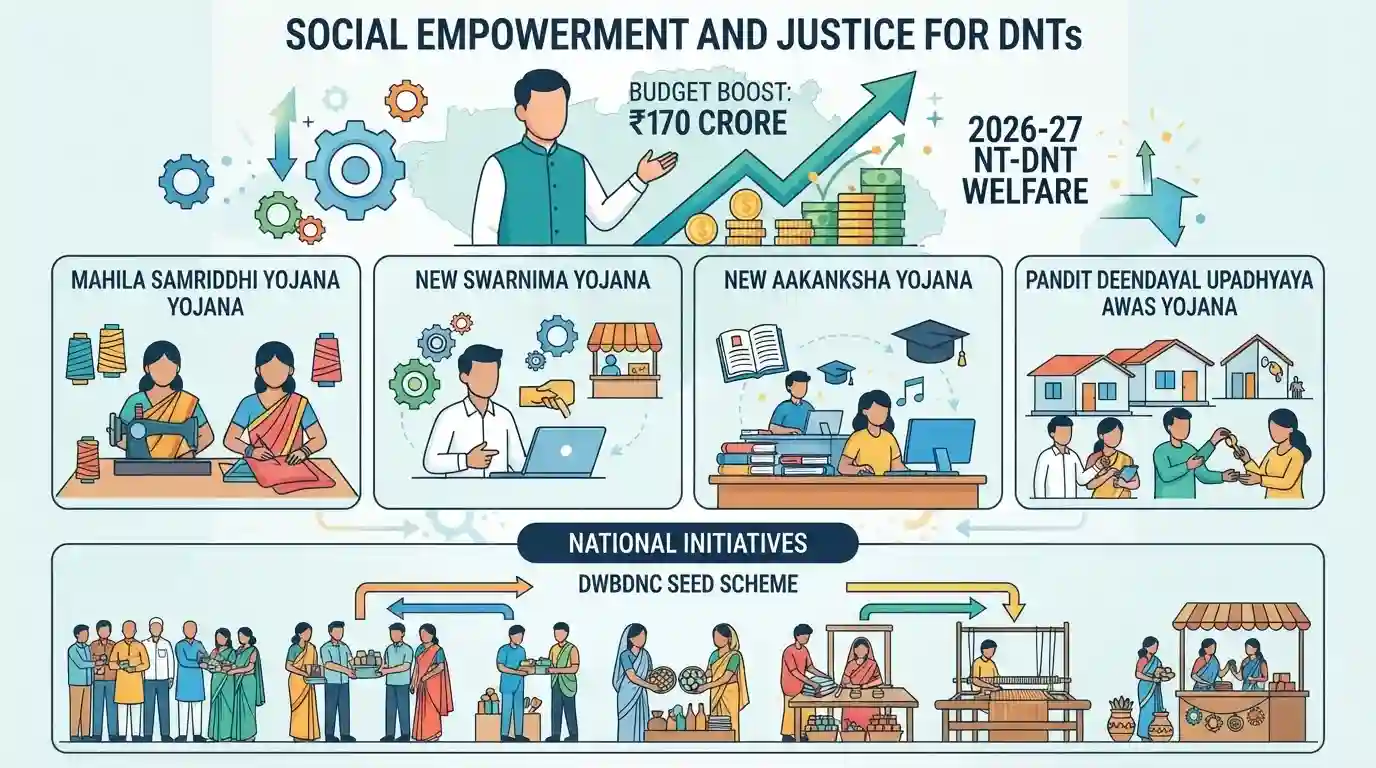
Gujarat Minister of Social Justice and Empowerment, Pradyuman Vaja, highlighted state-led and national initiatives for the education, skill development, and self-reliance of Denotified, Nomadic and Semi-Nomadic Tribes (DNTs) during the DNT Liberation Day event on August 31. The Gujarat government has boosted the 2026-27 NT-DNT welfare budget to ₹170 crore and expanded the scope of schemes like Mahila Samriddhi Yojana, New Swarnima Yojana, New Aakanksha Yojana, and Pandit Deendayal Upadhyaya Awas Yojana. Additionally, the Union Government's DWBDNC is actively executing the SEED scheme to foster economic empowerment and support self-help groups for these marginalized communities.
Key Points
- DNT Liberation Day is celebrated on August 31 to commemorate the repeal of the oppressive British-era Criminal Tribes Act of 1871 on August 31, 1952.
- The Gujarat Budgetary allocation for the welfare of Nomadic and Denotified Tribes (NT-DNT) has been increased from ₹163 crore to ₹170 crore for the 2026-27 financial year.
- The State Nomadic and Denotified Tribes Development Corporation's budget was raised to ₹20 crore (from ₹12 crore) to facilitate term loans of ₹3 lakh to ₹15 lakh and microfinance loans up to ₹2.50 lakh at nominal interest rates of 4% to 5%.
- Key state welfare schemes highlighted include Mahila Samriddhi Yojana (loans up to ₹2.5 lakh at 4%), New Swarnima Yojana (assistance up to ₹5 lakh), New Aakanksha Yojana (educational loans up to ₹15 lakh), and Pandit Deendayal Upadhyaya Awas Yojana (plot allotment and ₹1.70 lakh financial assistance via DBT).
- Administratively, the government has directed that caste certificates for DNT communities be issued within 7 days, with provision for appeals before the Prant Officer, Collector, and Analysis Committee.
- At the central level, the Development and Welfare Board for Nomadic, Denotified and Semi-Nomadic Tribes (DWBDNCs), constituted in 2019, is implementing the SEED Scheme to promote economic empowerment and activate over 7,000 women's self-help groups.
Important Terms
Criminal Tribes Act 1871

A colonial British legislation that branded entire nomadic and semi-nomadic communities as "born criminals" by birth. Repealed on August 31, 1952, which is now celebrated as DNT Liberation Day (Vimukti Diwas).
UPSC context
GPSC Class 1/2 GS Paper-I (History) & Paper-II (Social Justice), testing tribal history and post-Independence marginalization.
SEED Scheme (Scheme for Economic Empowerment of DNTs)
A Central Sector Scheme launched in 2022 to provide free competitive coaching, health insurance (via Ayushman Bharat), livelihood support, and housing assistance to Denotified, Nomadic, and Semi-Nomadic Tribes.
UPSC context
GS Paper-II (Social Justice and Welfare Schemes), testing policies and programs for vulnerable sections.
DWBDNC (Development and Welfare Board for De-notified, Nomadic and Semi-Nomadic Communities)
A specialized board established in 2019 under India's Ministry of Social Justice and Empowerment to plan, monitor, and implement welfare and developmental programs specifically for DNT, NT, and SNT communities.
UPSC context
GS Paper-II (Statutory and regulatory bodies), testing administrative institutions for backward classes.
Pandit Deendayal Upadhyaya Awas Yojana
A Gujarat state welfare scheme offering financial assistance of up to ₹1.70 lakh to homeless families and individuals from socially and educationally backward classes (SEBC), including NT-DNT, to construct new houses.
UPSC context
GS Paper-II/III (Gujarat State Schemes & Economy), testing rural/urban welfare and housing policies.
New Swarnima Yojana
A Gujarat state self-employment loan scheme implemented under the Social Justice Department, providing women entrepreneurs from backward classes (including DNT/NT) low-interest loans up to ₹5 lakh to foster self-reliance.
UPSC context
GS Paper-II (Women empowerment & state schemes), testing socio-economic development initiatives.
New Aakanksha Yojana
A Gujarat government educational loan scheme designed to support marginalized students (including NT-DNTs) by providing up to ₹15 lakh at low interest rates (around 4%) for pursuing higher education.
UPSC context
GS Paper-II (Human Resource Development & Education), testing financial assistance schemes for vulnerable sections.
Prelims Trap
DNT communities were formally denotified and liberated on August 15, 1947, alongside India's Independence.
They were actually liberated on August 31, 1952, when the colonial Criminal Tribes Act of 1871 was repealed, making August 31 'Vimukti Diwas'.
Static Concepts Connected
Which key committees and commissions recommended welfare reforms for DNTs in India?
- Ayyangar Committee (1949): Recommended the repeal of the oppressive Criminal Tribes Act of 1871, leading to their formal liberation.
- Renke Commission (2008): First to identify and estimate the DNT population; recommended establishing a dedicated national welfare board.
- Idate Commission (2018): Recommended creating a permanent commission for DNTs and mapping out specific state-wise categorizations.
Cross-Topic Patterns
Decolonizing Indian criminal laws
The transition from the colonial Criminal Tribes Act to the Habitual Offenders Act highlights India's ongoing efforts to decolonize criminal jurisprudence.
Financial inclusion via micro-credit
Gujarat's NT-DNT state schemes rely heavily on targeted low-interest micro-credit to bypass traditional commercial banking barriers for nomadic communities.

Vimukti Diwas history (1952) and SEED scheme pillars likely to feature in combined multi-statement questions on vulnerable groups.
Linked PYQs · 3
Linked PYQs · 3
- 2025GPSC_PRELIMSGS1
Which of the following statements is/are correct regarding the G-SAFAL scheme?
- 2024GPSC_PRELIMSGS1
The criteria for declaration of Scheduled areas include: 1. Preponderance of tribal population 2. Compactness and reasonable size of the area 3. Economic backwardness of the area as compared to neighbouring areas Select the correct answer code:
- 2022GPSC_PRELIMSGS1
Which of the following schemes facilitates bank loans to at least one Scheduled Caste/ Scheduled Tribe borrower and at least one woman borrower per bank branch for setting up greenfield enterprises?
