Nomadic Community Reservation Protest Turns Violent in Jaipur
Source:etvbharat ↗
Why It Matters
The article highlights the growing demand for reservation and welfare benefits by Denotified, Nomadic, and Semi-Nomadic Tribes (DNTs) in Rajasthan. This intersection of public policy, social justice, and law and order is a recurring theme in state-level governance exams, linking back to the historical, cultural, and socio-economic status of communities like the Kalbelias.
Summary
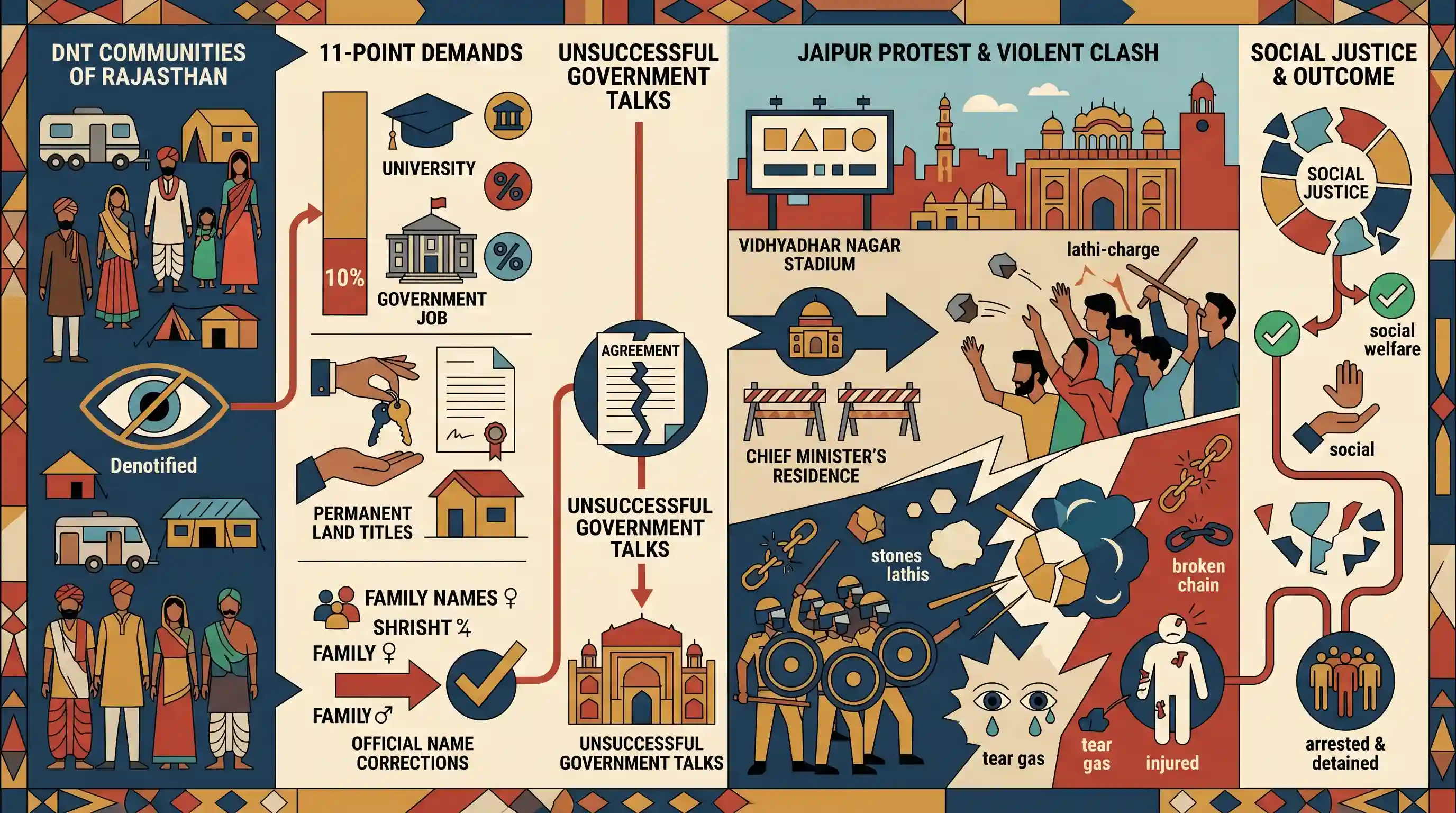
A reservation protest organized by nomadic and semi-nomadic (DNT) communities in Jaipur turned violent after unsuccessful talks with the Rajasthan state government. Demanding 10% reservation, permanent land titles, and official name corrections, protesters clashed with police near Vidhyadhar Nagar Stadium, leading to stone-pelting, police lathi-charge, and the firing of tear gas.
Key Points
- A protest by nomadic and semi-nomadic (DNT) communities demanding 10% reservation in government jobs and educational institutions turned violent near Vidhyadhar Nagar Stadium in Jaipur, Rajasthan.
- The clash erupted after talks between a delegation led by community representative Ratan Nath Kalbelia and the state government represented by senior IAS officer Kuldeep Ranka reached an impasse.
- Protesters resorted to stone-pelting, injuring several police personnel, which prompted the police to deploy tear gas shells, use lathi-charge, and call in the Special Task Force (STF) to restore order.
- Apart from the 10% reservation, the DNT community's 11-point charter of demands includes permanent land titles for their current residences and correcting official discrepancies in the names of various nomadic and semi-nomadic castes.
Important Terms
Denotified, Nomadic and Semi-Nomadic Tribes (DNTs)

Historically marginalized communities in India once legally branded as "criminals by birth" under colonial laws. They lack permanent land ownership and face severe socio-economic deprivation.
UPSC context
GS Paper I & II (Vulnerable Sections); tests understanding of tribal marginalization, historical injustices, and reservation demands.
Criminal Tribes Act, 1871
A draconian British colonial law that legally designated entire nomadic and semi-nomadic communities as "hereditary criminals," enforcing strict surveillance, movement restrictions, and confinement.
UPSC context
GS Paper I (Modern History) and GS Paper II (Social Justice); key for analyzing historical tribal discrimination and subsequent post-independence reforms.
Habitual Offenders Act (HOA)
Post-independence state legislations enacted to replace the Criminal Tribes Act, which shifted focus to individual offenders but historically continued the systemic surveillance and stigmatization of DNTs.
UPSC context
GS Paper II (Polity & Governance); tests awareness of legislative overreach, human rights recommendations, and Supreme Court rulings on targeted communities.
SEED Scheme
The Scheme for Economic Empowerment of DNTs, a central welfare initiative providing educational coaching, health insurance, housing assistance, and livelihood clusters for denotified and nomadic communities.
UPSC context
GS Paper II (Welfare Schemes); tests knowledge of affirmative action and targeted development programs for the most marginalized social groups.
Special Task Force (STF)
A specialized, highly trained division within a state police force deployed to manage high-stakes tasks, counter-insurgency, organized crime, or severe civil unrest.
UPSC context
GS Paper III (Internal Security); tests operational mechanisms for maintaining public order, riot control, and police deployment strategies during crises.
Rajasthan State Government
The executive and legislative authority of Rajasthan, responsible for administrative governance, maintaining local law and order, and addressing regional welfare and reservation demands.
UPSC context
GS Paper II (Federalism & State Governance); tests the state's role in law enforcement, public policy formulation, and resolving localized socio-political crises.
Prelims Trap
Denotified, Nomadic, and Semi-Nomadic Tribes (DNTs) are recognized as a distinct category under a dedicated Schedule of the Constitution of India.
DNTs are not classified under a single distinct constitutional schedule. They are scattered across SC, ST, and OBC lists depending on the state, though commissions have recommended a 'Third Schedule'.
Static Concepts Connected
What is the legal and colonial background of Denotified Tribes (DNTs) in India?
- Colonial branding: They were classified as 'hereditary criminals' under the colonial Criminal Tribes Act, 1871, which was repealed by the Indian government in August 1952.
- Habitual Offenders Act: After repeal, they were called 'Denotified', but the subsequent enactment of the Habitual Offenders Act, 1952, effectively sustained the legacy of systemic surveillance and stigma.
- Constitutional status: They do not belong to a single homogeneous category; instead, various DNT groups are distributed across SC, ST, and OBC lists in different states.
What are the key cultural characteristics of the Kalbelia tribe of Rajasthan?
- UNESCO recognition: Kalbelia folk songs and dances were inscribed on UNESCO's Representative List of the Intangible Cultural Heritage of Humanity in 2010.
- Performance and style: The dance movements mimic those of serpents; traditionally performed by women while men play instruments like the 'Been' (wooden wind instrument) and 'Daf'.
- Major dance forms: Includes 'Shankariya' (romantic duet based on a love story), 'Indoni' (performed in circular pairs), and 'Panihari' (pot-balancing dance).
Cross-Topic Patterns
Colonial policing legacies vs. DNT rights
The transition from colonial 'hereditary criminality' to the Habitual Offenders Act 1952 shows how colonial-era policing structures continue to marginalize DNTs in modern criminal justice systems.
Intangible heritage vs. livelihood insecurity
While Kalbelia culture enjoys global acclaim under UNESCO, the artists themselves face extreme socio-economic vulnerabilities, illustrating a gap between heritage preservation and structural social justice.

Analysis of Habitual Offenders Act 1952, SEED scheme, and UNESCO Kalbelia dance forms likely to appear as a multi-statement GS question.
Linked PYQs · 2
Linked PYQs · 2
- 2016RPSC_PRELIMSGS1
The Shankariya dance of Rajasthan is related to which community?
- 2012RPSC_PRELIMSGS1
Match the following – Tribal areas in Rajasthan A. Sahariya 1. Marwar B. Kathodi 2. Abu Road C. Garasia 3. Mewar D. Rabari 4. Baran 5. Banswara Code: A B C D
