PM-Kisan Instalment Release and Khet Bachao Abhiyan in Uttar Pradesh
Source:timesofindia ↗
Why It Matters
UPPSC frequently queries central sector schemes, their launch years, eligibility criteria, and financial provisions. PM-KISAN, as one of India's largest direct benefit transfer (DBT) welfare programs, and newly introduced campaigns like Khet Bachao Abhiyan are critical topics for the GS paper.
Summary
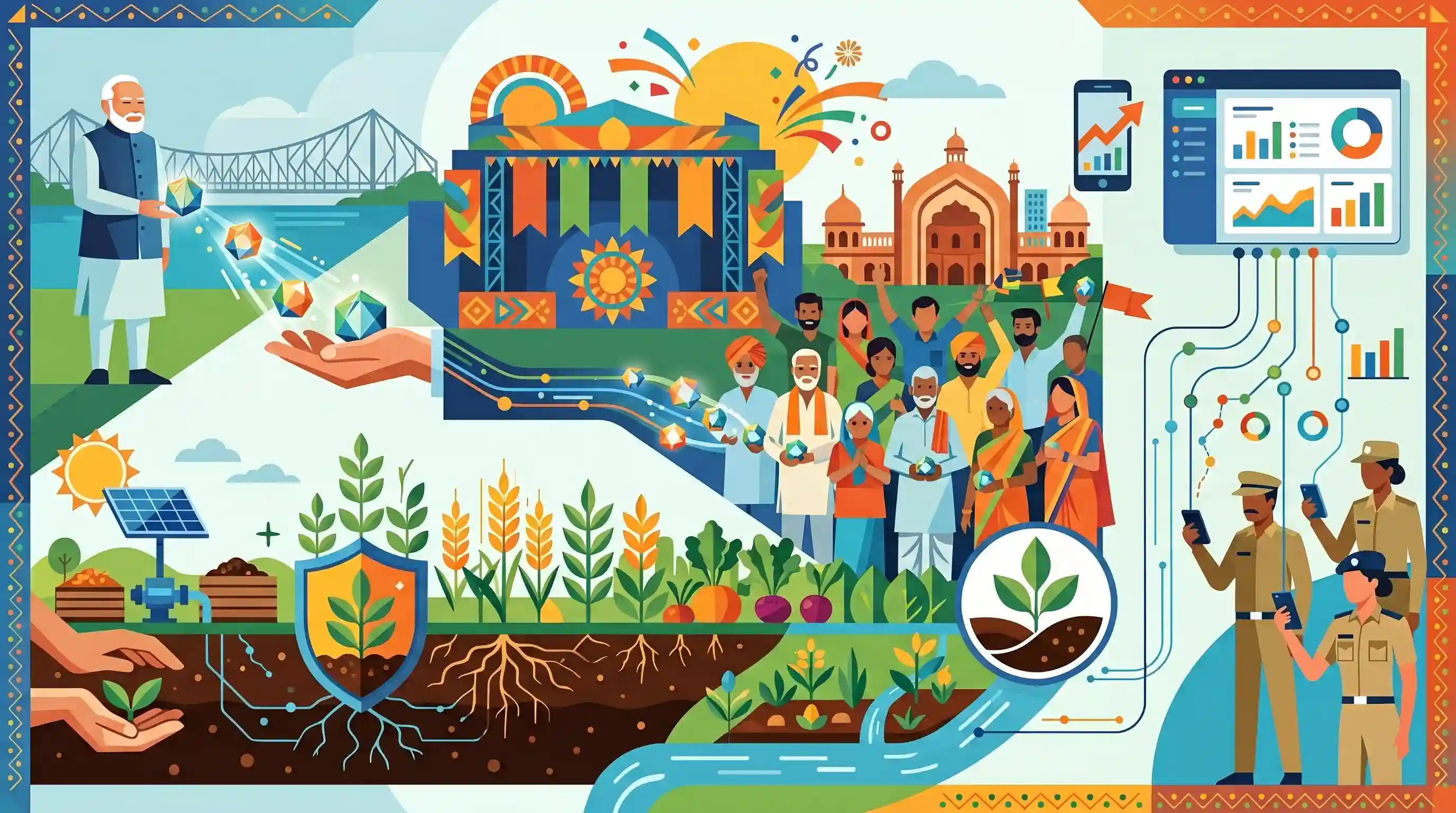
The Uttar Pradesh government organized state-wide 'PM-Kisan Utsav Divas' on June 20, 2026, to coincide with PM Narendra Modi's release of the 23rd instalment of the PM-Kisan Samman Nidhi scheme from West Bengal. The event was integrated with the central government's newly launched 'Khet Bachao Abhiyan'—a nationwide campaign to protect soil health and promote sustainable agriculture—while districts monitored farmer participation using the Event Participants Count System (EPCS) app.
Key Points
- Prime Minister Narendra Modi released the 23rd instalment of the PM-Kisan Samman Nidhi scheme for the April-July 2026 period on June 20, 2026, from Tarakeswar in Hooghly district, West Bengal.
- The UP Government directed all District Magistrates and divisional commissioners to organize 'PM-Kisan Utsav Divas' across the state to facilitate mass virtual participation of farmers.
- The release was linked to the nationwide 'Khet Bachao Abhiyan', which was launched on June 1, 2026, to protect farmland, restore soil health, and promote scientific, sustainable farming.
- PM-Kisan is a Central Sector Scheme providing Rs 6,000 annually in three equal instalments of Rs 2,000 to landholding farmer families across India.
- The Event Participants Count System (EPCS) mobile application was deployed to monitor and upload attendance, photos, and videos of the participating farmers during the event.
Important Terms
PM-Kisan Samman Nidhi (PM-KISAN) scheme

A Central Sector Scheme launched in 2019 providing ₹6,000 annually in three equal instalments directly to the bank accounts of landholding farmer families across India.
UPSC context
GS Paper III (Agriculture): Tests understanding of direct income support, DBT mechanisms, and fiscal interventions in rural development.
Khet Bachao Abhiyan
A nationwide month-long campaign (June 1–30, 2026) launched by the Ministry of Agriculture and ICAR to promote soil-test-based nutrient management, balanced fertilizer use, and sustainable farming.
UPSC context
GS Paper III (Sustainable Agriculture): Tests knowledge of central outreach programs, soil degradation, and green farming practices.
Event Participants Count System (EPCS) app
A centralized digital platform and mobile application designed to manage, track, and validate participant attendance and crowd estimation in government-organized events using AI, GPS, and real-time dashboards.
UPSC context
GS Paper II & III (E-governance): Tests knowledge of digital governance, citizen engagement tools, and administrative monitoring apps.
Krishi Vigyan Kendras (KVKs)
District-level agricultural science and extension centers established and funded by ICAR to bridge the gap between agricultural research institutions and local farmers through technology transfer and capacity building.
UPSC context
GS Paper III (Agricultural Extension): Tests understanding of grassroots scientific training, technology transfer, and localized farm support.
Farmer Producer Organisations (FPOs)
Collectives of primary producers, primarily small and marginal farmers, registered to aggregate resources, leverage economies of scale, and improve their bargaining power in markets and input sourcing.
UPSC context
GS Paper III (Agricultural Marketing): Tests awareness of agrarian collectivization, post-harvest infrastructure, and income-enhancement strategies.
Indian Council of Agricultural Research (ICAR)
An autonomous apex body under the Ministry of Agriculture and Farmers Welfare, established in 1929, responsible for coordinating, guiding, and managing agricultural research and education nationwide.
UPSC context
GS Paper III (R&D in Agriculture): Tests knowledge of India's apex agricultural research organization and technology-led farming growth.
Prelims Trap
PM-KISAN is a Central Sector Scheme that provides direct income support to all rural households, including landless agricultural laborers.
PM-KISAN is strictly restricted to landholding farmer families. Landless agricultural laborers, tenant farmers, and sharecroppers are excluded from the scheme's direct benefit transfer benefits.
Static Concepts Connected
What is the difference between Central Sector and Centrally Sponsored Schemes?
- Funding pattern: Central Sector schemes are 100% funded by the Union, whereas Centrally Sponsored schemes involve cost-sharing (e.g., 60:40) with States.
- Implementation responsibility: Central Sector schemes are primarily implemented by Central ministries, while Centrally Sponsored schemes are executed by State administrations.
- Syllabus examples: PM-KISAN is a Central Sector scheme, while MGNREGS and PM Awas Yojana operate as Centrally Sponsored schemes.
What parameters are monitored under the Soil Health Card Scheme?
- Nutrient categories: It monitors 12 parameters including Macro-nutrients (N, P, K), Secondary-nutrient (S), and Micro-nutrients (Zn, Fe, Cu, Mn, B).
- Physical parameters: It assesses crucial physical-chemical properties of soil namely pH, Electrical Conductivity (EC), and Organic Carbon (OC).
- Scheme integration: Originally launched in 2015, the SHC scheme is now merged under the Rashtriya Krishi Vikas Yojana (RKVY) umbrella.
Cross-Topic Patterns
Digital Infrastructure + Agrarian Welfare
The convergence of DBT, BHASHINI-powered chatbots (Kisan-eMitra), and AI-based monitoring (EPCS) showcases how India's digital public infrastructure scales up targeted agrarian welfare delivery.
Soil Health + Sustainable Agriculture
Linking cash transfers to campaigns like 'Khet Bachao Abhiyan' aligns direct social security with ecological targets, directly supporting SDG 15 (Life on Land) and sustainable agriculture.

Expect questions testing the functional boundaries of PM-KISAN, such as beneficiary exclusion lists and integrated AI-governance tools.
Linked PYQs · 3
Linked PYQs · 3
- 2023UPPSC_PRELIMSGS1
Which of the following (Scheme - Year) is not correctly matched?
- 2024UPPSC_PRELIMSGS1
Arrange the following schemes launched by the Government of India in chronological order and choose the correct answer from the codes given below : 1. Swachh Bharat Mission 2. Pradhan Mantri Kaushal Vikas Yojana 3. Pradhan Mantri Garib Kalyan Yojana 4. Pradhan Mantri Mahila Shakti Kendra Scheme Codes :
- 2022UPPSC_PRELIMSGS1
Which one of the following is the targeted group under the 'Pradhan Mantri Swandhi Scheme'?
