District Mineral Foundation Fund Diversion and Welfare Mandates
Source:Indian Express ↗
Why It Matters
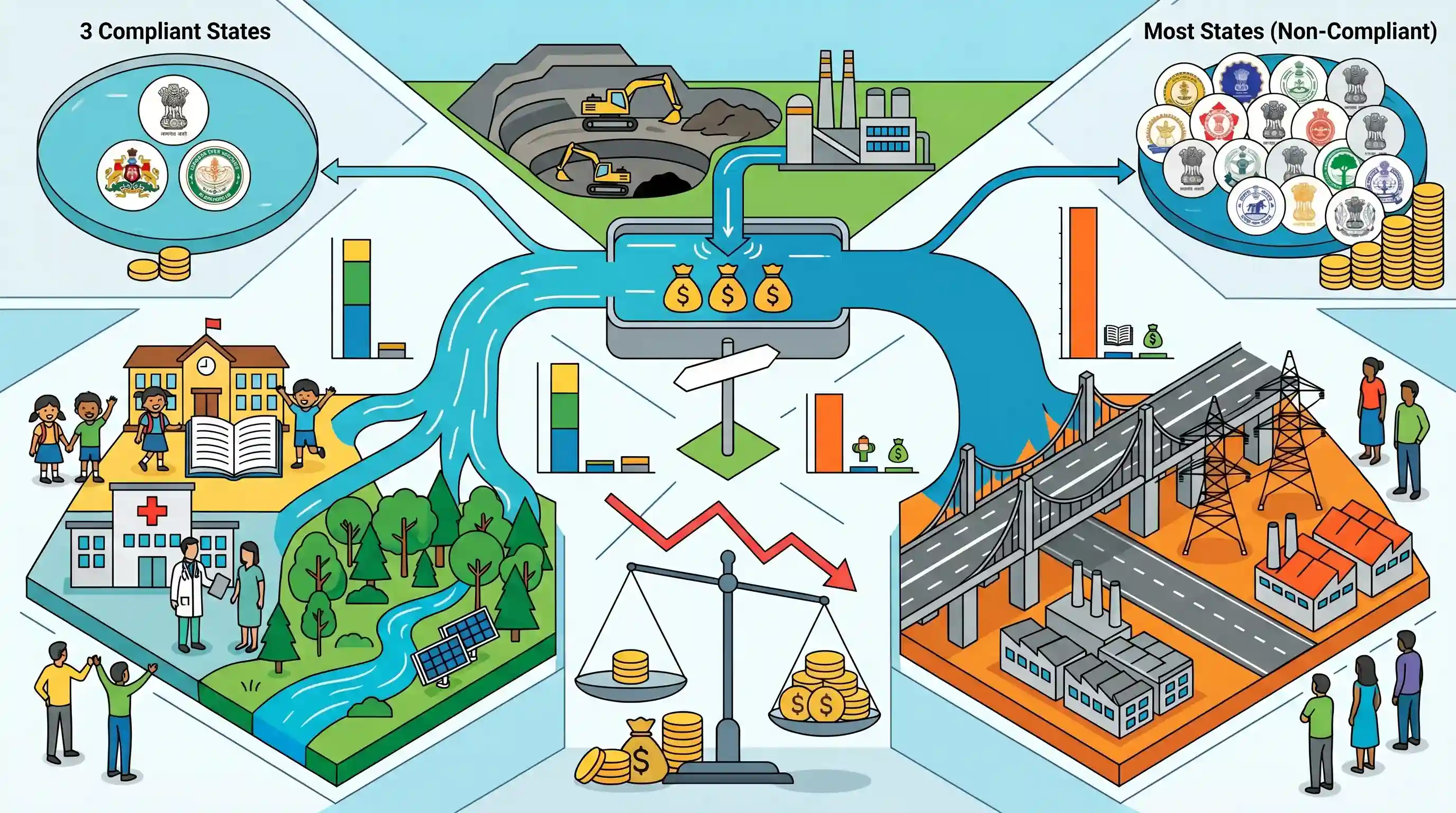
It demonstrates the governance challenges in implementing decentralized welfare schemes (PMKKKY) and highlights how local administrative preference for physical infrastructure often sidelines the social and environmental imperatives intended for marginalized, mining-affected communities.
Summary
Recent data reveals that only three states have met the mandate of spending at least 60% of their District Mineral Foundation (DMF) funds on 'priority sectors' like education, healthcare, and environmental protection under the Pradhan Mantri Khanij Kshetra Kalyan Yojana (PMKKKY). Instead, most states are utilizing these funds primarily for physical infrastructure, violating the core objective of the MMDR Act to uplift and rehabilitate vulnerable communities in mining-affected areas.
Key Points
- Under the Pradhan Mantri Khanij Kshetra Kalyan Yojana (PMKKKY) guidelines, at least 60% of District Mineral Foundation (DMF) funds must be spent on priority sectors like healthcare, education, drinking water, and environmental preservation.
- Up to 40% of the funds are permitted to be used for 'other priority areas' such as physical infrastructure, energy, and irrigation.
- Current data reveals that only three states are meeting the 60% mandate, with most states disproportionately diverting these funds toward physical infrastructure.
- This misallocation undermines the statutory intent of the MMDR Act, which established DMFs specifically to protect and uplift vulnerable communities and ecologies in mining-affected regions.
Important Terms
Pradhan Mantri Khanij Kshetra Kalyan Yojana (PMKKKY)

A 2015 welfare scheme by the Ministry of Mines aimed at mitigating the adverse impacts of mining. It utilizes District Mineral Foundation (DMF) funds for healthcare, education, and livelihoods in affected areas.
UPSC context
GS Paper II: Welfare schemes for vulnerable sections; GS Paper III: Government policies and implementation issues.
District Mineral Foundation (DMF)
A statutory non-profit trust established in mining-affected districts. It manages contributions from mining leaseholders to fund developmental and environmental projects for local communities as mandated by the MMDR Act.
UPSC context
GS Paper II: Governance/Transparency; GS Paper III: Resources. Tests institutional frameworks for inclusive growth.
Mines and Minerals (Development and Regulation) Amendment Act, 2015
The landmark 2015 amendment to the 1957 Act that introduced competitive auction-based mineral allocation and mandated the creation of the District Mineral Foundation (DMF) for community welfare.
UPSC context
GS Paper III: Mineral Resources and Policy Design. Tests understanding of legislative reforms in natural resource management.
Priority Sectors (under DMF)
Specific areas like healthcare, education, and water supply that must receive at least 60% of DMF funds under PMKKKY guidelines to ensure the welfare of mining-affected populations.
UPSC context
GS Paper II: Social Justice/Welfare. Relevant for analyzing the performance and fund-diversion issues of government schemes.
National Mineral Exploration Trust (NMET)
A statutory body established under the MMDR Amendment Act, 2015, to promote and conduct mineral exploration across India, funded by a 2% levy on royalties paid by miners.
UPSC context
GS Paper III: Economy and Resource Extraction. Tests understanding of resource exploration strategies and institutional reforms.
Prelims Trap
"District Mineral Foundations (DMFs) are statutory bodies established by the Central Government."
DMFs are non-profit statutory trusts set up by State Governments under the MMDR Act, 2015. They are not established by the Central Government.
Static Concepts Connected
What is the structural mandate of the District Mineral Foundation (DMF)?
- Statutory Origin: Established by State Governments in any district affected by mining operations as a non-profit statutory trust.
- Core Objective: To work for the interest and benefit of persons and areas affected by mining-related operations.
- Funding Mechanism: Funded through mandatory contributions from mining lease holders (a prescribed percentage of the royalty paid).
How does PMKKKY regulate the expenditure of DMF funds?
- Central Framework: Acts as the overarching central guideline framework under which State DMFs must execute their developmental projects.
- 60% High Priority: At least 60% must be spent on healthcare, education, drinking water, environment preservation, and women/child welfare.
- 40% Other Priority: Capped at 40% for physical infrastructure, irrigation, energy, and watershed development.
Cross-Topic Patterns
DMF alignment with PESA and Fifth Schedule
Mining disproportionately affects tribal populations. UPSC often links the utilization of DMF funds in Scheduled Areas to mandatory Gram Sabha consultation requirements under the PESA Act, 1996.
CAG oversight on district-level statutory funds
The diversion of DMF funds highlights the critical role of the CAG in auditing district-level statutory trusts and dedicated funds that operate outside standard budgetary allocations.

Expect a multi-statement prelims question in 2026 pairing DMF's state-level establishment against the Centre's PMKKKY 60/40 fund rules.
Linked PYQs · 3
Linked PYQs · 3
- 2016PrelimsGS1
What is/are the purpose/purposes of 'District Mineral Foundations' in India? 1. Promoting mineral exploration activities in mineral-rich districts 2. Protecting the interests of the persons affected by mining operations 3. Authorizing State Governments to issue licences for mineral exploration Select the correct answer using the code given below.
- 2025MainsGS3
Mineral resources are fundamental to the country's economy and these are exploited by mining. Why is mining considered an environmental hazard? Explain the remedial measures required to reduce the environmental hazard due to mining.
- 2019MainsGS2
Performance of welfare schemes that are implemented for vulnerable sections is not so effective due to absence of their awareness and active involvement at all stages of policy process. Discuss.
